

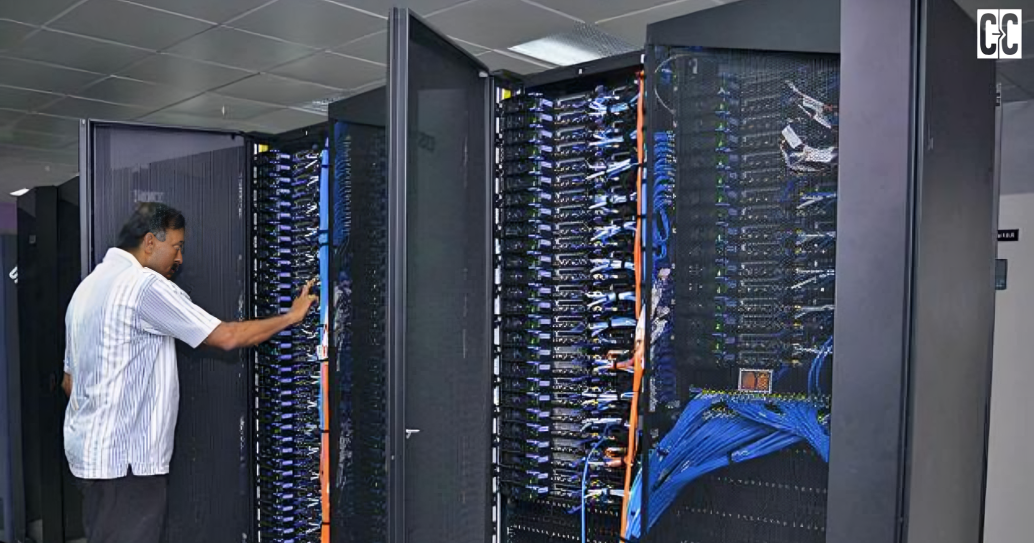
India now runs 40 supercomputers under a national mission. Measured against China, the United States and Europe, the harder test is not speed but who gets access.
As of September 2026, India had more than doubled the cumulative supercomputing capacity it had established through the National Supercomputing Mission (NSM), according to the Press Information Bureau (PIB) reported. In September 2026, India had 40 supercomputers that had 68 PF (petaflops) of computational capacity, up from 33 supercomputers and 32 PF reported to the Lok Sabha in November 2024.
The distribution is uneven: 13 systems cross the 1 PF mark while 15 are below 500 teraflops. The Mission, launched in April 2015 with an investment of approximately 4,500 crores, had aimed at 73 systems by 2022 – now the goal is 50 systems above 123 PF, which translates to a smaller number of larger machines.
The release foregrounds public-good applications. A flood early-warning system forecasts river-basin floods up to two days ahead and is used in the Mahanadi basin; a forest-fire model has been tested in the Sikkim Himalayas; a genomics platform screened existing drugs during COVID-19. NSM systems have served more than 16,000 researchers, including over 2,900 PhD scholars, across 400-plus institutions. India generates nearly 20 percent of the world’s data, it adds.
Reach is the pressure point. Researchers from 400-plus institutions are a sliver of the roughly 58,600 registered in the Education Ministry’s AISHE 2021-22 survey. Not every college needs supercomputing, but the ratio shows how concentrated use remains. At the January launch of PARAM Rudra at IIT Bombay, DST Secretary Abhay Karandikar said the 3 PF system would benefit over 200 faculty and 1,200 students there and be accessible to researchers nationwide. Launching IIT Madras’s PARAM Shakti facility, MeitY Secretary S. Krishnan said the Mission backs application-driven projects with dedicated funding.
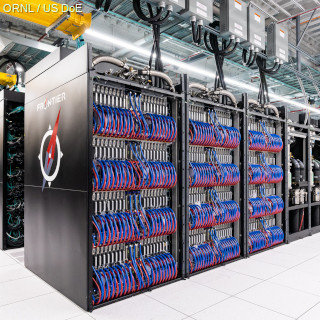
Internationally, the gap is even more stark. Five TOP500 systems on the June 2026 list are at or above 1 exaflops (1,000 PF): the largest is China’s Line Shine at 2.198 exaflops, with America’s El Capitan at 1.809exaflops and Europe’s JUPITER at 1.000 exaflops. They’re 15.4 and 13.2 times, respectively, India’s total NSM capacity and nearly 32 times India’s largest single combined NSM system. Japan’s Fugaku has 442 PF, just over six times India’s capacity; the relative ratios are estimates due to differing benchmarks.
India’s best–ranked entry is private: Yotta’s Shakti Cloud at 84.3 PF, ranked 32nd on the list, higher than the 68 PF quoted for the entire public sector fleet. The divide runs deeper than speed. A 2025 analysis by Oxford University researchers, as reported by The New York Times, found that only 32 countries host the large data centres used to build advanced AI. American and Chinese firms operate over 90 percent of the facilities others use for AI work; India has at least five, while Africa and South America have almost none. Oxford researcher Vili Lehdonvirta compares computing to oil, saying its producers “could have something similar” influence over international affairs.
India’s second route to compute is the IndiaAI Mission’s shared GPU pool: more than 38,000 GPUs at about ₹65 per GPU-hour for approved users, Business Standard reported in June. Experts disagree on how to allocate scarce compute. Omprakash Subbarao, chief executive of FSID CORE, IISc’s R&D arm, warned that first-come, first-served allocation can favour institutions already skilled at proposal writing, and said that building compute is “the easy part”; running it reliably is harder. EY India’s Hari Balaji argued the opposite: concentrate subsidised GPUs among a handful of deserving players, since scale compounds in frontier-model work.
Europe pools access by design. EuroHPC controls 35% of the availability on its petascale systems and up to 50% on its pre-exascale and exascale machines, and allocates that portion free of charge by peer review, based on the quality of the science, to eligible European users. India has ten systems to go, but it is about how they serve that is as important as how fast they serve. Whether petaflops become a publicly available asset or a prestige luxury could hinge on decisions to announce the distribution by region and type of institution, and to extend PARAM Shavak, a “supercomputing-in-a-box”, to a broader population of engineering colleges and universities.
Clear Cut Research Desk
New Delhi, UPDATED: October 09, 2026 14:30 IST
Written By: Yatharth Pathak