Thiruvananthapuram, October 29, 2025 – On November 1, the southern Indian state of Kerala will officially announce that it has eradicated “extreme poverty,” based on its own definition of the term, possibly becoming the first Indian state to achieve this status. The announcement will take place on Kerala Day (Kerala Piravi) under the auspices of the Kerala government led by Chief Minister Pinarayi Vijayan, which is planning a massive event in the state capital.
In August 2021, the Kerala government initiated a program called the “Extreme Poverty Eradication Project” (EPEP), which defines extreme poverty in terms of four multiple dimensions: (1) food security, (2) health access no access or inadequate health access, (3) income below the poverty line, (4) homelessness and/or unstable housing (Kerala Government). According to government sources, about 64,006 families in total were identified as “extremely poor” across the state in the baseline survey (The New Indian Express).
Why is this important for the state?
Kerala has always received attention for good human‐development indicators but has typically lagged economically behind some other states in India. In addition to general development, a few central reasons behind this announcement are:
- High literacy and social infrastructure:The latest surveys indicate that Kerala’s literacy rate is over 94%. A solid public health and education infrastructure has led to declining poverty and deprivation over many years.
- Sturdy remittance flows: According to the 2023 edition of the Kerala Migration Survey, remittances to Kerala are ₹ 2,16,893 crore in 2023 (an increase from about ₹ 85,092 crore in 2018) which equate to about 23.2% of the Net State Domestic Product (NSDP) (IIMAD). These remittances supported consumption, savings and investments in education and housing for households.
- Steady economic growth and policy focus: The Economic Review 2024 reported that Gross State Domestic Product (GSDP) growth averaged about 6.5% in 2023-24. Kerala Government On the policy side, welfare schemes such as the free health insurance scheme (Karunya Arogya Suraksha Padhathi) service to an estimated 4.2 million families and a continuing strong public distribution system have addressed multi-dimensional deprivation (The Indian Express).
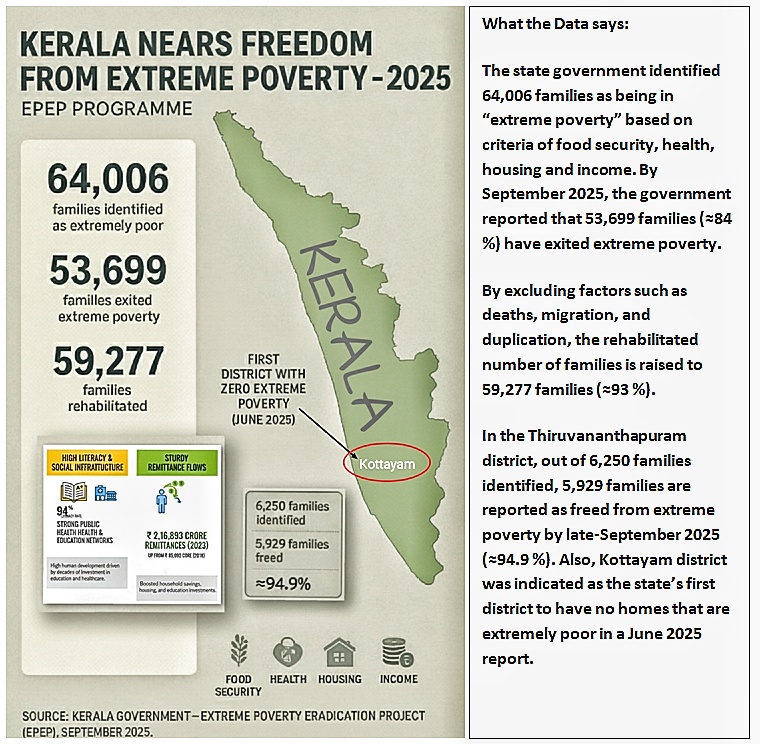
Photo Credit: Antara Mrinal
What the declaration will cover
On November 1, the state government announced plans to commemorate the occasion with celebrations throughout the districts and proclaim that no family in Kerala remains in the ‘extreme poverty’ category under the EPEP criteria Local self-government institutions and the women-led community network Kudumbashree were key partners in the micro-planning efforts for identified families (Kerala Government).
The proclamation will emphasize that beyond income, families have received support in terms of housing, health access, food security, and representation through identity documents and bank accounts.
Challenges and Critiques
Despite the milestone, some advocacy groups contend there are serious gaps. For example, tribal organizations in Wayanad district report that many families are still landless homeless, living in makeshift structures, and suffering from malnutrition and anaemia (The News Minute). The government counts “extremely poor families” as around 64,000, but critics maintain that many marginalized households are either excluded from the list or have not seen meaningful progress.
Some analysts note that while strong remittances and social infrastructure have lessened visible poverty, economic vulnerabilities remain high: unemployment rates for graduates are still high, the agricultural sector has contracted, and the state remains heavily reliant on migrant income (The secretariat).
The state government has framed the accomplishment as a starting point toward achieving Sustainable Development Goal 1 (No Poverty) and associated SDGs by 2030. The next phase is expected to address residual and hidden poverty, employment opportunities (especially for young people and women), and reduce dependence on remittances through economic diversification. State officials say the formal declaration will not mean “no more” poverty alleviation efforts, but rather a shift to a “graduated support” model: people freed from extreme poverty will be monitored and be provided with livelihood support until they are fully engaged with stable economic activity.
Sources:
- Kerala Government / PRD materials (state announcements and PRD newsletter).
- ThePrint (background on definitions and programme).
- Mathrubhumi (figure for rehabilitated families excluding deaths/migrations).
- Times of India (Thiruvananthapuram and Kottayam district reports).
Clear Cut Livelihood Desk
New Delhi, UPDATED: Oct 30, 2025 01:01 IST
Written By: Antara Mrinal