


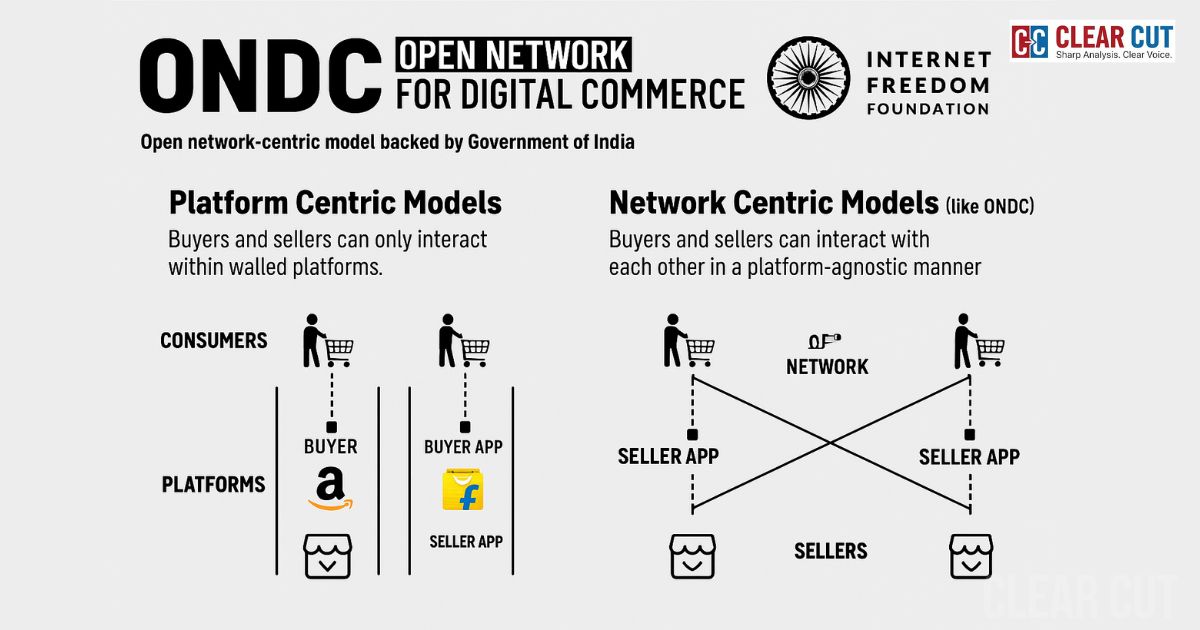
In a world of monopolistic e-commerce, India’s ONDC is perhaps one of the boldest experiments in social and economic ecosystems. Conceived under DPIIT, it aims at allowing small sellers to strive against giant digital players like Amazon and Flipkart by leveling the field. Beyond policy announcements and press statements, ONDC is something bigger: it is India trying to rewrite the architecture of the digital marketplace.
The Idea of a “Digital Public Good”
The idea behind ONDC is deceptively simple: instead of private companies owning platforms that connect buyers and sellers, ONDC acts like an open network protocol-similar to UPI for payments. In practice, this means different buyer and seller applications can seamlessly interoperate on a common network. For consumers, this means that someone using a single app can see products and prices listed on others. For sellers, particularly small ones, it means visibility and access previously locked behind corporate gates.
This shift-from platform capitalism to protocol democracy-is what makes ONDC revolutionary. The aim of the network is to ensure that digital commerce, which has grown fast in India but remains concentrated, becomes more accessible, transparent, and equitable.
A Growing Digital Economy
Photo Credit: Internet
The scale of ONDC’s early progress is remarkable. By April 2024, the platform had onboarded upwards of 500,000 sellers, close to 70 percent of which were small or medium enterprises. It had facilitated 7.22 million transactions in that month alone, according to DPIIT Secretary Rajesh Kumar Singh. By July 2024, the monthly order volume had climbed to nearly 12 million, with 638,000 active vendors spread across 609 cities.
By March 2025, ONDC had crossed 200 million cumulative transactions, half of which came in the previous six months alone. These are not isolated statistics; they show acceleration in the adoption-a signal that ONDC’s “open network” vision is translating into real, quantifiable impact.
For a digital economy that has long been dominated by a few large players, these numbers suggest that India may be on the threshold of a more participatory digital future.
Inclusion Through Access
The real success of ONDC, however, will not lie in the metrics but in its accessibility. Small shopkeepers and micro-entrepreneurs that have been excluded from the e-commerce revolution because of digital illiteracy or logistical barriers find entry points into the digital economy through this network of partner apps. Integrations ranging from Paytm to Mystore and Craftsvilla enable sellers to join the network with minimum onboarding costs.
For women-led enterprises and rural entrepreneurs, this model has a particular resonance. It decentralizes control and brings digital visibility to those for whom access was the missing currency. That 70 percent of the onboarding sellers are SMEs shows its potential as a social equalizer in the digital economy.
The Challenges Beneath the Vision
But no democratic experiment comes without friction. ONDC’s ambition to be “the UPI of commerce” also exposes it to UPI’s very challenge: monetization and sustainability. As with UPI, transaction volumes might go up but profitability remains unclear. While major food delivery and retail apps have joined the network, retention and customer satisfaction vary widely.
Besides, the logistical challenges-from fulfillment reliability to returns management-continue to test scalability. The digital literacy of smaller sellers remains a bottleneck. While the government had promised capacity building through partner programs, real-life, large-scale measurement of outcomes is awaited.
And then, of course, there is consumer behavior. E-commerce usage is driven by convenience, not ideology. For ONDC to succeed, it must offer a seamless experience equal to or better than the incumbents it hopes to unseat. That is a tall order.
The Broader Digital Moment
Still, ONDC’s emergence fits within a larger pattern of India’s digital statecraft. From Aadhaar to UPI to DigiLocker, India has consistently pursued public digital infrastructure as a tool for empowerment. ONDC is the next frontier in this model-one where commerce becomes a public utility rather than a private preserve.
Its potential goes much beyond economics. Successfully, ONDC could redefine how citizens interact with markets-distribute agency from corporations to consumers and small enterprises. This may soon become an exportable model as countries in Africa and Southeast Asia have already shown interest in India’s digital governance architecture.
A Cautious Optimism
In that sense, the story of ONDC is one of cautious optimism. The progress is real; the intent is clear, but the path remains uneven. It represents a test case for whether a government-led digital public good can stand toe-to-toe with global private platforms and still remain open, fair, and scalable.
If ONDC succeeds, it will be more than the digitization of commerce; it will signal the democratization of the digital economy itself: a technological platform not so much serving profit but rather participation.
Clear Cut Research Desk
New Delhi, UPDATED: Nov 02, 2025 09:00 IST
Written By: Janmojaya Barik

Your article helped me a lot, is there any more related content? Thanks! https://www.binance.com/register?ref=IXBIAFVY
There are plenty. Do visit our portal.
Thanks for keeping things clear and to the point, that is honestly hard to find online these days, and after reading through firstisnotequallast the message stayed consistent which makes me trust the information being shared more than I usually do on similar pages that cover this same kind of topic.
Thank you so much for your thoughtful feedback! We’re really glad you found our content clear, consistent, and trustworthy. Our goal is to present well-researched information in a simple and reliable way, so it’s great to know that came across. We truly appreciate your support and hope you’ll continue reading and sharing your thoughts with us!