


In June 2023, the Government of India launched the Mangrove Initiative for Shoreline Habitats and Tangible Incomes, a program that quietly yet firmly repositions the restoration of mangroves from an afterthought in conservation to a national climate and livelihood mission. As the Ministry of Environment, Forest and Climate Change expands its implementation through 2025, MISHTI represents one of India’s most ambitious blue-carbon and community-based ecological efforts.
A Policy Rooted in Climate and Community
Finance Minister Nirmala Sitharaman first announced MISHTI in the Union Budget 2023-24. The ambitious plan aims to bring back and enhance India’s mangrove ecosystems on 540 sq. km of degraded coastlines in five years. It operates under the MoEFCC with collaboration from the state forest departments, CAMPA, and other coastal stakeholders.
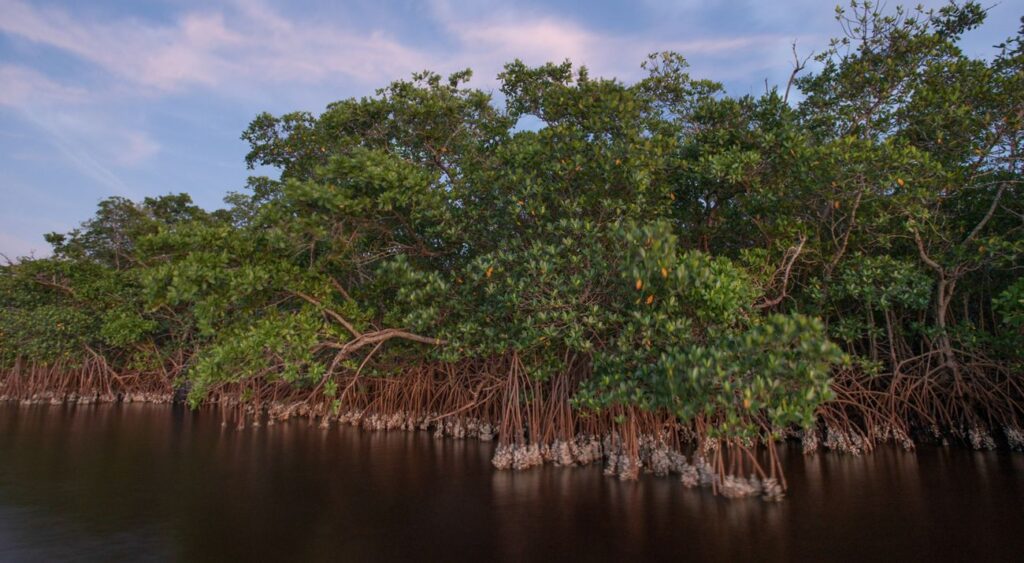
The logic is simple, yet deep: mangroves protect coastal populations against storm surges, provide fisheries with nurseries, lock away vast quantities of carbon, and provide alternative incomes for local communities through eco-tourism, honey collection, and aquaculture.
India’s Mangrove Baseline
According to the India State of Forest Report 2023 by FSI, the total mangrove cover of the country is 4,992 km², which accounts for just 0.15 % of the geographical area. The cover has increased marginally by 146 km² between 2019 and 2023, a positive sign but still modest compared to the potential.
About 42% of India’s mangrove forests are in West Bengal, followed by 23% in Gujarat, 13% in Andhra Pradesh, and 5% in Odisha. MISHTI targets restoration in the Sundarbans, Mahanadi Delta, Krishna-Godavari estuaries, Gulf of Kachchh, and other coasts characterized by erosion and saline intrusion: their ecology and livelihoods are threatened.
The Science Behind the Strategy
Source: Internet
Mangroves are nature’s own coastal engineers. According to recent studies published in the Journal of Coastal Research and Global Environmental Change, mangrove belts reduce wave height by 30-60% within the first 100 meters of forest width and sequester three to four times more carbon per hectare than tropical rainforests.
In climate-policy speak of the 2020s, that makes mangroves both adaptation and mitigation assets. They store carbon in biomass and soils while buffering vulnerable coastlines from cyclones-critical in a country where one-third of the population lives within 100 kilometres of the sea.
Implementation and Early Results
The MoEFCC has so far identified more than a dozen coastal districts across West Bengal, Odisha, Andhra Pradesh, Tamil Nadu, Gujarat, and Maharashtra for MISHTI interventions. Certain states have taken an early lead in this regard, such as Gujarat. The state forest department reported 19,020 hectares of mangrove afforestation by February 2025-the largest so far under MISHTI.
Each plantation is guided by hydrological suitability studies and community involvement. Projects have been carried out under the National Coastal Mission, with interventions by INCOIS for remote-sensing verification of projects.
The approach depends on local livelihoods. The families are engaged in nursery raising, crab farming, and sustainable honey collection. In Odisha, for instance, in the Bhitarkanika region, the community forest groups recorded increased fish stocks and supplemental incomes within two years of restoration.
From Protection to Participation

Release of Indian State of Forest Report, Image Source: Internet
The most significant single difference between MISHTI and other programs on forestry is its emphasis on people as protectors rather than fencing off areas of mangrove, and incorporating villagers as economic partners. Its participatory model has roots in successful experiments, such as the Gulf of Kachchh Eco-Development Project in Gujarat and Odisha’s Community Mangrove Regeneration Programme, both of which reduced forest encroachment along with improving household resilience.
The Global Dimension
India’s mangrove strategy is also in line with the country’s commitments under the Paris Agreement and the Mangrove Alliance for Climate, a worldwide platform co-launched at COP27 by the UAE and Indonesia. In fact, it lends greater credibility to India’s voice in global climate diplomacy, as MISHTI connects local adaptation with global carbon-reduction goals.
Challenges Over the Horizon All is not plain sailing, though. Mangrove restoration fails when monocultures replace natural diversity, or when hydrology is disrupted by embankments and shrimp farms. Land-use conflicts in the deltaic regions can stall the project, while monitoring survival rates over five years demands high institutional capacity. While the carbon-credit financing is being explored, experts have sounded a note of caution against commoditization of ecosystems without long-term community ownership. After all, success for MISHTI lies not in the plantations counted but in the mangroves that survive, self-regenerate, and sustain livelihoods. A Blueprint for Resilient Coasts As the climate clock ticks faster, MISHTI offers a model of green infrastructure that works with nature, not against it. It fuses ecological function with human wellbeing, proving that climate action in India need not be confined to emissions charts or electric vehicles. Sometimes, resilience begins in the silence of coasts.
Clear Cut Climate Desk
New Delhi, UPDATED: Nov 07, 2025 05:16 IST
Written By: Janmojaya Barik