
As the country moves towards its long-term goal of Viksit Bharat 2047, women empowerment is a key component of India’s developmental strategy. A society anchored by the fundamental ideals of liberty, equality and fraternity, defending the rights of women is not only a policy objective but a moral and national obligation. The Government of India, under the leadership of Prime Minister Narendra Modi, has formalized this commitment through Mission Shakti, aimed at women empowerment. The mission works as a unique project thereby, interconnecting an ecosystem of institutional development, grassroots mobilisation and socio-economic transformation. It demonstrates an awareness that women empowerment is essential to the country’s social fabric, economic output, and democratic morals and values.
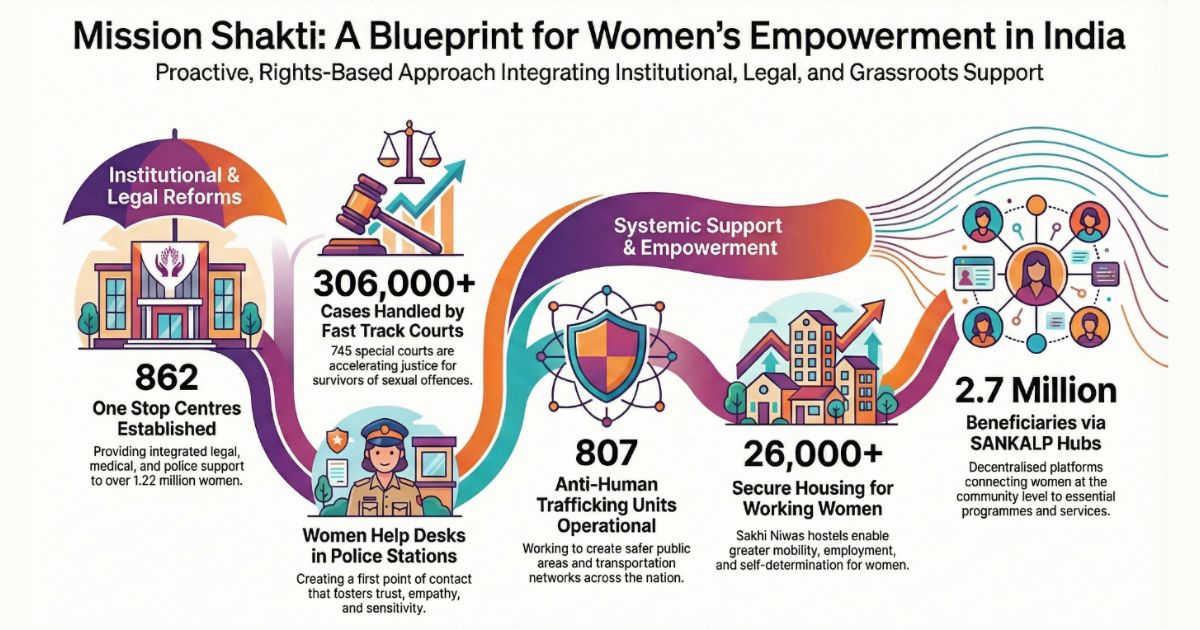
A change in the state’s strategy from reactive welfare to proactive and rights-based governance is at the heart of Mission Shakti. One important institutional innovation in addressing gender-based violence is the creation of One Stop Centers (OSCs), which was started in 2015. These clinics centralize important services such as legal aid, medical attention, police facilitation, shelter, and psychiatric counselling. These help survivors to manage the aftermath of abuse with dignity and support. Over 862 OSCs are functional across India and over 12.20 lakh women are served to date. The model provides empirical evidence of how integrated interventions can transcend systemic gaps that previously left survivors alone. The OSCs signify a journey from quiet to visibility, fear to liberation, positioning women at the core of the justice and welfare system.
Complementing these efforts is a parallel transformation in the justice delivery system. 745 Fast Track Special Courts were established which include 404 exclusive POCSO courts. This underscores the state’s effort to reduce procedural delays and enhance accountability in cases of sexual offences. The disposal of over 3.06 lakh cases through these mechanisms signals a conscious attempt to align legal processes with gender-based crimes. Simultaneously, Women Help Desks in police stations, most of them staffed by women personnel, are redefining the first point of contact for survivors. This helps by fostering an environment of trust, empathy, and institutional sensitivity. The approach indicates how gender-responsive reforms help recalibrate state structures to uphold women’s rights effectively.
Mission Shakti further expands into addressing systemic vulnerabilities such as trafficking, unsafe mobility and economic hardship. The state is working to create safer public areas and transportation networks for women. It established 807 Anti-Human Trafficking Units operating throughout the nation and monitoring systems funded by the Nirbhaya Fund. Initiatives such as Beti Bachao Beti Padhao (BBBP), Pradhan Mantri Matru Vandana Yojana (PMMVY), and Sakhi Niwas hostels contribute to a larger continuum of empowerment. The one that extends from transforming societal attitudes to enabling economic independence. Sakhi Niwas offers secure housing to more than 26,000 working women. It is an example of infrastructure support, especially in urban and peri-urban settings, helping open up new opportunities for mobility, employment and self-determination.
SANKALP- Hub for Empowerment of Women, is a decentralized platform that links women to programs, rights, services and provides a crucial layer of convergence. This program, has over 27 lakh beneficiaries. It emphasises a crucial community-level coordination to attain long-term results. All these solutions acknowledge that violence against women is a national issue. Also, it impacts social well-being, economic engagement and democratic legitimacy in addition to being a gendered problem.
As India enters the Amrit Kaal, this phase of accelerated transition involves placing women at the core of national development. The goal of Viksit Bharat 2047 can be realised only with guaranteeing women are secure, respected and enabled to fully engage in the political, social, and economic arenas. Nari Shakti, therefore, emerges as a strategic imperative that foregrounds women as agents of change, contributors to growth, and architects of the nation’s destiny. Mission Shakti has a very comprehensive and convergent approach to this. It provides an agenda seeking to institutionalise gender justice and expand women’s potential.
Clear Cut Gender Desk
New Delhi, UPDATED: Dec 03, 2025 04:45 IST
Written By: Nidhi Chandrikapure