

One of the most persistent environmental issues in South Asia is the air quality situation in Delhi. The toxicity of the air Delhi breathes is quite visible and everyday reality for millions of people in the National Capital Region (NCR). In actuality, Delhi’s air quality is persistently poor all year round. Despite the fact that pollution maxima are frequently linked to the winter months. The brief periods of intense monsoon rains provide some respite. Yet, the structural reasons of pollution that keep the Air Quality Index (AQI) in extremely bad and dangerous level cannot be concealed by these periods.
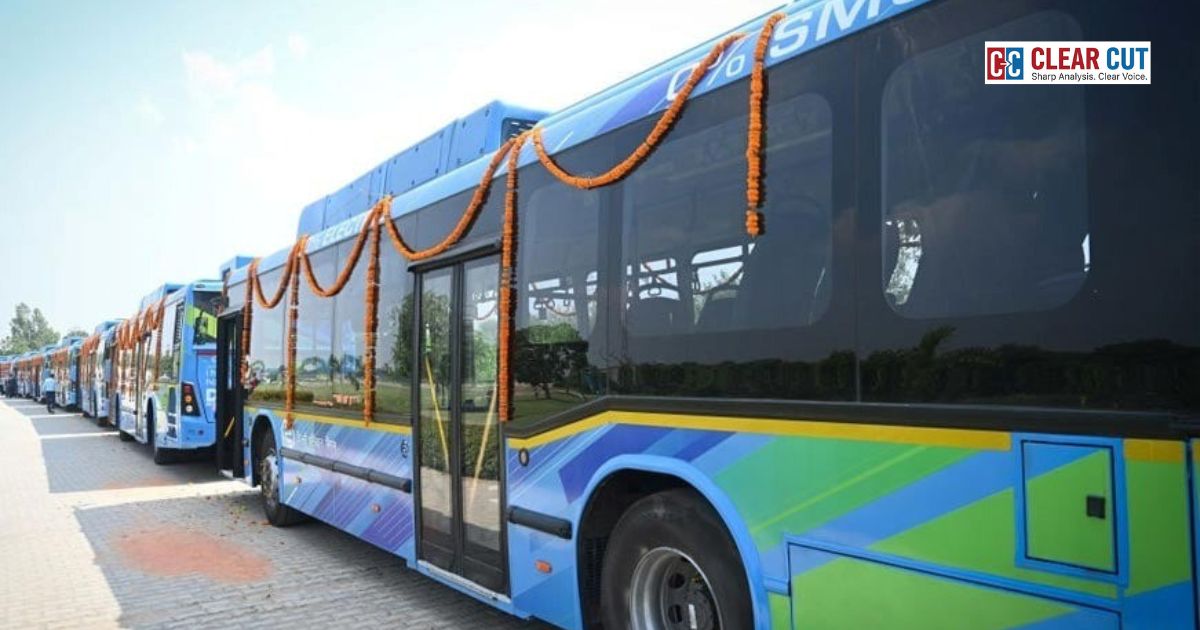
The transportation industry continues to be the biggest source of pollution in Delhi. PM2.5, nitrogen dioxide and carbon monoxide concentrations are largely produced by vehicle emissions. They rise in a coordinated manner over the majority of the year. Over 1.1 million cars come into and go out of Delhi every day. According to Centre for Science and Environment report, the city is home to more than half of all registered cars in the NCR. Approximately 37% of these are still subject to out-of-date BS I to BS III emission standards. Delays in the introduction of electric buses have hindered the city’s shift to cleaner mobility. The public transportation infrastructure has not kept up with the expanding population. Despite Delhi’s plans to purchase an extra 5,000 electric buses, none have been put into service till date. The official estimates indicate that it may take many years to fully implement the plan. The city requires at least 11,000 to 12,000 public buses to maintain dependable coverage. According to urban mobility specialists and there are now only about 5,267 in operation. As a result, the reliance on private automobiles keeps increasing. The Delhi Electric Vehicle Policy’s ambitious goals have also encountered implementation difficulties. The previous objective of 25% EV penetration by 2024 has only reached roughly 13% to 14%.
The persistent of high AQI values are caused by a number of different industries in addition to transportation. The hazardous mixture of particulate matter and gaseous pollutants is increased by industrial pollution. In addition the burning of waste and biomass, construction dust, landfill fires and the combustion of household fuels. Experts have often emphasised that stubble burning is only episodic. Despite the fact that it is frequently cited as a significant wintertime impact in neighbouring states. Vehicles, urban combustion sources and industrial clusters are more contributing factors. The scope of the issue has not always been reflected in the regulatory responses. Although source apportionment studies are still being commissioned, it is more urgent to take decisive action that lowers emissions than to pursue more detailed measurements without corresponding adjustments on the ground.
An essential insight into how concerted policy effort might reverse severe urban pollution is provided by a comparison with China. Delhi’s present air quality is comparable to or worse than that of big Chinese cities like Beijing a few decades ago. China used a multifaceted strategy that included stringent enforcement with structural improvements. It made investments to transform coal-based energy systems into cleaner natural gas substitutes, improved fuel quality, and provided industries with cutting-edge end-of-pipe treatment solutions. Most importantly, China quickly increased the size of its public transportation systems and tightened the enforcement of emission regulations across businesses and automobiles. The transportation industry was able to move away from high emission patterns thanks to the widespread adoption of electric mobility, ongoing financial support, and urban planning improvements. Over the past ten years, China’s approach has produced quantifiable improvements in urban air quality, despite the country still being the world’s biggest car consumer.
However, governance issues and sluggish institutional reactions continue to impede Delhi’s progress toward cleaner air. The impact of policy improvements is lessened by conflicting political narratives, unequal enforcement of pollution control regulations, fragmented responsibilities between state and central agencies, and delays in public procurement. Strengthening public transportation, boosting electric mobility, controlling industrial emissions, enhancing waste management, and encouraging behavioral changes like a decrease in reliance on private vehicles are all necessary for a long-term solution. Additionally, it calls for data transparency, uniform enforcement of environmental regulations, and a change from seasonal, episodic pollution control initiatives to a year-round approach.
In conclusion, transport emissions serve as a crucial anchor for ongoing pollution, which is the cause of Delhi’s high AQI readings. The fundamental causes are found in urban movement patterns, industrial practices, and regulatory failures, even while episodic elements like stubble burning garner public attention. China’s history shows that when political will, organized governance, and significant investment come together, declining air quality can be reversed. Delhi faces institutional as well as technological challenges. The metropolis runs the risk of normalizing poisonous air as a constant aspect of urban life if swift action is not taken. The way forward necessitates an all-encompassing and persistent strategy that places a higher priority on cleaner transportation, more stringent emission regulations, and a stronger environmental governance structure that can bring about long-term change.
Clear Cut Climate Desk
New Delhi, UPDATED: Dec 10, 2025 03:10 IST
Written By: Nidhi Chandrikapure