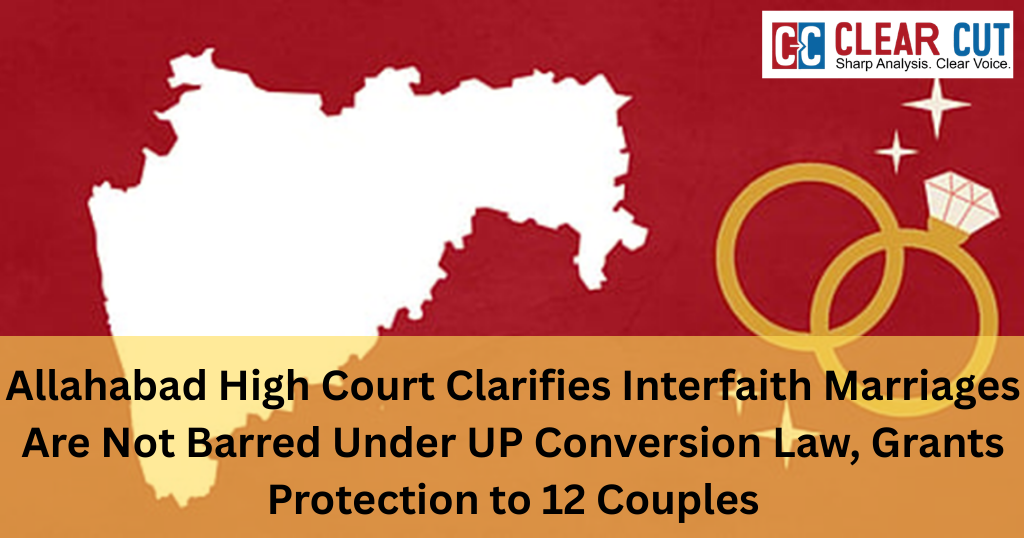
The Allahabad High Court clarified that interfaith marriages are not prohibited under the Uttar Pradesh Prohibition of Unlawful Conversion of Religion Act, 2021, as the law targets only forced or fraudulent conversions.
Key Highlights
- Allahabad High Court ruled that interfaith marriages are not prohibited under the UP anti-conversion law.
- Protection granted to 12 interfaith couples in live-in relationships.
- Court clarified that the 2021 Act targets forced or fraudulent conversion, not voluntary adult marriage.
- Police directed to prevent harassment of consenting adults.
- Constitutional rights under Article 21 reinforced.

The Allahabad High Court has clarified that interfaith marriages are not prohibited under the state’s anti-conversion law. The court granted protection to 12 interfaith couples who were living together and feared harassment or coercive action under the state’s conversion statute.
The court said that the law does not ban marriages between people of different religions. It only penalises forced or fraudulent religious conversions. If two adults marry out of free will, the state cannot interfere merely because they belong to different faiths.
This ruling has important legal and social implications, especially in Uttar Pradesh, where the anti-conversion law has often been invoked in cases involving interfaith relationships.
Background: The UP Anti-Conversion Law
The case revolves around the Uttar Pradesh Prohibition of Unlawful Conversion of Religion Act, 2021. The law aims to prevent religious conversion through force, fraud, coercion, undue influence, or marriage solely for the purpose of conversion.
Under the Act, individuals seeking to convert must follow a formal procedure, including prior notice to district authorities. The law also makes certain offences cognisable and non-bailable, which means police can arrest without a warrant in some cases.
However, the High Court observed that the Act does not prohibit interfaith marriage itself. It targets unlawful conversion, not voluntary relationships between consenting adults.
Why the Court Granted Protection
The 12 couples approached the High Court seeking protection from alleged harassment by families and possible police action. They argued that they were adults living together voluntarily and had not engaged in forced or fraudulent conversion.
A bench of the Allahabad High Court noted that personal liberty under Article 21 of the Constitution protects the right of two consenting adults to live together, irrespective of religion. The court stated that interfaith relationships cannot automatically be treated as suspicious under the anti-conversion law.
The judges clarified that unless there is clear evidence of coercion or deceit, authorities cannot presume that an interfaith marriage violates the statute. The court directed the police to ensure that no harassment occurs and that the couple’s safety is protected.
Legal Interpretation of the Conversion Law
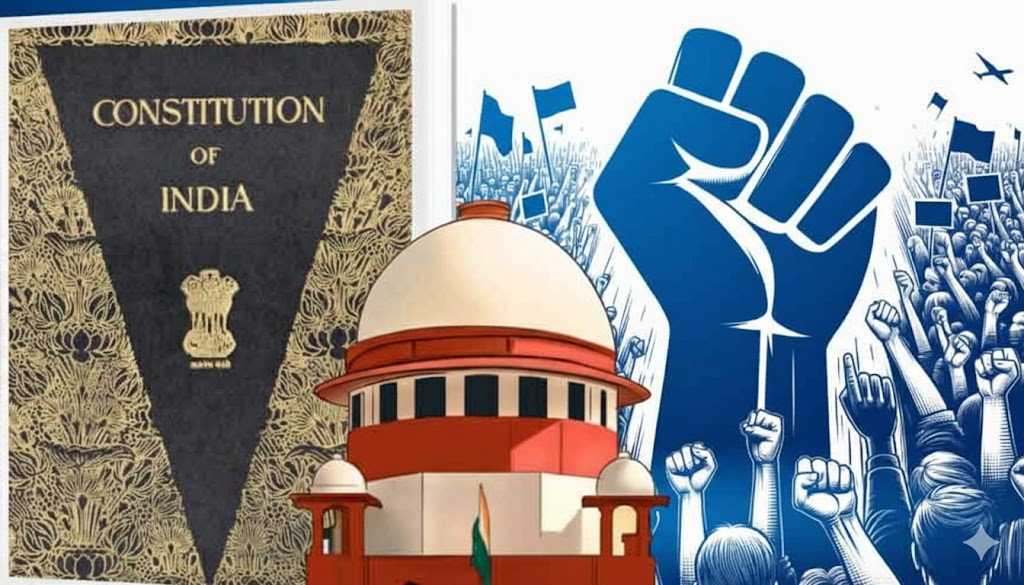
The court’s reasoning is rooted in constitutional principles. Article 21 guarantees the right to life and personal liberty. The Supreme Court of India has repeatedly upheld the right of consenting adults to choose their partners, including in interfaith and inter-caste marriages.
The High Court observed that the UP law must be interpreted narrowly. It cannot be used to restrict voluntary adult relationships. The mere fact that partners belong to different religions does not automatically imply illegal conversion.
Legal experts say this clarification is significant because there has been confusion over whether the law indirectly discourages interfaith marriages. The court has now made it clear that marriage between adults of different faiths remains lawful unless it involves forced conversion.
The Social Context Behind the Case
Interfaith marriages in India often face social resistance. Families sometimes oppose such unions due to cultural, religious, or caste considerations. In some instances, police complaints are filed under anti-conversion laws, even when no coercion exists.
According to National Crime Records Bureau (NCRB) data, Uttar Pradesh consistently reports high numbers of cases registered under various special and local laws. However, conviction rates in conversion-related cases remain a subject of legal scrutiny.
Social activists argue that legal ambiguity can increase anxiety among couples. When laws appear broad or open to interpretation, families or local authorities may attempt to use them to pressure interfaith partners.
The High Court’s ruling aims to reduce this uncertainty by clearly distinguishing between voluntary marriage and unlawful conversion.
Impact on Live-In Relationships
Notably, the court also extended protection to couples in live-in relationships. Indian courts have recognised live-in arrangements between consenting adults as part of personal liberty.
By granting protection, the High Court reinforced the idea that adults have autonomy over personal choices, including decisions about marriage or cohabitation. The court emphasised that state agencies must not interfere without valid legal grounds.
This approach aligns with earlier constitutional judgments that protect individual choice in matters of marriage and relationships.
Balancing Law and Personal Liberty
The ruling highlights a broader governance challenge: balancing the enforcement of anti-conversion laws with constitutional freedoms.
State authorities argue that the 2021 Act protects vulnerable individuals from coercive religious practices. However, the judiciary has consistently maintained that enforcement must not infringe on fundamental rights.
The High Court clarified that the burden lies on the state to demonstrate unlawful intent. Without evidence of fraud, force, or misrepresentation, interfaith marriages cannot be criminalised.
Legal scholars note that this interpretation prevents misuse of the law while preserving its original objective of preventing forced conversions.
Broader Implications for Uttar Pradesh
Uttar Pradesh is India’s most populous state, with over 240 million residents. Social diversity, migration, and urbanisation have increased interaction across communities.
Interfaith relationships are not uncommon in urban centres. However, they often attract public attention and political debate. The High Court’s clarification may influence how district administrations handle similar cases in the future.
Police authorities are now expected to act cautiously and ensure that anti-conversion provisions are not applied mechanically in relationship disputes.
Key Highlights
- Allahabad High Court ruled that interfaith marriages are not prohibited under the UP anti-conversion law.
- Protection granted to 12 interfaith couples in live-in relationships.
- Court clarified that the 2021 Act targets forced or fraudulent conversion, not voluntary adult marriage.
- Police directed to prevent harassment of consenting adults.
- Constitutional rights under Article 21 reinforced.
A Significant Judicial Clarification
The High Court’s decision sends a clear message: the law cannot override personal liberty without evidence of wrongdoing. Interfaith marriages remain legally valid in Uttar Pradesh unless coercion or fraud is proven.
The ruling strengthens legal clarity in a sensitive social domain and underscores the judiciary’s role in safeguarding individual rights within India’s complex social fabric.
Clear Cut Gender, Research Desk
New Delhi, UPDATED: Feb 26, 2026 01:00 IST
Written By: Samiksha Shambharkar