
India presented a strong vision of inclusive development at the United Nations Commission for Social Development, but gaps in youth employment, digital access, and policy contradictions raise concerns at home. The article highlights the contrast between India’s global commitments and the everyday realities faced by marginalized communities.
At the 64th UN Commission for Social Development, India presented an ambitious blueprint for equitable growth. The harder question is whether the domestic record matches the global declaration.
February–April 2026 | International Affairs & Governance
Topics: UN Commission for Social Development, Viksit Bharat 2047, Inclusive Development, South-South Cooperation, India Foreign Policy, Social Protection, Digital Exclusion, Youth Unemployment
Keywords: CSocD 64th session, Savitri Thakur, Sabka Saath Sabka Vikas, Vasudhaiva Kutumbakam, PM-JAY, PM-SHRI, PMJVK, Viksit Bharat, Copenhagen Declaration, Doha Political Declaration, skilling India, education-employment mismatch

Themes: Rhetoric vs. Reality, Multilateralism, Development Diplomacy, Social Infrastructure, Governance Credibility, Marginalisation
India’s Vision on the Global Stage
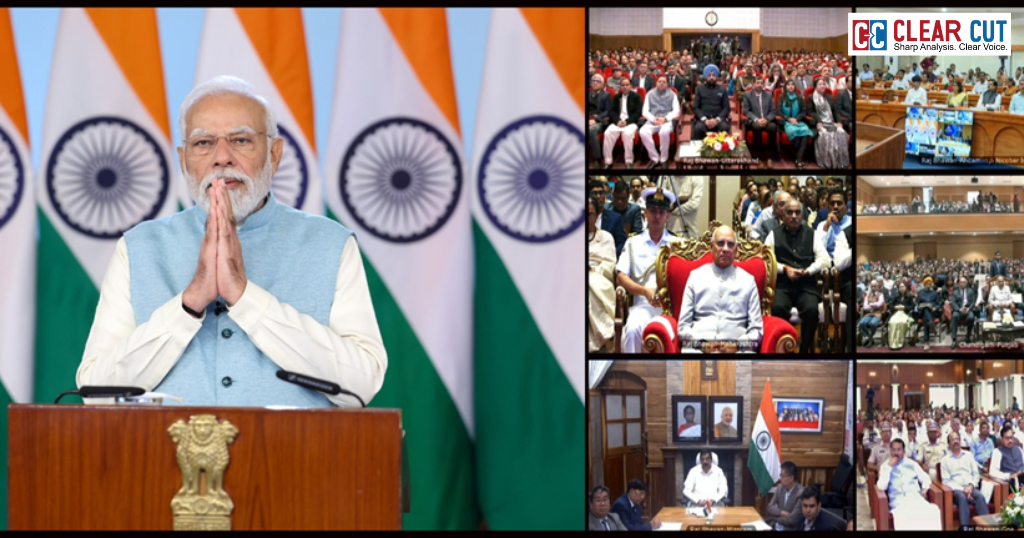
In early February 2026, India presented its vision of inclusive, rights-based progress at the 64th Session of the United Nations Commission for Social Development in New York. Minister of State for Women and Child Development Savitri Thakur delivered the statement, focusing on two main ideas: the constitutional principle of equality and the goal of Viksit Bharat (Developed India) by 2047, which marks the 100th anniversary of the nation’s independence.
The session was titled “Leveraging Outcomes of the Second World Summit for Social Development from Copenhagen to Doha.” Thakur informed the gathered representatives from over 100 UN member states that India follows the philosophy of “Sabka Saath, Sabka Vikas” (Together, for everyone’s development). This demonstrates a commitment from the government and society to ensure no citizen is left behind. She referenced the idea of Vasudhaiva Kutumbakam, meaning “the world as one family,” to express India’s willingness to share its development experience with other countries.
Achievements and Expanding Global Role
India has made significant improvements to its social infrastructure over the past decade. The Pradhan Mantri Jan Vikas Karyakram has allocated funds to areas with a high concentration of minorities, resulting in the construction of schools, health centers, and vocational training facilities. The PM-JAY health insurance program covers a large portion of India’s lower-income population. The PM-SHRI school modernization scheme aims to upgrade thousands of government schools across the country. These accomplishments are noteworthy for a nation supporting the social needs of 1.4 billion people across 28 states.
India also used the session to advocate for stronger South-South cooperation. This involves sharing knowledge, policy models, and institutional capacity among developing nations. This approach has become a key part of Indian diplomacy, emphasizing that the Global South can look beyond Western development models. Countries like India, which have dealt with widespread poverty and complex institutions, have valuable models to share.

Gaps Between Vision and Reality
However, international forums also invite scrutiny. The gap between India’s declared development philosophy and reality often raises concerns. The education-employment mismatch noted by analysts in 2026 highlights a troubling contradiction: despite producing more graduates than ever, youth unemployment, especially among the highly educated has increased. Critics argue that a skilling ecosystem focusing on small, subsistence-level businesses fails to provide the inclusive development the government claims.
Digital welfare systems aimed at increasing efficiency and reducing waste have, in practice, left many people behind. Those without smartphones, facing biometric data issues, or lacking consistent internet access have been excluded. By making entitlements dependent on digital verification, the state has unintentionally recreated previous exclusions, now filtered through technology instead of bureaucracy.
Contradictions and the Test of Credibility
The passage of the Transgender Persons Amendment Act just weeks after India’s UN statement created a stark contradiction. A government that proclaimed development must be inclusive quickly moved to limit the legal definition of a marginalized group at home, despite opposition from a Supreme Court-appointed panel, political parties, and the affected community.
Conclusion: The Measure of Inclusion
None of this undermines the validity of India’s development goals. The Viksit Bharat 2047 framework has driven policy planning that genuinely aligns state efforts with long-term social objectives. India’s participation in international forums has also helped shape global standards for inclusive development. However, the true measure of a development vision is not in its presentation at the UN but in the everyday experiences of those at the margins of the system it is meant to benefit.
References
https://www.pmindia.gov.in/en/news_updates/pm-launches-viksit-bharat-2047-voice-of-youth/#:~:text=He%20said%20that%20social%20thinking,%E2%80%9D%2C%20the%20Prime%20Minister%20emphasized.[N1]
https://www.pib.gov.in/PressReleaseIframePage.aspx?PRID=1985077®=3&lang=2
Clear Cut CSR, Research Desk
New Delhi, UPDATED: April 08, 2026 09:00 IST
Written By: Tanmay J Urs