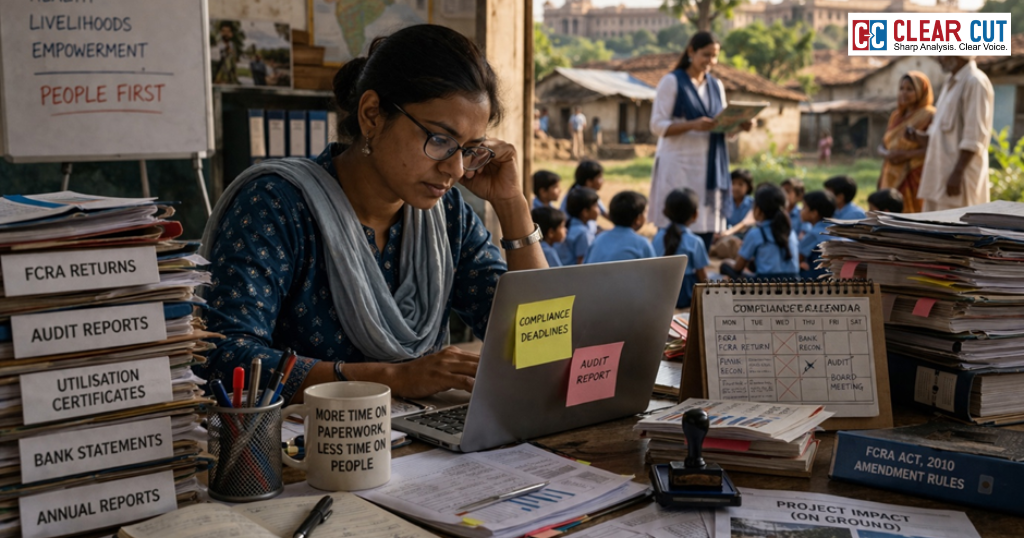
The FCRA Amendment 2026 increases compliance burdens on NGOs, shifting focus from social work to administrative tasks. This risks slowing grassroots development and discouraging genuine social innovators.
For 26 years, I have worked at the intersection of community needs and government goals. In that time, I have seen NGOs (Non-Governmental Organizations) and CBOs (Community-Based Organizations) act as the vital “human infrastructure” of India. They are the bridge between a policy written in New Delhi and a family living in a remote hamlet.
Today, that bridge is under heavy maintenance. With the introduction of the Foreign Contribution (Regulation) Amendment Bill, 2026, we are seeing the latest in a series of shifts that began with the 2010 Act and accelerated through major amendments in 2020.
The Elephant in the Room
It is important to address the questions many citizens and policymakers ask: Is there harm in following rules? Shouldn’t India safeguard its interests?
The answer is a firm yes. No professional in the social sector argues for a “wild west” of unregulated cash. We recognize that foreign funds must not be used to undermine national security or create artificial bottlenecks for infrastructure projects. Safeguarding the nation’s interest is not just a government duty; it is a citizen’s duty.
However, we must distinguish between accountability and administrative exhaustion.
The “Compliance Trap”
The NGOs have seen significant shifts in the last 15 years; the sector has shifted from “reporting” to “micro-management.”
- The 2010 Act introduced renewal cycles.
- The 2020 Amendment banned sub-granting and lowered administrative caps to 20% (MHA, 2020).
- The 2026 Bill now proposes a “Designated Authority” to manage NGO-built assets like schools and clinics (Lok Sabha, 2026).
When we talk about “misuse of funds,” the solution should be surgical and punishing the wrongdoers. Instead, the current trend is a “blanket” increase in compliance that affects everyone.
Imagine when a small NGO has to spend 20-40% of its energy on filing audits, maintaining specific bank accounts in the capital, and now worrying if their community center might be “vested” in a government authority. We must appreciate that they aren’t “misusing funds”, rather they are simply losing time. Every hour spent on a technical compliance form is an hour lost from teaching a child or helping a farmer.
NGOs: Bottlenecks or Boosters?
Some may think that NGOs hinder development. Yet, the government’s own data tells a different story. The NITI Aayog’s Aspirational Districts Programme (2025-26) relies heavily on civil society to achieve “saturation” in health and education.
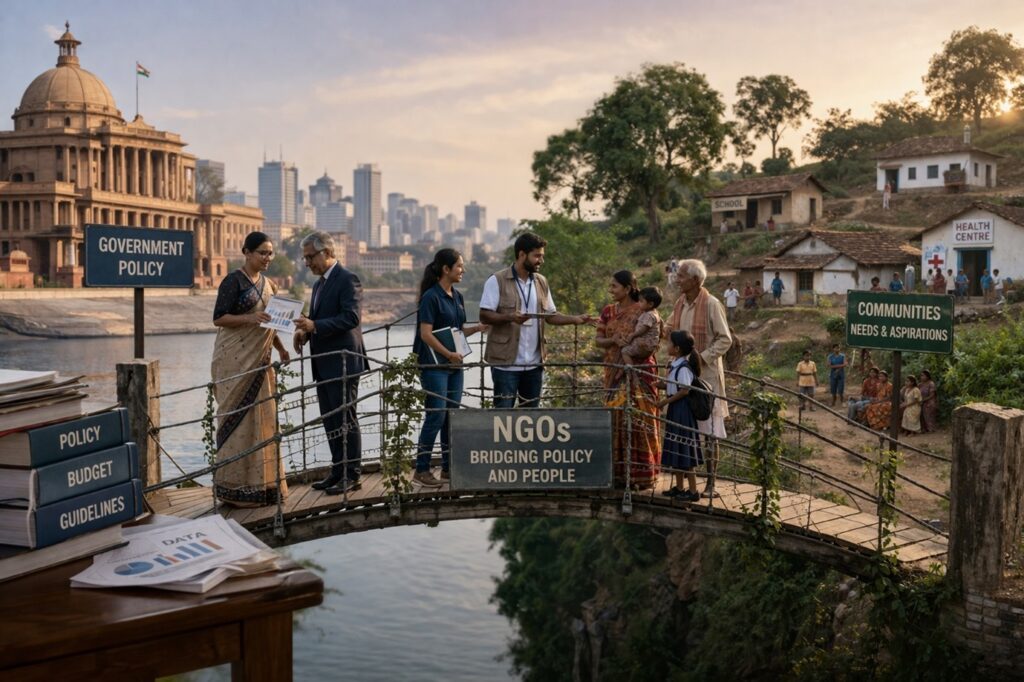
NGOs are not bottlenecks; they are the people who grease the wheels of government machinery. They operate in the community, with the community. Because the community trusts them, they can convince a hesitant family to vaccinate a child or adopt a new farming technique. If the government “burns the bridge” by making the trust-builders feel like suspects, the development agenda will actually slow down, not speed up.
The Risk
My biggest concern as a social development sector practitioner, is the diminishing interest of the genuine changer. If we make the “cost of doing good” too high, the people who want to change society out of pure passion will walk away. They will see the legal risks and the administrative burdens as too high a price to pay. We will be left with a sector of “compliance experts” rather than “social innovators.”
Furthermore, we must address the psychological toll of constant shifts. Amendments to the law should be milestones of progress, not a cause of anxiety. Currently, for many NGOs, the announcement of a new regulation has become a “not again” moment. When organizations spend their energy bracing for the next change rather than building the next school, we lose the creative friction that drives development.
A Path Forward
There’s no denial that regulation is the guardrail. But also, freedom is the fuel. To keep our social sector vibrant, the government should consider:
- Differentiated Compliance: Don’t treat a local primary school the same way you treat a massive international think-tank.
- Asset Protection: Ensure that assets created through years of community sweat and foreign support remain with the people they serve.
- Consultative Regulation: Include the voices of those with decades of field experience before making the next amendment.
The goal of the state and the NGO is the same: a prosperous, secure, and developed India. Let us ensure that in our effort to “count” every contribution, we don’t make the contributions stop counting altogether.
Clear Cut CSR, Research Desk
New Delhi, UPDATED: April 08, 2026 01:00 IST
Written By: Paresh Kumar