

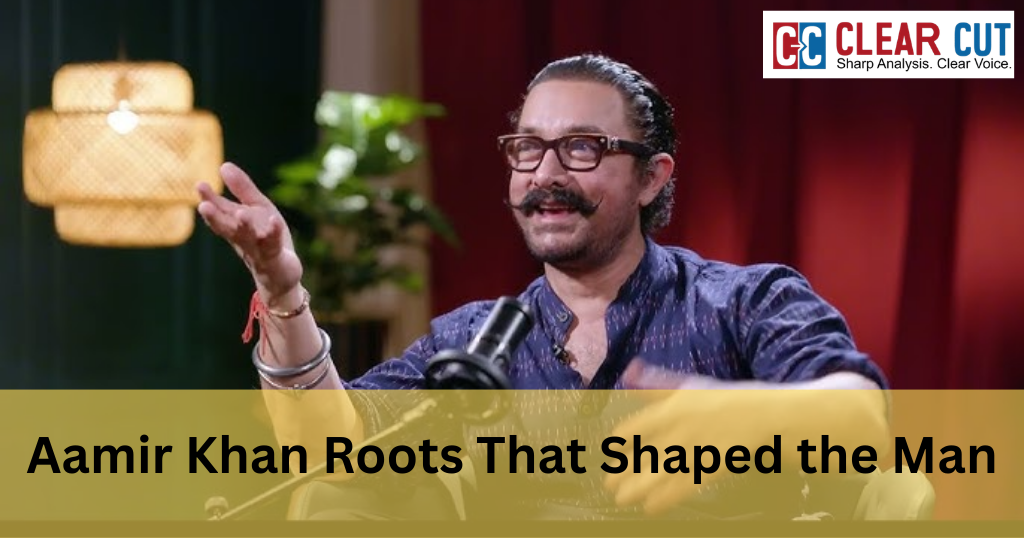
The journey of Aamir Khan shows how cinema, education, and social advocacy can create meaningful change beyond entertainment. Through films like Taare Zameen Par and initiatives like the Paani Foundation, he has promoted inclusive education, water conservation, and gender justice.
Born in Mumbai on March 14, 1965, Aamir Khan came from a family steeped in Hindi cinema. While his father, Tahir Hussain, was a film producer, his uncle, Nasir Hussain, was one of the most significant filmmakers of his era. However, Aamir did not have an uninterrupted privileged upbringing. As a child, he saw first-hand the cyclical nature of the film industry, where success could be ephemeral and failure frequently abrupt. While some projects were successful, others failed, and there was always financial uncertainty. He gained a realistic understanding of professional instability and the value of perseverance over entitlement as a result of this early exposure.
This grounded perspective was reinforced during his formative years. Aamir was not a flamboyant or charismatic student at J. B. Petit School, St. Anne’s High School, or Narsee Monjee College. He was quiet, perceptive, and very focused, according to his teachers and peers. He favoured contemplation over performance and listening over speaking. Later, this temperament, which is characterized by thoughtfulness rather than impulse, would influence both his public persona and acting style.
Sport was crucial in helping him develop his discipline. Aamir trained hard and dealt with the emotional pressures of competition as a state-level tennis player for Maharashtra. He learned to rely on patience and repetition, to accept setbacks without resentment, and to lose and start over through sport. His career decisions and his capacity to interact with complex social realities without spectacle were greatly influenced by these lessons in emotional control and fortitude.

From Newcomer to National Sensation
With Qayamat Se Qayamat Tak, Aamir made his debut in mainstream Indian cinema in 1988. He became a national sensation almost immediately after the movie. Aamir decided to take his time, in contrast to many actors who quickly profit from unexpected fame. He deliberately took a break from his unrelenting
signing and spent time learning about cinema as a craft rather than a product.
Films like Dil, Jo Jeeta Wohi Sikandar, Rangeela, and Andaz Apna Apna gave him the opportunity to experiment with different genres while keeping creative control throughout the 1990s. His unwillingness to follow formulaic success became well-known. By the end of the decade, Aamir had established a reputation as an actor who prioritized story integrity over commercial trends and turned down more scripts than he accepted.
His later shift to socially conscious storytelling was made possible by this stage. It also solidified his reputation as a performer who made choices based on introspection rather than commercial pressure.

Beyond Stardom and Into Socially Conscious Cinema
A turning point came with Lagaan in 2001, a film set in colonial India that resonates very effectively with rural pride, resilience, and empowerment. Not only did Aamir star in Lagaan, but he also produced it, indicating a level of commitment to ensure stories he is passionate about get told on the big screen.
Nominated for an Academy Award, it showed that stories set against local contexts can resonate worldwide without compromising their core elements.
Ever since Lagaan, Aamir’s films have become increasingly responsive to ethics and societal issues. Taare Zameen Par triggered a nationwide conversation on dyslexia and inclusive education, encouraging understanding rather than stigma. This engagement with mental health continued in Sitaare
Zameen Par in 2025, which brought attention to emotional well-being and psychological resilience, further normalising discussions around mental health.
In the year 2014, his movie PK, challenged the superstition in Indian society and unquestioned authority, and later in Dangal, where the narrative moved beyond girls’ participation in sports to assert their right to education and equal opportunity. Taare Zameen Par challenged society regarding dyslexia because the
story was about a child who had dyslexia but was very brilliant in the arts.
The reason this period was so special was not only the message but the way it was communicated. Aamir was associated with and combined all his ideas with educators and psychologists. His movies turned out to be classes and learning forums in themselves.
When Cinema Became Public Advocacy
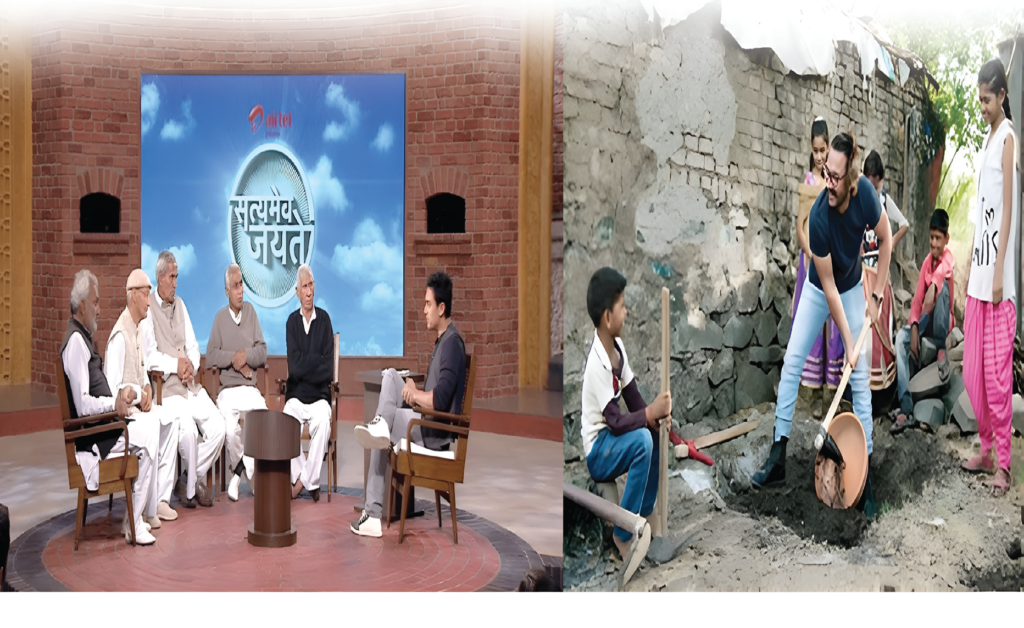
This transition from cinematic engagement to direct advocacy thus surfaced through Satyamev Jayate.
The television program presented medical negligence survivors, caste violence, domestic abuse, and systemic discrimination on a national platform. For most viewers, it was the first time that such
issues were being collectively spoken about with seriousness and compassion.
Importantly, the programme did not isolate stories from action. It amplified the work of organisations like Breakthrough, Majlis, Childline India, and the Sneha Foundation to expand their reach and mobilise support. The show connected media, civil society, and policy conversations, underlining the way in which storytelling inspires collective responsibility.
This marked the transition in Aamir’s career from representation to participation, wherein fame became a
means of dialogue rather than distance.
Philanthropy Rooted in Education and Inclusion
Education has been a core point of intervention for Aamir Khan’s philanthropy. Since Taare Zameen Par,
he has supported a number of organisations that work with children with learning disabilities, such
as the Akanksha Foundation and networks of special educators in Mumbai and Delhi. His advocacy strongly championed mainstreaming in inclusive classrooms rather than segregation, maintaining that difference needs accommodation, not isolation.
Besides finance, Aamir spoke about rigid systems of assessment, flawed training for teachers, and emotional costs due to exclusionary schooling. His intervention thus betrayed a sense that reforming education involves unlocking structural bottlenecks rather than individual inadequacies.Besides finance, Aamir spoke about rigid systems of assessment, flawed training for teachers, and emotional costs due to exclusionary schooling. His intervention thus betrayed a sense that reforming education involves unlocking structural bottlenecks rather than individual inadequacies.
Water, Rural Livelihoods, and Collective Action
The Paani Foundation is the longest-running effort by Aamir in rural development, which he has established with the co-founder Kiran Rao. Watershed management and community mobilisation
are used as the foundation to solve the drought and water scarcity of Maharashtra. Instead of depending on the outside hand, its strategy lies on the concept of local ownership and science planning. The
Satyamev Jayate Water Cup was one of such projects that made villages do some water conservation efforts together. The monsoon was preceded by the planting of check dams, contour trenches and rainwater harvesting facilities by communities. Throughout the years, these endeavours resulted in building up a water storage capacity of more than 550 billion Litres. This made the reliance on tanker water, as well as distress migration, less substantial. This transformation is seen in Velu village of the Satara district. After being characterized by chronic water deficits and seasonal migration, the village embarked on the coordinated water bodies and embankments. Within a year, the level of groundwater was better, agriculture was stable, and females no longer had to spend a lot of time and money on the long distances to fetch water.
Availability of clean water in the vicinity changed health behaviour, labour supply, and basic dignity. Income growth was boosted, and input expenses decreased by an average of 70 to 80 percent among farmer groups that adopted such practices. Water conservation was therefore seen as a channel
of realizing economic stability and social resilience.
Supporting Women and Gender Justice
Gender justice has been a conscious effort by Aamir Khan. He used Satyamev Jayate to empow
er the voices of women who had survived violence, and in conjunction with legal activists like Flavia Agnes, to clarify rights and remedies by the use of organisations like Majlis. His action was aimed at institutional responsibility and not at personal absconding. To have made the women and their experiences a focus of his work and legal literacy central, his writings helped illuminate that gender justice does not exist in the symbolism of a few gestures at the operational level of systems.
A Legacy Beyond the Screen
In a nation with an uncertain climate, practicing rural affliction and constant disparity, Aamir Khan shows that celebrity impact could transcend figuratively. This has made visibility to become long-term social
impact as he grounds his involvement in education, water security, gender justice, and collective participation. His philanthropy is not based on the big things or his personal branding. Rather, it empowers existing institutions, reinforces the grassroots work, and rejuvenates community- based change. The villages in which people stay water secure, the village in which people live together, and the dialogue that occurs will all remain as a legacy to his work in the public, long after the films are forgotten.
Clear Cut Education, Gender Desk
New Delhi, UPDATED: March 08, 2026 09:00 IST
Written By: Samiksha Shambharkar