
Banyan Nation turns plastic waste into high-quality recycled resin that matches virgin materials, focusing on quality, traceability, and industrial use. It is helping reshape India’s recycling system by making circular economy solutions commercially viable.
Banyan Nation began with a simple idea, clean plastic can be used again and again if systems are built to handle it properly. The founders believed recycling did not have to mean low quality or down-cycling. They set out to prove that post-consumer plastic could meet industrial standards and compete with virgin polymer.
Today, the company sells recycled polyethylene and polypropylene resins used by mainstream manufacturers. Large brands buy the material. Policymakers cite the model. Global forums recognise the work. The journey from waste to worth has been slow, technical, and deliberate.
Tighter the problem, bigger the claim
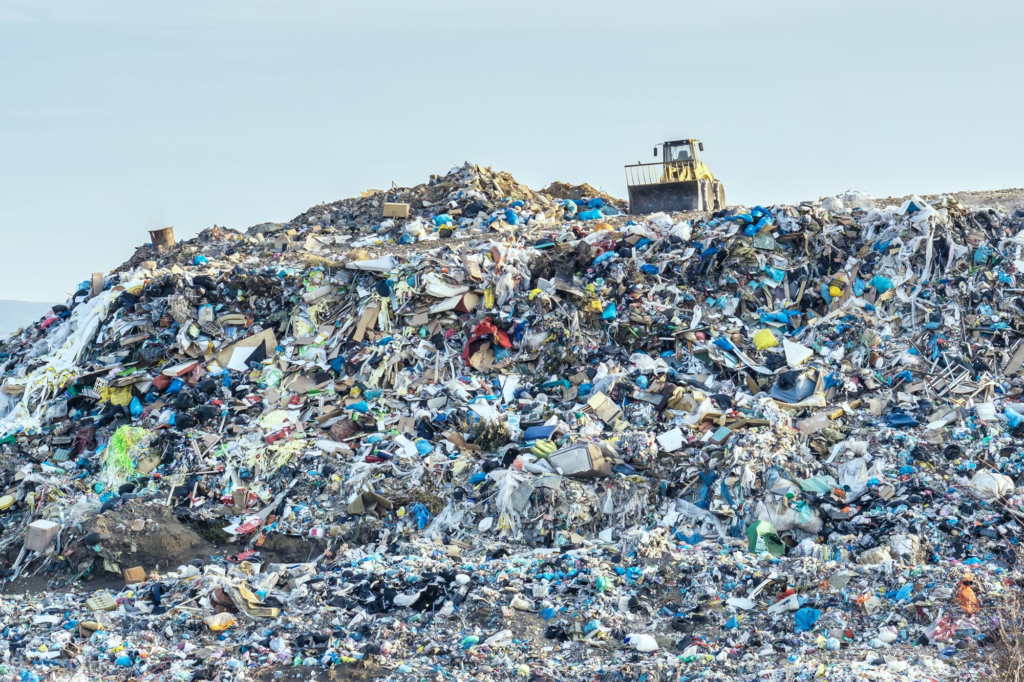
India produces millions of tonnes of plastic waste every year, much of it never enters formal recycling channels. The result is visible everywhere, clogged drains, polluted rivers, and plastic burned in the open. Banyan Nation does not attempt to solve every part of this problem. Instead, it focuses on one difficult gap, quality. The company removes inks, coatings, labels, and contaminants from discarded plastic. It converts mixed post-consumer waste into near-virgin quality resin that can return to packaging and industrial products. This shift, from low-grade flakes to industry-grade pellets, changes the economics of recycling for both buyers and sellers. Media have noted that this focus on quality, rather than volume alone, is what separates Banyan from many recyclers.
The process
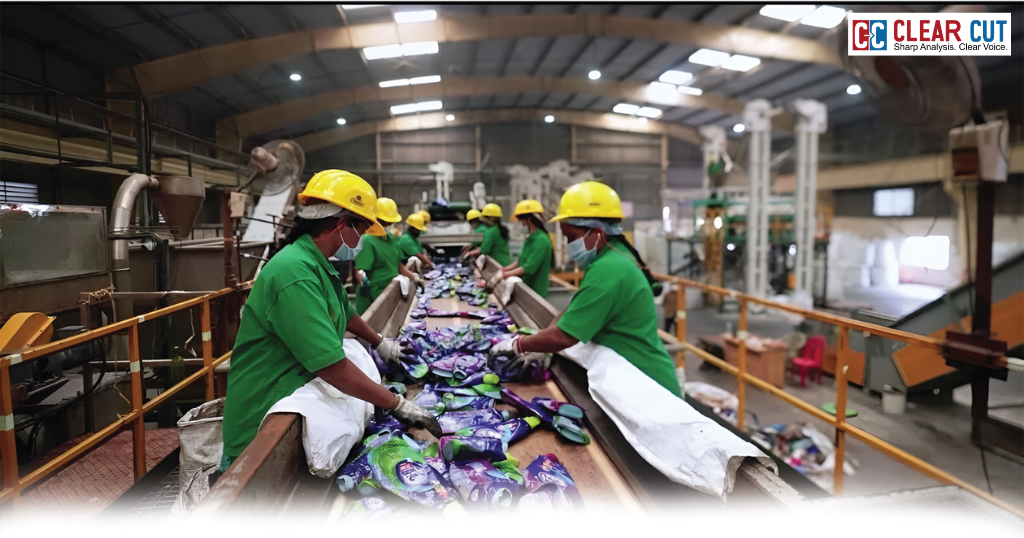
Plastic waste enters the system through a mix of organised collec- tion and informal supply chains. Bottles and containers reach the facility, where sorting and washing begin. Advanced washing systems remove oils, inks, and residues that typically lower recycled plastic quality. The material is then dried, melted, and extruded into pellets. These pellets undergo testing for colour consistency, odour, and mechanical strength. The final resin is tuned for injection moulding, blow moulding, or extrusion. This matters because manufacturers can run the material on existing machines without costly changes. Banyan’s leadership has repeatedly stated in interviews that process control, not just machinery, is the real differentiator.
The hidden product: Trust
Recycled plastic struggles with one major issue, trust. Brands worry about inconsistency. Regulators worry about safety, especially for packaging with human contact. Banyan Nation invests heavily in traceability and laboratory testing to address this. Each batch is documented. Test results are shared with customers.
This transparency allows procurement teams to justify switching from virgin resin. The World Economic Forum has cited Banyan for building reliable recycled material supply chains, especially in markets
where informal collection dominates. That external validation helps convert sustainability interest
into real purchase orders.
Scaling up: From pilots to plants
Scaling recycling is not just about demand, it is about land, capital, and approvals. Banyan Nation began
with a pilot facility before expanding operations near Hyderabad. As demand increased, the company
announced plans to invest nearly ₹200 crore to scale capacity. The Telangana government welcomed
the expansion. State minister Sridhar Babu publicly highlighted employment generation and the
role of circular economy startups in industrial growth. Media framed the project as both an environmental
and economic investment, showing how state support can accelerate circular infrastructure.
Why brands are buying recycled resin?
Three forces are driving demand. Regulation is one. India’s Extended Producer Responsibility framework pushes companies to account for post-consumer plastic. Consumer pressure is another, as sustainability commitments move from marketing to procurement. The third driver is economics. High-quality recycled resin can compete with virgin plastic when supply is consistent and performance is predictable. Banyan positions its product not as a compromise but as a substitute. Business media profiles note that this framing resonates with packaging and automotive suppliers who care more about specifications than slogans.
The social angle, integrating workers and waste pickers
Recycling in India depends heavily on informal labour. Banyan Nation builds structured links
with waste aggregators, self-help groups, and collection partners. These relationships improve sorting
at source and stabilise supply. For waste collectors, formal offtake means predictable income and safer
handling conditions. Company reports and interviews describe training initiatives that raise material
quality while supporting livelihoods. This social integration reduces friction in a system often fragmented
by small, unorganised suppliers.
Technology, not magic
There is no single breakthrough machine at Banyan Nation. The advantage lies in system design.
Precision washing lines, optical sorting, controlled drying, and in-house quality labs work together to reduce variability. Forbes India has reported that this technical discipline allows Banyan’s recycled resin to meet demanding industrial applications. The result is material that performs consistently, batch after batch, a non-negotiable requirement for large manufacturers.
Recognition and credibility
Early recognition played a key role in Banyan’s growth. The company received global attention
through World Economic Forum circular economy platforms and awards. These endorsements
did more than add prestige. They reassured customers, attracted investors, and opened doors to policy
conversations. Over time, this credibility helped Banyan move from pilot buyers to long-term supply
agreements with major brands.
Challenges that remain
The road is not smooth. Feedstock quality varies by season and location. Contamination raises costs. Expansion requires heavy capital investment. Policy incentives differ across states. Even when high-grade recycled resin is available, many converters need technical adjustments to adopt it fully. Banyan operates in a market where virgin plastic remains cheap and globally traded. Yet its emphasis on quality and traceability softens these structural challenges.
What success looks like?
For Banyan Nation, success is not just revenue growth. It includes steady demand from large manufacturers, formal income for waste collectors, and regulatory systems that reward recycled content.
Government statements around new plants and media coverage of expansion plans suggest that multiple
stakeholders are beginning to align around this vision. Circular economy is no longer treated as a side project, it is becoming industrial policy.
Voices from the field
Co-founder Mani Vajipey has said in interviews that the company’s goal is premium recycled plastic for injection and extrusion markets. Forbes India quoted him on the need for deep washing and tight process control to meet industrial benchmarks. Telangana minister Sridhar Babu’s public statements, reported by regional and national outlets, emphasised employment and sustainability as twin benefits of Banyan’s expansion. These voices show how business and policy narratives are converging around circular manufacturing.
The bigger picture
Banyan Nation represents one piece of a larger transition. Governments, brands, and startups must
work together to close material loops. High-quality recycling reduces dependence on virgin polymer
and cuts lifecycle emissions.
Clear Cut Climate, Startup Desk
New Delhi, UPDATED: March 25, 2026 05:45 IST
Written By: Ayushman Meena