
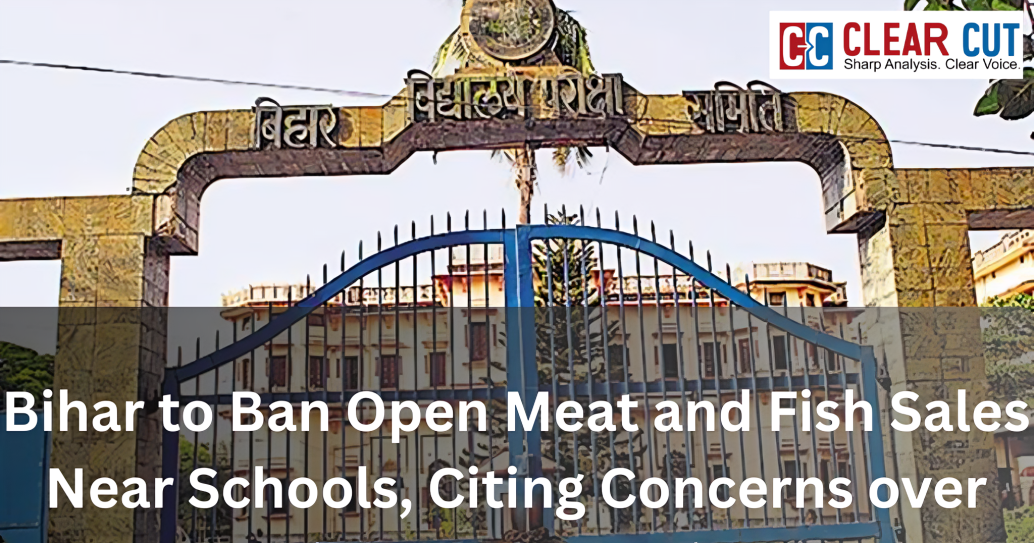
The Bihar government plans to ban open meat and fish sales near schools, claiming it may reduce “violent tendencies” in children, but experts question the scientific basis of this link.
Key Highlights
• Bihar government plans to prohibit open sale of meat and fish near educational institutions
• Deputy Chief Minister Samrat Choudhary linked the move to preventing “violent tendencies” in children
• The proposal has sparked debate among educators, traders, and public health experts
• Implementation details and enforcement guidelines are expected from district administrations
• The decision raises questions about evidence, food rights, and regulatory priorities
What the Decision Is About
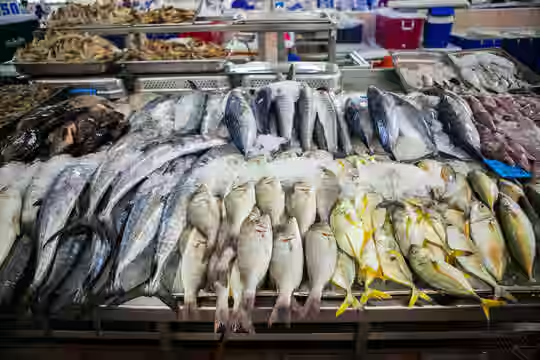
The Bihar government has announced that it will ban the open sale of meat and fish near schools and other educational institutions. The stated reason is to prevent what officials described as “violent tendencies” among children.
According to statements reported by Scroll and The Federal (February 2026), Deputy Chief Minister Samrat Choudhary said that exposure to open meat markets near schools could negatively influence children. He suggested that regulating such sales around educational spaces would help maintain a “healthy environment” for students.
The move has triggered debate because it links food display practices with behavioural outcomes among children.
What Officials Said
Deputy Chief Minister Samrat Choudhary stated that the government would introduce measures to restrict open meat and fish sales in the vicinity of schools. He argued that such regulation would contribute to reducing aggressive tendencies in children.
The announcement reportedly followed discussions within state administrative circles regarding environmental conditions around educational institutions.
While no formal gazette notification was immediately cited in reports, officials indicated that district administrations would receive instructions to enforce the decision once guidelines are finalized.
The Policy Context: Regulation Around Schools
Indian states already regulate certain activities near schools. For example:
• Tobacco sales are prohibited within 100 yards of educational institutions under the Cigarettes and Other Tobacco Products Act (COTPA).
• Noise pollution norms apply near school premises.
• Some states regulate liquor shops near schools and places of worship.
The Bihar government appears to be extending this regulatory logic to food markets, specifically open meat and fish stalls.
However, unlike tobacco and alcohol, meat and fish are legal food items widely consumed across India.
Is There Scientific Evidence?
The key justification cited in statements was the concern about “violent tendencies” among children. However, behavioural science research does not establish a direct causal link between seeing meat being sold and developing aggression.
Psychological studies typically associate aggressive behaviour with factors such as:
• Socio-economic stress
• Exposure to violence
• Family environment
• Media influence
• Mental health conditions
There is no established consensus in child psychology literature that proximity to meat shops influences violent behaviour.
Public health experts note that hygiene and sanitation concerns near schools may be a stronger policy basis than behavioural claims.
Hygiene and Urban Planning Dimensions
Open meat markets sometimes raise concerns related to:
• Waste disposal
• Odour
• Vector control (flies, stray animals)
• Sanitation
Municipal health regulations often require meat shops to follow hygiene standards, including proper storage, covered displays, and waste management.
Urban planning specialists argue that if hygiene is the primary concern, the focus should be on improving regulatory enforcement rather than imposing blanket bans.
Social and Economic Impact
The proposed ban could directly affect small vendors and daily wage earners who operate meat and fish stalls near schools.
In many towns, markets develop organically around high-footfall areas such as educational institutions. Restricting vendors may impact their livelihoods.
According to data from India’s informal sector studies, small-scale meat and fish vendors often belong to economically weaker communities. In several parts of India, including Bihar, the meat trade is historically associated with specific caste and minority communities who depend on this occupation for intergenerational livelihood. Policies that restrict vending spaces without rehabilitation or alternative arrangements can disproportionately affect these socially and economically marginalised groups.
Relocation without adequate compensation or support may deepen income insecurity for communities already operating within the informal economy.
Food rights advocates argue that policy decisions affecting food trade must balance public interest with economic justice and social equity.
Food Choice and Cultural Sensitivity
India is a diverse country with varied dietary practices. Meat and fish form staple foods in several regions, including parts of Bihar.
Regulating open sale is not the same as banning consumption. However, critics argue that symbolic messaging linking meat visibility with aggression may stigmatize certain dietary practices.
Education policy analysts emphasize that school environments should focus on:
• Curriculum quality
• Safe infrastructure
• Emotional well-being programs
• Counseling services
They caution against linking behavioural outcomes to food exposure without robust research.
Governance and Implementation Questions
The effectiveness of the proposed measure will depend on clear guidelines:
• What distance qualifies as “near” a school?
• Does the rule apply to all meat products or only open displays?
• Will vendors receive alternative vending zones?
• How will enforcement be monitored?
District administrations will likely play a key role in defining operational rules.
Experts recommend stakeholder consultation, including vendors’ associations and school management committees, before implementation.
Broader Public Debate
The announcement has sparked a wider discussion about how governments address child behaviour and public morality.
Supporters argue that school zones should be strictly regulated to maintain a clean and controlled environment.
Critics argue that behavioural issues among children require deeper interventions, including counseling, social welfare programs, and violence prevention strategies.
The debate reflects the intersection of governance, culture, public health, social equity, and individual choice.
Conclusion
The Bihar government’s decision to ban open meat and fish sales near educational institutions, as stated by Deputy Chief Minister Samrat Choudhary and reported by Scroll and The Federal, has generated significant public discussion.
While the policy aims to create a conducive environment around schools, questions remain about the scientific basis linking meat sale visibility with violent behaviour.
If implemented, the measure will affect vendors, school surroundings, and urban market structures. Policymakers will need to balance hygiene standards, child welfare concerns, economic realities, and social sensitivity.
The issue highlights a broader challenge in governance: ensuring that public policy decisions are evidence-based, socially inclusive, and economically balanced.
How Bihar moves from announcement to implementation will determine whether the measure functions as symbolic regulation or evidence-based public health policy.
Clear Cut Education, Livelihood Desk
New Delhi, UPDATED: Feb 26, 2026 09:00 IST
Written By: Samiksha Shambharkar