

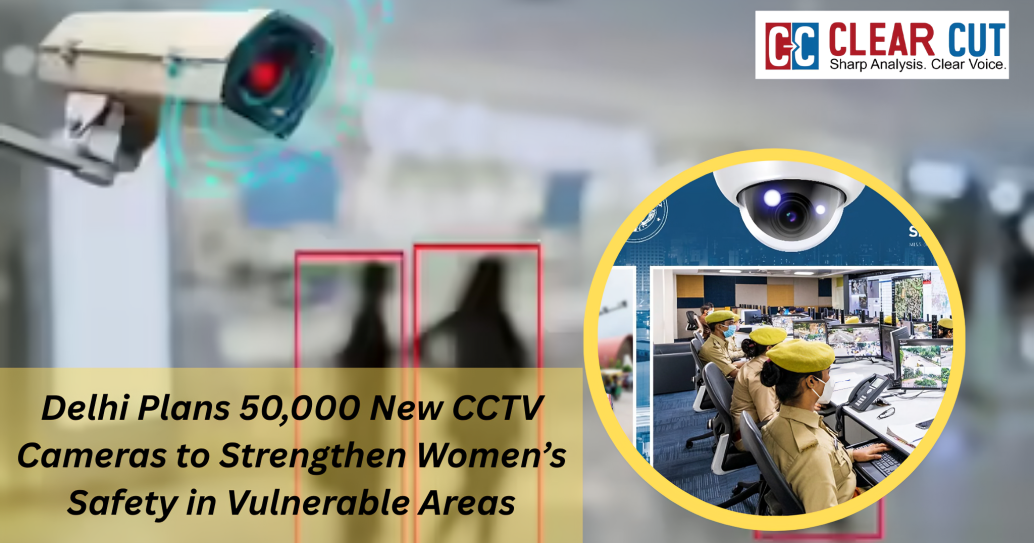
Delhi is adding 50,000 CCTV cameras to improve women’s safety in vulnerable areas. The system will enable real-time monitoring and faster police response. Along with surveillance, officials emphasize privacy safeguards and community involvement.
The Delhi government has announced a major expansion of public surveillance, approving the installation of 50,000 additional CCTV cameras across the city. The move aims to strengthen women’s safety, especially in areas identified as vulnerable due to poor lighting, low footfall, or a history of crime. Authorities say the project is part of a broader strategy to use technology as a preventive tool rather than relying only on post-crime response.
The decision comes amid continued public concern over women’s safety in public spaces and repeated demands for stronger, visible deterrence mechanisms.
What the Decision Means
In practical terms, the plan means that many streets, lanes, bus stops, markets, and residential pockets in Delhi will soon have more cameras watching public movement. These cameras will record activity round the clock and feed into monitoring systems linked with local police stations.
Officials from the Delhi Home Department stated that the focus is not blanket surveillance, but targeted installation in areas where women feel unsafe while commuting, especially during early morning and late evening hours.
How the Plan Will Be Implemented
The implementation will take place in phases. Local administrative units, along with the Delhi Police, have been asked to map “vulnerability zones” based on crime data, citizen complaints, and safety audits. Inputs from Resident Welfare Associations and ward-level committees will also guide placement.
According to senior officials involved in the rollout, the cameras will integrate with existing city surveillance infrastructure. Footage will remain accessible to authorised police personnel for investigation and real-time monitoring.
The project builds on earlier CCTV initiatives in Delhi, which already include tens of thousands of cameras installed near schools, markets, and residential colonies.

Role of Police and Monitoring Mechanisms
The Delhi Police will play a central role in operationalising the system. Police Commissioner Sanjay Arora has previously emphasised that surveillance works best when combined with rapid response teams and patrolling.
Control rooms at district and zonal levels will receive live feeds. Officers will use footage to track suspicious activity, respond faster to distress calls, and collect evidence in cases of harassment, stalking, or assault.
Police officials also highlighted that CCTV footage has already helped solve several crimes in recent years, particularly in identifying suspects and reconstructing timelines.
Why CCTV Is Seen as a Safety Tool for Women
Public surveillance is often debated, but studies and policing experience suggest that visible cameras can deter crimes like chain-snatching, eve-teasing, and street harassment. For many women, the presence of cameras offers psychological reassurance while navigating public spaces.
Women’s rights groups in Delhi have acknowledged that cameras alone cannot eliminate gender-based violence, but they can reduce everyday risks when combined with lighting, policing, and community vigilance.
The government has framed this initiative as part of a preventive safety model, shifting focus from punishment after crimes to deterrence before they occur.

Concerns Around Privacy and Surveillance
At the same time, civil liberties advocates have raised questions about privacy and data protection. They argue that large-scale surveillance must operate within clear legal safeguards to prevent misuse.
Legal experts point out that India still lacks a comprehensive personal data protection framework specifically governing public surveillance. They stress the need for transparent rules on data storage, access, and retention.
Responding to these concerns, officials from the Home Department stated that CCTV footage will be accessed only for lawful purposes and retained for limited periods unless required for investigation.
Social Impact and Gendered Realities
Women’s safety in Delhi is not only a law-and-order issue but also a social one. Many women adjust their routines, routes, and work hours due to fear in public spaces. This directly affects their mobility, employment opportunities, and quality of life.
Urban safety researchers argue that technology-driven interventions like CCTV can help reclaim public spaces for women, but only if supported by gender-sensitive policing and accountability.
Activists also stress that safety must extend beyond central or affluent areas to informal settlements and peripheral neighbourhoods, where women often face greater risk and fewer resources.
Learning from Past Experience
Delhi’s earlier CCTV projects have shown mixed results. In some areas, crime reporting increased because people felt more confident approaching police with evidence. In others, poor maintenance reduced effectiveness.
Officials say the new phase aims to address these gaps through better upkeep, regular audits, and coordination between civic agencies and police.
The government has also indicated that future safety planning may include linking CCTV with emergency response systems and women’s helplines.
Key Highlights of the Initiative
- 50,000 new CCTV cameras to be installed across Delhi
- Focus on women’s safety in vulnerable and poorly lit areas
- Implementation guided by police data and local inputs
- Delhi Police to monitor and use footage for rapid response
- Privacy safeguards promised, though concerns remain
Technology as One Part of Safety
The expansion of CCTV surveillance signals Delhi’s continued reliance on technology to improve urban safety. While cameras cannot address deeper social causes of violence, they can act as a deterrent and accountability tool when used responsibly.
For women navigating the city every day, the real test will be whether these cameras translate into faster help, safer streets, and greater confidence in public spaces. If combined with policing reforms and community engagement, the initiative could mark a meaningful step toward making Delhi’s streets safer for everyone.
Clear Cut Gender, Research Desk
New Delhi, UPDATED: Feb 07, 2026 05:30 IST
Written By: Samiksha Shambharkar