
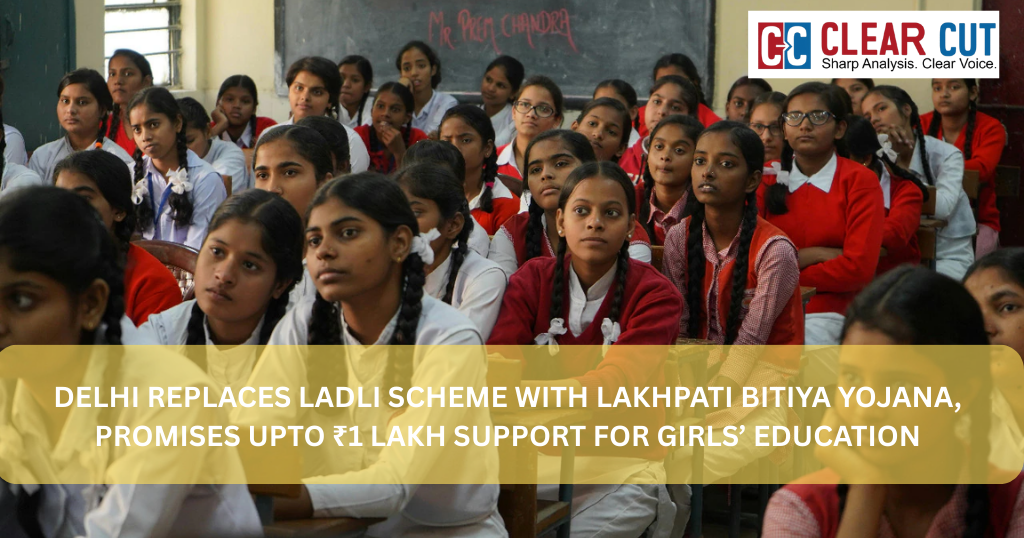
Delhi government will launch the Lakhpati Bitiya Yojana from April 1, 2026, replacing the Ladli Scheme to provide structured financial support for girls. Eligible beneficiaries can receive up to ₹1 lakh through direct benefit transfers at key education stages, aimed at reducing dropouts among economically weaker sections.
The Delhi government has announced a major policy shift aimed at strengthening financial support for the education of girls. The long-running Ladli Scheme will be replaced by the Lakhpati Bitiya Yojana, a new initiative that promises cumulative financial assistance of up to ₹1 lakh for eligible girls, from birth to higher education. The scheme is scheduled to be implemented from April 1, 2026.
The government says the move is part of a broader effort to reduce school dropouts among girls caused by financial constraints and to ensure continuity in education through key academic stages.
Government’s Intent and Vision
Chief Minister Rekha Gupta described the scheme as a long-term investment in social development. Addressing officials and stakeholders, she said the government wants to remove economic pressure from families when it comes to educating daughters.
“Education should not stop because of lack of money. This scheme ensures that a girl receives structured support at every critical stage of her academic journey,” the Chief Minister said.
She added that empowering girls through education has a direct impact on health, employment, and decision-making within families, which ultimately benefits society at large.
How Lakhpati Bitiya Yojana Works
Under the Lakhpati Bitiya Yojana, financial assistance will be released in multiple stages and deposited directly into an Aadhaar-linked bank account in the name of the girl child. The direct transfers are designed to coincide with important educational milestones.
The proposed structure includes:
- ₹11,000 at the time of birth
- ₹5,000 on admission to Class 1
- ₹5,000 each at Classes 6, 9, 10 and 12
- ₹20,000 after completing graduation or an approved diploma course
While the direct payout totals ₹56,000, officials explained that interest accumulated over the years is expected to raise the final amount close to ₹1 lakh by the time the beneficiary reaches adulthood or completes higher education.

Eligibility Conditions
The scheme targets families from economically weaker sections. To qualify, the girl must be born in Delhi, and her family should have resided in the city for a minimum of three years. Annual household income must not exceed ₹1.20 lakh. The benefit will be limited to two daughters per family.
Officials said the eligibility rules are designed to ensure focused delivery and to prevent misuse, while still covering a large number of vulnerable households.
Why the Ladli Scheme Was Replaced
The Ladli Scheme, launched in 2008, played an important role in encouraging enrolment of girls in schools. However, government reviews found that a significant number of beneficiaries were unable to access maturity benefits due to documentation issues, delayed processing, and lack of awareness.
Senior officials said the new scheme addresses these gaps through a simplified, technology-driven system. Automatic tracking, digital verification, and direct transfers are expected to reduce delays and ensure timely payments.
“The objective is not just to announce benefits, but to make sure they actually reach the girl child,” a senior official from the education department said.
Institutional and Policy Support
The National Commission for Protection of Child Rights welcomed the announcement, calling it a step aligned with the constitutional mandate to protect and promote the rights of children. In an official statement, the commission stressed that financial support linked to education can help address dropout rates, especially at the secondary level.
Policy experts have also pointed to successful models in other states. Conditional cash transfer schemes focused on girls’ education have been associated with improved attendance, delayed early marriage, and higher transition rates to higher education.
Views From the Education Sector
Education professionals have underlined that financial support must be complemented by quality schooling. A senior academic associated with a government education advisory panel noted that incentives help families stay committed to schooling, particularly during financially stressful years.
“Support at transition points like secondary school and college admission is crucial. That is where many girls are forced to drop out,” the academic said.
Child welfare organisations also highlighted the importance of awareness campaigns so families understand how and when to claim benefits.
Implementation Roadmap
The Delhi government plans to launch a dedicated online portal before the scheme comes into force. Registration will be permitted at birth as well as at defined academic stages, including primary school admission, secondary classes, and entry into higher education.
Authorities have also stated that pending benefits under the Ladli Scheme will be cleared separately to ensure that existing beneficiaries are not affected by the transition.
With the Lakhpati Bitiya Yojana, the Delhi government aims to move from one-time assistance to sustained educational support. If implemented effectively, the scheme could significantly strengthen girls’ access to education and serve as a model for other states seeking long-term, outcome-focused welfare policies.
Clear Cut Education, Child Protection Desk
New Delhi, UPDATED: Feb 11, 2026 08:10 IST
Written By: Ayushman Meena