

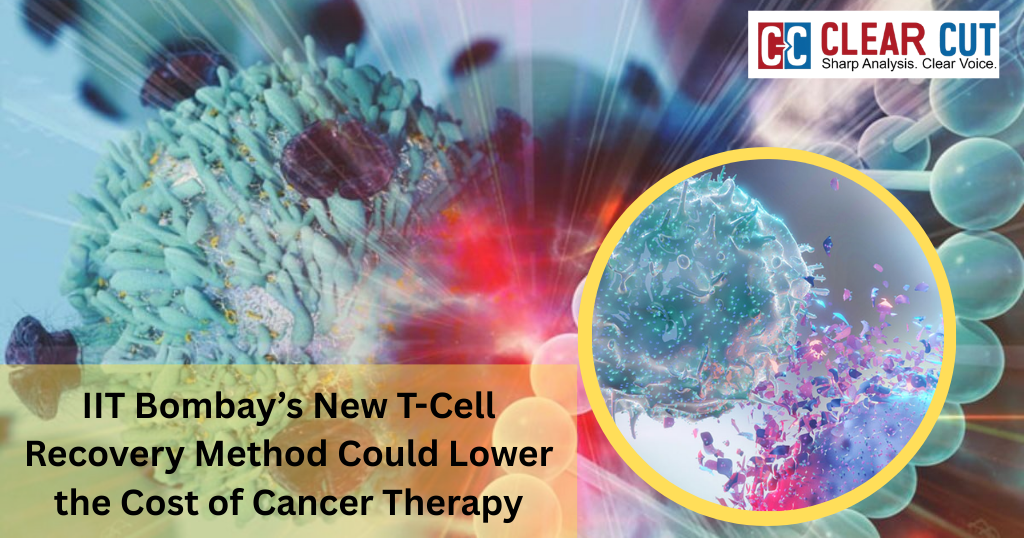
Researchers at IIT Bombay have developed a safer T-cell recovery method that improves the quality and survival of immune cells used in CAR T-cell therapy. The innovation reduces damage during cell collection, helping lower the cost of cancer treatment. It enhances safety and scalability, making advanced therapies easier for hospitals and labs to adopt. clThis breakthrough supports affordable cancer care in India and expands access to life-saving treatments.
A recent scientific breakthrough from India has raised hopes of making advanced cancer treatment more affordable and accessible. Researchers at Indian Institute of Technology Bombay have developed a simpler and safer way to recover lab-grown immune cells used in cancer therapy. The method focuses on improving how T-cells are collected after they are grown in the laboratory, a crucial step in treatments such as CAR T-cell therapy.
This development matters because CAR T-cell therapy, though highly effective for certain cancers, remains expensive and technically demanding. By improving one critical step in the process, the IIT Bombay method could reduce costs, improve safety, and widen access to life-saving treatment.
Understanding the Breakthrough in Simple Terms
CAR T-cell therapy works by taking a patient’s own immune cells, modifying them in a lab so they can better recognise cancer, and then infusing them back into the body. Before these modified cells can be given to patients, scientists must recover them from laboratory culture systems.
Until now, this recovery process relied on harsh chemical or mechanical techniques that could damage the cells or reduce their effectiveness. The IIT Bombay team developed a gentler method that allows T-cells to be retrieved more efficiently without harming them.
In simple words, the scientists found a way to “lift” these immune cells from lab surfaces without stressing or killing them, keeping the cells healthier for treatment.
Why T-Cell Recovery Is a Big Deal
T-cells are living, delicate units. Their strength lies in their ability to survive, multiply, and attack cancer once reintroduced into the patient’s body. When recovery methods damage them, fewer effective cells reach the patient, reducing treatment success.
The new approach improves both cell yield and cell quality. This means more viable T-cells can be prepared from the same sample. According to researchers involved in the project, this could directly improve patient outcomes while also lowering the need for repeated lab procedures.
For hospitals and biotech firms, this improvement can translate into lower production costs and fewer failed batches.
How the New Method Works
Traditional recovery methods often use enzymes or scraping techniques to detach cells from culture plates. These approaches can disrupt cell membranes and weaken immune responses.
The IIT Bombay method uses a specially designed surface and recovery process that allows cells to detach naturally under controlled conditions. This reduces physical and chemical stress on the cells.
Scientists explained that the process maintains the functional integrity of T-cells, meaning the cells remain active and capable of targeting cancer cells after reinfusion.
Implications for CAR T-Cell Therapy in India
CAR T-cell therapy has already shown success in treating certain blood cancers such as leukemia and lymphoma. In India, a few hospitals have begun offering this therapy, but costs remain high, often running into several lakhs of rupees.
By simplifying cell recovery, the IIT Bombay innovation could lower manufacturing costs. This is especially important in India, where affordability determines access for most patients.
Health researchers say that reducing even one step in the complex CAR T-cell pipeline can make a meaningful difference. When combined with local manufacturing and public-sector support, this method could help bring advanced cancer care closer to middle- and lower-income patients.
Safety and Scalability Advantages
Another key benefit of the new method is safety. Gentler recovery reduces the risk of contamination and cell damage, which are major concerns in cell-based therapies.
Scalability is also important. As demand for CAR T-cell therapy grows, labs need methods that can work consistently at larger volumes. The IIT Bombay technique is designed to integrate into existing lab workflows, making it easier for research hospitals and biotech startups to adopt.
Experts in biomedical engineering point out that such process-level innovations often determine whether a therapy can move from research labs to real-world healthcare systems.
A Step Toward Democratizing Cancer Care
The social impact of this innovation goes beyond science. Cancer care in India often reflects deep inequalities. Advanced therapies remain concentrated in elite urban hospitals, leaving many patients without options.
By reducing complexity and cost, this method supports the broader goal of democratising access to cutting-edge healthcare. It also aligns with India’s push to strengthen domestic biomedical research and reduce dependence on imported technologies.
Public health experts argue that innovations like this are essential if India wants to address rising cancer rates without overwhelming families financially.
Positioning India in Global Biomedical Research
The development also highlights India’s growing role in advanced biomedical research. Instead of only adopting global technologies, Indian institutions are now contributing original solutions to global health challenges.
Researchers involved in the project noted that the method could be adapted for other immune-cell-based therapies beyond cancer, opening new avenues for regenerative medicine and immunotherapy.
This strengthens India’s position as both a healthcare provider and a knowledge producer in the global medical ecosystem.
What Comes Next
The next step involves testing the method in collaboration with clinical partners and biotech firms. Regulatory approvals and clinical validation will determine how quickly the innovation reaches patients.
Scientists remain cautious but optimistic. They stress that while this method does not cure cancer by itself, it removes a key bottleneck in delivering effective treatment.
Key Highlights
- IIT Bombay developed a gentler method to recover lab-grown T-cells
- The technique improves cell quality and survival
- It can reduce the cost of CAR T-cell cancer therapy
- The method enhances safety and scalability
- It supports wider access to advanced cancer care in India
A Small Change With Big Potential
The IIT Bombay T-cell recovery method shows how incremental scientific improvements can have far-reaching social impact. By focusing on affordability, safety, and accessibility, the innovation bridges the gap between laboratory science and real-world healthcare needs.
As cancer cases rise and treatment costs climb, such solutions remind us that progress does not always come from dramatic discoveries. Sometimes, it comes from making existing therapies work better for more people.
Clear Cut Health, Research Desk
New Delhi, UPDATED: Feb 07, 2026 01:30 IST
Written By: Samiksha Shambharkar