
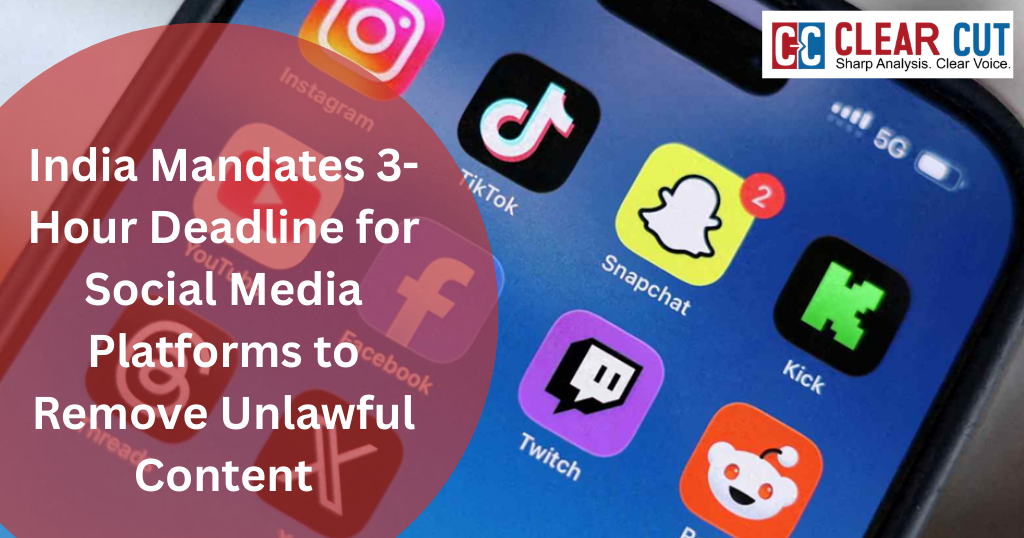
India mandates major social media platforms like Meta, X, and YouTube to remove unlawful content within 3 hours of official orders to curb misinformation, hate speech, and threats to public order.
India has introduced a strict new rule requiring social media companies to remove unlawful content within three hours of receiving official orders. The move significantly reduces the earlier compliance window and signals a tougher regulatory stance on digital platforms operating in the country.
The directive applies to major intermediaries such as Meta, X, YouTube, and other large platforms that host user-generated content. Government officials have stated that the measure aims to prevent the rapid spread of harmful, illegal, or destabilising material online.

What the New Rule Means
In straightforward terms, the government has shortened the time that social media companies get to act when authorities flag illegal content. Earlier, platforms had up to 36 hours to comply with takedown requests under the Information Technology (Intermediary Guidelines and Digital Media Ethics Code) Rules, 2021.
Now, certain categories of unlawful content must be removed within just three hours after receiving a valid order from authorised agencies. According to government clarifications, the three-hour rule has been issued as an executive compliance directive under the existing IT Rules framework and is binding on significant social media intermediaries once formally notified through official communication channels.
Officials from the Ministry of Electronics and Information Technology (MeitY) clarified that this accelerated timeline primarily applies to sensitive cases that may threaten public order, national security, or individual safety. These categories include content related to terrorism, incitement to violence, threats to sovereignty and integrity of India, child sexual abuse material, and misinformation capable of triggering panic or communal unrest. The government argues that harmful content can spread widely within minutes, making rapid intervention necessary.
Legal and Regulatory Framework Behind the Move
The directive builds upon the Information Technology Act, 2000, and the 2021 IT Rules. Under these rules, social media intermediaries must appoint grievance officers, comply with takedown requests, and assist law enforcement when required.
Sources familiar with government briefings indicated that the updated compliance requirement aligns with Section 69A of the IT Act, which empowers the Central Government to direct blocking of public access to information through a prescribed procedure when it is necessary in the interest of sovereignty and integrity of India, defence of India, security of the State, friendly relations with foreign States, or public order, or for preventing incitement to the commission of any cognisable offence.
Officials have emphasised that orders will continue to be issued through authorised government channels. Platforms are expected to respond immediately upon receipt.
The change also follows rising concerns over misinformation, deepfakes, hate speech, and content that could trigger violence or panic.
Government’s Rationale: Speed in the Digital Age
Senior government officials have stated that viral misinformation can escalate into real-world harm within hours. During recent public briefings, digital governance representatives pointed to instances where manipulated videos and inflammatory posts circulated widely before being taken down.
Authorities argue that a three-hour deadline strengthens preventive governance. By reducing the response window, they aim to limit damage before harmful narratives gain momentum.
Officials also framed the move as part of India’s broader push for digital accountability. India has over 800 million internet users, making it one of the largest digital markets globally. The government maintains that platforms operating at this scale must act responsibly and swiftly.
Concerns from Tech Companies and Civil Liberties Groups
While the government presents the rule as a public safety measure, critics have raised concerns about its implications for freedom of expression and operational feasibility.
Technology policy experts have pointed out that determining whether content is unlawful often requires contextual analysis. A three-hour deadline may pressure platforms to remove content pre-emptively to avoid penalties.
Civil liberties advocates argue that rapid takedown requirements could increase the risk of over-censorship. They stress the need for transparency in issuing removal orders and for clear documentation of the legal basis for each directive.
Digital rights researchers have also highlighted that small or emerging platforms may struggle to maintain 24/7 compliance infrastructure, unlike global tech giants with extensive moderation teams.
Compliance and Penalties
Under existing IT Rules, non-compliance can lead to the loss of intermediary safe harbour protections. This means platforms could become directly liable for user-generated content if they fail to act on lawful orders.
Legal analysts note that losing safe harbour status can expose companies to criminal prosecution or civil liability under Indian law.
Officials have indicated that the government will monitor compliance closely. Platforms are expected to strengthen internal processes to ensure round-the-clock responsiveness.
Social Impact and Public Debate
The new rule reflects a broader tension between digital freedom and digital responsibility. On one side, citizens demand protection from online harassment, hate speech, and misinformation. On the other side, activists warn against excessive state control over speech.
India has experienced several instances where online rumours have contributed to communal tensions or public unrest. Authorities argue that fast takedown mechanisms can prevent escalation.
However, public trust depends on transparency. Experts recommend publishing periodic transparency reports detailing the number of takedown orders issued, categories of content targeted, and compliance rates.
Global Context
India’s decision comes at a time when governments worldwide are tightening digital regulations. The European Union enforces strict timelines under the Digital Services Act. Countries such as Australia and Germany also impose rapid removal requirements for harmful content.
By introducing a three-hour compliance window, India positions itself among jurisdictions adopting assertive regulatory models.
At the same time, global tech companies must navigate varied national standards. Industry representatives argue that harmonised frameworks would reduce compliance complexity across regions.
Key Highlights
• Social media platforms must remove specified unlawful content within three hours of receiving official orders.
• The rule builds on the IT Act, 2000, and the 2021 Intermediary Guidelines.
• Authorities cite national security, public order, and misinformation risks as key reasons.
• Non-compliance may result in loss of safe harbour protections.
• Civil liberties groups urge safeguards against misuse and over-censorship.
A New Phase in Digital Governance
The three-hour takedown mandate marks a decisive shift in India’s digital governance strategy. It reflects the government’s intent to prioritise rapid intervention over extended review processes in sensitive cases.
The rule places greater responsibility on social media platforms to act swiftly and decisively. At the same time, it raises important questions about transparency, accountability, and the balance between regulation and free expression.
As India continues to expand its digital footprint, the effectiveness of this policy will depend not only on enforcement but also on fairness, clarity, and public trust.
Clear Cut Education, Research Desk
New Delhi, UPDATED: Feb 17, 2026 09:00 IST
Written By: Samiksha Shambharkar