

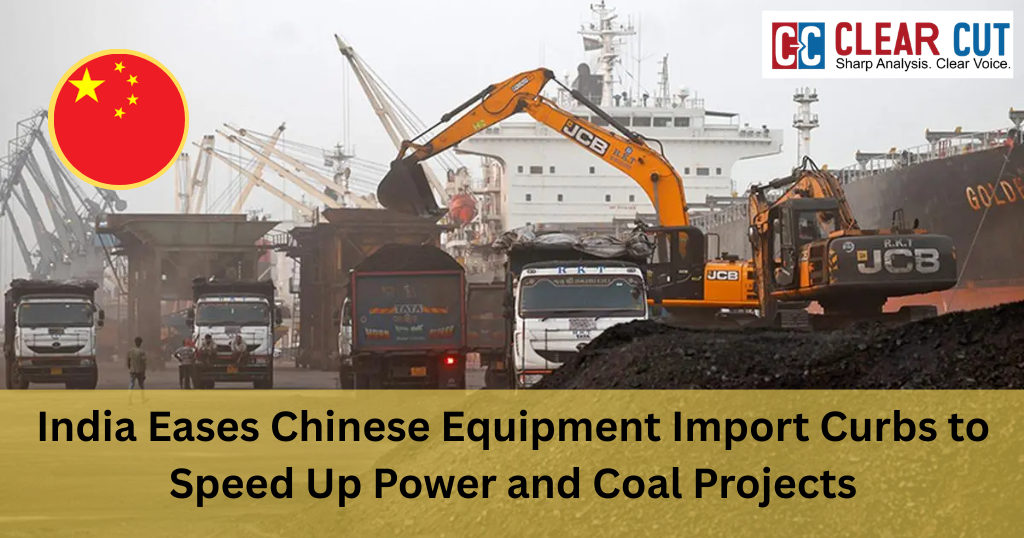
India has moved to relax key restrictions on Chinese equipment imports for its power and coal sectors. The decision comes after years of delays and rising shortages that have hampered infrastructure plans, according to government sources and industry figures.
The policy shift marks the first major rollback of trade curbs introduced after a 2020 border clash with China. The earlier restrictions required Chinese bidders to secure political and security clearances before competing for Indian state contracts.
Delays and Shortages Mount Pressure
Officials say the new measures aim to ease supply bottlenecks. State-run power and coal companies can now procure specific Chinese-made components without prior government approval. A formal government order is expected soon.
One senior government official involved in the discussions told Reuters the decision was driven by immediate infrastructure needs. “We face real shortages,” the official said. “Critical projects cannot wait.”
India plans to add 500 GW of non-fossil energy capacity by 2030 but has struggled to expand transmission and coal handling networks because of equipment delays, officials said. They reported a roughly 40 % shortfall in essential power transformer components over the next three years.
Government and Industry Reactions
In Delhi this week, Union Power Minister R. K. Singh addressed reporters. “Our power targets must stay on track. We are adjusting policy to fix bottlenecks,” he said, highlighting execution hurdles in both renewable and conventional energy builds.
Energy sector bodies also weighed in. Suresh Prabhu, chair of a major coal and electricity producers’ association, told a business forum that domestic manufacturing capacity remains constrained. “We simply need more sources,” he said.
Ashok Gupta, a senior analyst at a New Delhi energy policy think tank, said the move was necessary to prevent cost spirals. “Relying solely on domestic output for specialised transformers and switchgear has pushed costs higher and slowed delivery,” he told a television broadcast. (Energy policy interview)
Private developers, who have repeatedly urged policy change, welcomed the decision. “Without limited imports, timelines slip and tariff burdens rise for consumers,” a private power company executive said at a sector workshop last month.
Security and Self-Reliance Concerns
The cautious reopening keeps in place core national security safeguards. India’s Atmanirbhar Bharat (self-reliant India) strategy has sought to develop domestic manufacturing, especially in critical infrastructure. However, that policy has faced challenges due to supply constraints and higher costs.

Former commerce secretary Anand Sharma said India cannot let geopolitical caution stall development. “We cannot let geopolitical caution stall development,” he told reporters at a policy forum. “Energy security is itself a national security issue.”
Diplomatic Signals and Global Context
The shift comes amid cautious signs of stabilising ties between India and China. External Affairs Minister S. Jaishankar told diplomats at a briefing that India would balance commerce with security. “We welcome commerce but not at the cost of sovereignty,” he said.
Meanwhile, global trade analysts said India’s move reflects broader trends of selective engagement amid changing supply chains. Global trade expert Meera Nair said, “No large economy can fully decouple from global supply chains. India is adjusting its stance while protecting key industries.”

What’s Next? Targeted Easing and Monitoring
Officials emphasise that the relaxation is limited and targeted. Final measures will likely include strict criteria for case-by-case approvals and safeguards to protect domestic suppliers against being undercut by low-cost imports.
The government will also set performance reviews at scheduled intervals. A senior official noted that if domestic production ramps up sufficiently, exemptions will be scaled back. “We will monitor results and adjust,” the official said.
Energy ministry planning documents show that future exemptions could be tied to local value-addition requirements, meaning imported equipment must be bundled with technology transfer or partnerships with Indian manufacturers.
Coal and power sector regulators said they would issue updated procurement guidelines to implement the new policy within weeks. They called for transparency, competitive bids, and safeguards to prevent unfair practices.
Some members of parliament have called for clear sunset clauses on exemptions to ensure the long-term self-reliance goal is not diluted.
Final Summary: The Policy Dilemma
India’s decision reflects a stark policy dilemma. On one hand, New Delhi wants to build robust and modern energy infrastructure quickly. Equipment shortages and project delays are slowing progress toward national goals. On the other hand, India remains determined to protect national security and nurture local industry under its self-reliance agenda. The calibrated easing attempts to balance these competing imperatives. Around limited exemptions, India seeks both faster delivery of critical infrastructure and reassurance that foreign engagement does not compromise its strategic autonomy.
Clear Cut Climate, Research Desk
New Delhi, UPDATED: Feb 26, 2026 05:25 IST
Written By: Ayushman Meena