

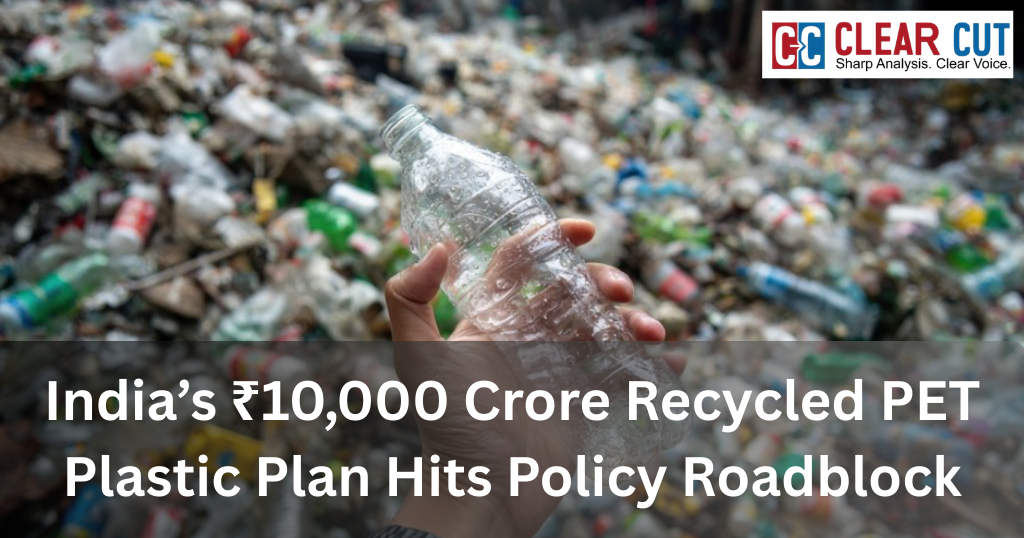
India’s ₹10,000 crore recycled PET (r-PET) plan has hit a policy delay, creating uncertainty that is slowing investments and industry growth. Without clear enforcement of the recycled content mandate, India’s circular economy and plastic waste reduction goals risk losing momentum.
India’s effort to transform plastic waste into a ₹10,000 crore circular economy opportunity has run into a policy challenge that threatens investments and sector growth. The plan centres on encouraging the use of recycled polyethylene terephthalate (r-PET) — a recycled form of PET plastic used in beverage bottles — by making it mandatory in packaging. However, delays and uncertainty in finalising the supporting regulations have slowed industry uptake and created confusion among recyclers and beverage companies alike.
The Policy Goal: Recycled Content in PET Bottles
The Indian government had drafted rules in 2022 that would require beverage-grade plastic bottles to contain at least 30% recycled content in PET bottles. policy was intended to apply from April 2025, giving industry several years to adjust production, supply, and recycling capacity. It aimed to turn an estimated 9.5–12 lakh tonnes per year of PET bottle demand into a dependable market for recycled plastic, while reducing landfill waste and promoting waste collection. (The Better India)
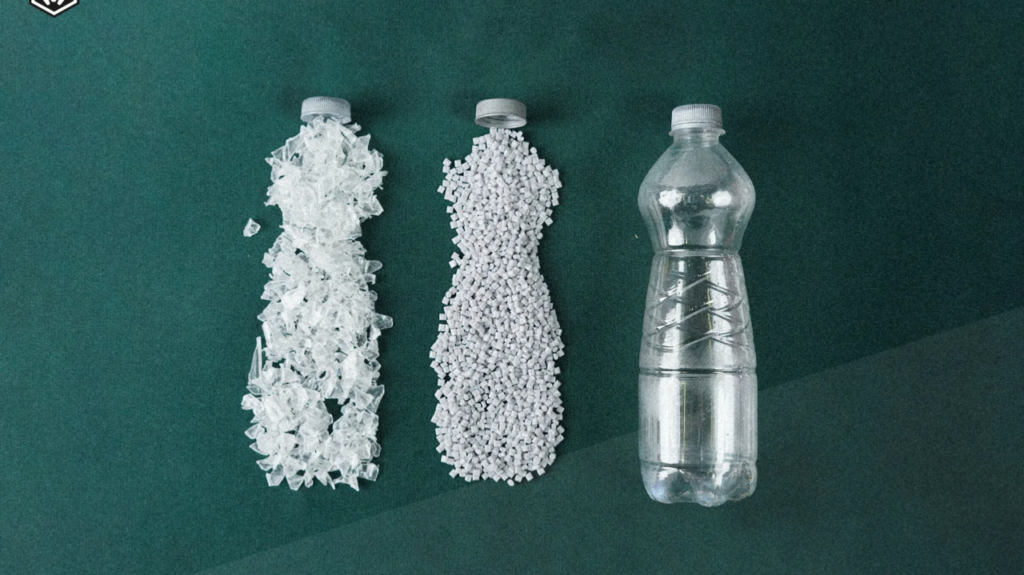
The Food Safety and Standards Authority of India (FSSAI) has already approved about 3.5 lakh tonnes of food-grade r-PET capacity, roughly covering the 30 per cent requirement for PET bottles. This suggests the technical capacity exists to meet the intended mandate, according to industry estimates.
How the Policy Roadblock Emerged
Despite this preparation, the final regulation has been delayed. In June 2025, the environment ministry released a draft notification that could dilute the mandate’s immediacy, allowing companies to carry forward shortfalls in r-PET use over a three-year period. This proposed shift weakened the immediacy of compliance and dampened demand for r-PET, as manufacturers decided to delay purchases of recycled plastic until enforcement became clearer.
This uncertainty has had a ripple effect. Companies were investing in advanced recycling infrastructure based on the original policy’s timelines. Now, with enforcement potentially relaxed, demand for r-PET has stalled. Industry representatives report that capacity utilisation has fallen to around 1 lakh tonnes per year, far below available capacity, which undermines business prospects for recyclers.
Industry Investments at Risk
The transition towards r-PET was expected to attract large capital flows. Goutham Jain, Director-General of Association of PET Recyclers-Bharat (APR Bharat), said the sector had collectively invested more than ₹10,000 crore in setting up advanced recycling facilities, many equipped with internationally accredited technologies. He noted that policy uncertainty has “paralysed the entire r-PET ecosystem”, leaving investors unsure whether mandates will be enforced as originally planned.
Recyclers argue that these facilities comply with stringent food-contact standards — including those recognised by European and U.S. regulators — and that they were built in response to clear government mandates. With enforcement delayed, many plants lie underutilised, and future expansion plans have stalled.
Economic and Environmental Stakes
PET plastic is widely used in beverage packaging worldwide. In India, PET consumption is estimated at 12–14 lakh tonnes annually, excluding sectors like pharmaceuticals and packaging sheets. Of this, around 9.5–12 lakh tonnes could be available for r-PET usage under the mandate.
Beyond raw numbers, policy clarity affects environmental goals. Recycled PET reduces carbon emissions and energy use compared with virgin plastic. Industry experts point out that shifting to r-PET can reduce energy consumption, conserve resources, and cut landfill waste — core goals of circular economy strategies.
However, without a firm regulatory push, investments may dry up, which has broader implications. According to recyclers, the r-PET value chain employs millions of workers in collection, sorting, and processing — much of this labour coming from marginalised communities tied to informal waste management networks. Delayed demand risks undermining their livelihoods.
Corporate and Consumer Reactions
Beverage brands — including PepsiCo, Coca-Cola, and Bisleri — are key consumers of r-PET. Industry discussions reported in earlier years show that these companies have expressed concerns about capacity constraints and costs associated with r-PET compliance, even as they remain crucial partners in scaling recycled material usage.
With policy certainty lacking, companies may postpone commitments to recycled plastic procurement, opting instead to wait until enforcement details are finalised. This hesitancy slows momentum across the entire recycling ecosystem.
Consumer expectations also play a role. As public awareness of sustainability grows, demand for environmentally responsible packaging — including r-PET bottles — rises, particularly among younger and eco-conscious buyers. Clear policies can help align corporate strategy with consumer demand.
Policy Clarity is Key to Circular Growth
The r-PET policy roadblock highlights the delicate balance between government mandates, industry planning, and environmental outcomes. Experts argue that a transparent, enforceable regulatory timeline — rather than prolonged uncertainty — is essential to sustain private investment and scale up circular economy practices.
Without firm direction, the billions of rupees already invested in recycling infrastructure risk being underutilised or abandoned, weakening India’s ability to turn waste into economic value and threatening commitments to sustainable growth.
Conclusion
India’s ambitious plan to create a ₹10,000 crore recycled PET ecosystem hinged on mandatory use of recycled plastic in packaging. Initial policy drafts and industry investments indicated readiness to move toward a circular economy. Yet, delays and possible relaxations in enforcing the r-PET content mandate have stalled demand and left investors and recyclers in limbo. Clarity, credibility, and consistent enforcement of environmental policy will be essential to enable both economic returns and meaningful reductions in plastic waste. Only with a clear regulatory roadmap can India realise both its environmental goals and the economic potential of its recycling sector.
Clear Cut CSR, Climate, Livelihood Desk
New Delhi, UPDATED: Feb 24, 2026 01:00 IST
Written By: Samiksha Shambharkar