
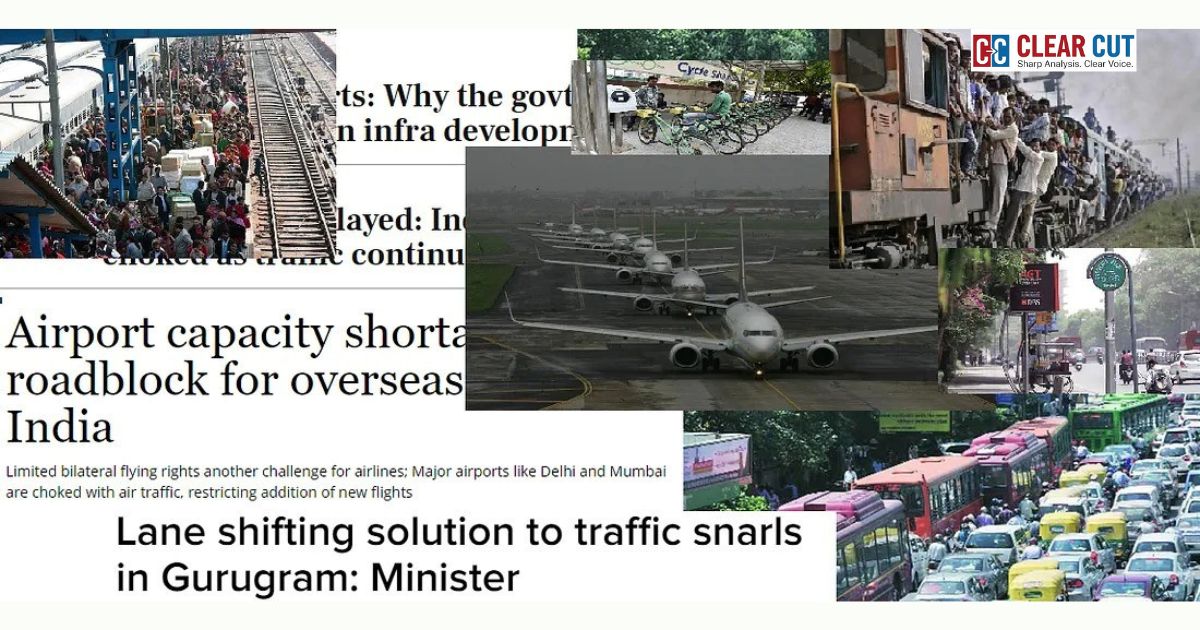
Over the past seven months, India’s transportation system has seen extraordinary strain. The nation has experienced two significant interruptions that highlighted the vulnerability of its transportation systems. The enormous rush on trains headed for Bihar during Chhath Puja and the Bihar elections to the grounding of Indigo aircraft due to regulatory non-compliance. Even if these occurrences are not interconnected, they both point to broader structural problems in India’s transportation system. These include the effects of monopolies, limited public investment and imbalances between supply and demand. These crisis cause travel delays and also alter the welfare system. They also disproportionately impact the middle class and impoverished.
Overcrowded Trains and a Failing Public Transport Supply
The Indian Railways experienced an extraordinary spike in demand in October and November. Thousands of migrants returned home for the elections and holiday season. Unreserved compartments became dangerously packed due to fixed tariffs and a restricted number of trains. Squeezed onto coaches well above their intended capacity, passengers were observed traveling in dangerous and unfriendly conditions. This situation is a classic demand shock from an economic standpoint. Prices would increase in a free market until supply and demand were equal. However, public services like rail travel cannot function only on the basis of profit. Mobility, affordability and social welfare all depend on low fares. But the lack of sufficient investment is the true problem, not the low prices.
The supply problem
As per the critics, artificially low fares result in inefficiency. However, inadequate railway capacity increase is the true cause of the failure. The state must invest in increasing regularity, safety and accessibility while maintaining the affordability of key services. However, under a neo-liberal economic framework, India’s capacity to develop public infrastructure is constrained by:
- Limits on the fiscal deficit
- pressure to cut back on government expenditures
- unwillingness to tax wealthy individuals
- reliance on private funding for expansion
Thomas Poketty observes, even a small tax on the top 1% might greatly improve public transportation infrastructure. However, domestic and international capital oppose such policies. It traps India in a cycle of underfunded public infrastructure and deteriorating service quality. Hundreds of Indigo flights were grounded due to regulatory non-compliance in December. This happened within weeks after the railway bottleneck. This abrupt reduction in supply resulted in severe cancellation of flights, rising ticket costs and market disruption. The effects of this typical supply shock were made worse by Indigo’s almost monopolistic position in the Indian aviation industry. Shortages from one carrier wouldn’t raise prices for the entire industry in a truly competitive market. However, the aviation industry in India has grown more concentrated, making consumers at risk.
Deregulation without competition
Policymakers contend that efficiency results from the involvement of the private sector. However, in the absence of robust competition rules, deregulation frequently leads to market concentration rather than consumer gain. Evidence from around the world supports this. Because private companies transferred supply-chain disruptions directly to consumers. Further, monopoly pricing power contributed to US inflation during Joe Biden’s presidency. This pattern is reflected in India, where public welfare is diminished by flexible prices in an uncompetitive market.
The Bigger Picture: Neo-liberal Constraints and the Decline of Public Welfare
The tensions of India’s neo-liberal economic paradigm are seen in both the Indigo problem and the overcrowding on trains. First, financial limitations and pressure, the state is deterred from increasing public transportation. Second, the lack of checks on private businesses, near-monopolies are able to set pricing during interruptions. Third, customers have little real choice except to deal with congested public services and expensive private alternatives. Fourth, Welfare decreases and vital mobility becomes erratic, unpredictable, and uneven under such a system.
The Larger Crisis: Neo-liberalism, Monopolies, and the Erosion of Public Welfare
Despite their apparent differences, the disruptions in aviation and railroads are caused by the same economic foundation. A neo-liberal paradigm encourages deregulation and the dominance of the private sector while limiting the state’s capacity to invest in public infrastructure. As a result, there are two crises: strong private monopolies on the one hand, and inadequate public services on the other. The government struggles with excessive demand while maintaining low pricing since it cannot increase services without going against fiscal norms. Deregulated private markets, on the other hand, consolidate power and allow businesses to sharply increase prices in the event of disruptions. Both results lower public welfare, either by providing services that are too expensive or by creating dangerous overcrowding.
Implications for India’s Future
The foundation of social inclusion and economic mobility in India is the country’s transportation network. The urban poor, rural households, and migrant laborers are all impacted when railways fail. Business travel, logistics, and time-sensitive mobility are all impacted when aviation fails. When taken as a whole, these crises point to a bigger structural problem: an economic system that puts market efficiency ahead of citizens’ daily needs. Similar disruptions will continue to harm commuters unless India tackles the twin issues of growing corporate monopolies and underinvestment in public transport. To protect public welfare, a recalibrated strategy is required, which includes raising public spending, controlling private domination, and ensuring equal mobility.
Clear Cut Research Desk
New Delhi, UPDATED: Dec 11, 2025 03:00 IST
Written By: Nidhi Chandrikapure