
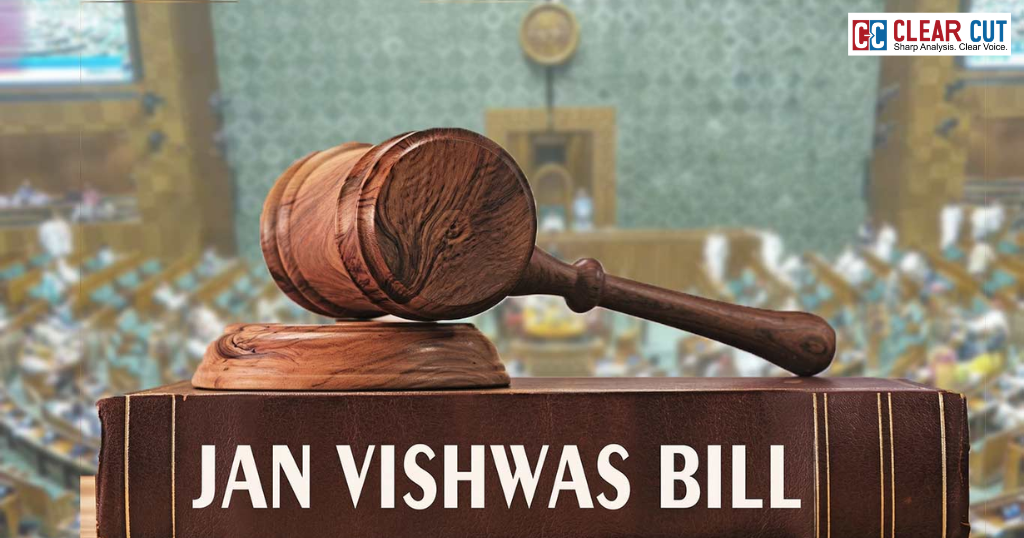
India’s Jan Vishwas Bill 2026 decriminalises minor offences, replacing jail terms with monetary penalties to reduce compliance burden. It promotes trust-based governance and boosts ease of doing business, especially for MSMEs.
A Law That Respects the Citizen
India’s legal framework carried the weight of a colonial-era thinking for decades. The assumption was simple, and it was unfortunately unkind. The ordinary citizen is a suspect until proven otherwise. A shopkeeper who filed a form late could face criminal charges. A small business owner, who missed a labelling requirement could be imprisoned. The law did not distinguish between genuine wrongdoing and honest mistakes. It simply punished.
That is now changing.
On April 2, 2026, Parliament passed the Jan Vishwas (Amendment of Provisions) Bill, 2026. A force of legislation that signals a fundamental shift in how the Indian state relates to its people. Prime Minister Narendra Modi called it a “significant step towards strengthening a trust-based governance framework that empowers citizens.” The words matter. Trust, not suspicion, is now the stated starting point.
What the Bill Actually Does
The Bill amends 784 provisions across 79 Central Acts administered by 23 Ministries. Out of these, 717 provisions are being decriminalised to foster ease of doing business, and 67 provisions are being amended to ease ease of living.
In plain terms, for 717 offences, jail terms are replaced by monetary penalties and administrative actions. Minor technical lapses such as late filings, documentation errors, or procedural delays, no longer carry the stigma or risk of a criminal record.
The Bill also introduces a three-step model: a warning, a correction period, and then a financial penalty. It gives the citizens and businesses a fair chance to fix honest mistakes. This is not leniency. It is proportionality. It is what a fair system looks like.
It was passed by the voice vote in the Rajya Sabha after the Lok Sabha cleared it on April 1. The bill covers laws administered across sectors including coal, commerce and industry, shipping, urban development, and transport.
The Human Cost of Outdated Rules
To understand why this Bill matters, consider what the older system meant for real people.
A person could face imprisonment for not displaying a trade licence correctly under current laws for the time being in force, for minor violations under the Apprentices Act, 1961, or for using non-standard weights and measures even inadvertently. These were not crimes. They were paperwork problems. Yet the legal system treated them with the same machinery it reserves for serious offences such as police complaints, court dates, bail, and the permanent shadow of a criminal record.
Commerce Minister Piyush Goyal described this as a “colonial mindset where punishment prevailed over fairness,” and noted that the reform covers 6 laws dating back to the pre-independence era.
The burden was felt more sharply at the bottom. For a daily wage worker, a small trader, or a first-generation entrepreneur, a criminal charge is not an inconvenience. It is a catastrophe.
Relief for MSMEs and Small Businesses
Small businesses and individuals stand to gain the most. Replacing imprisonment with fines for minor, technical, or procedural violations, particularly relieves them from disproportionate legal risk.
Commerce Minister Goyal called it “a significant milestone in our journey towards Viksit Bharat 2047”. This adds and supports to the notion “With one single law, we have decriminalised, simplified and made compliance less burdensome for the common man, MSMEs, entrepreneurs, startups and businesses.”
India has over 63 million MSMEs, contributing 30% of the country’s GDP and providing employment to hundreds of millions. For these enterprises, regulatory compliance is not just a legal matter. It shapes whether a business survives. Removing the spectre of criminal liability for minor lapses clears genuine space for growth.
Built Through Consultation, Not Imposition
What is equally notable is how this Bill came to be.
The 2026 Bill replaced the Jan Vishwas Bill of 2025, which initially covered only 17 Central Acts. A Select Committee, chaired by Mr. Tejasvi Surya reviewed the legislation across 49 sittings. The committee gave gave its report in March 2026 and recommended expanding the scope to cover 65 added Acts.
The result was a bill that is more comprehensive, more consultative, and more grounded in the lived reality of those it affects. PM Modi specifically acknowledged this approach, saying that the consultative process reflected a genuine commitment to hearing from those who understand the problem firsthand.
This is the kind of lawmaking that builds institutional credibility. When citizens see that their concerns were part of the process, not an afterthought.
A Line Has Been Crossed
The Jan Vishwas Bill, 2026 rationalises more than 1,000 offences by removing or decriminalising minor legal violations, replacing them with a framework that fosters regulatory trust between the government, citizens, and businesses.
Serious offences stay criminal. Environmental damage, food adulteration, and spurious drugs still carry imprisonment. The Bill is not an amnesty. It is a recalibration, one that says the law should match the severity of the wrong.
India is not the first country to undertake regulatory decriminalisation. But as Minister Goyal noted, the scale of this reform, over 1,000 provisions across 79 Acts addressed in a single piece of legislation, has no clear parallel anywhere in the world.
Conclusion: Trust as Policy
A country’s laws tell you something about how it sees its people. For too long, India’s regulatory code communicated suspicion. A system where a mistake was a crime, where compliance meant fear, and where the machinery of the state loomed over every small transaction and filing.
The Jan Vishwas Bill, 2026 does not solve everything. Implementation will figure out whether the spirit of the law reaches the street-level citizen. But it sends a clear message. The government is choosing to govern through trust rather than threat.
That is not a small thing. For millions of Indians, the shopkeeper, the startup founder, the small manufacturer, it may be the most important policy shift in years.
References
https://prsindia.org/billtrack/the-jan-vishwas-amendment-of-provisions-bill-2026
Clear Cut Livelihood, Research Desk
New Delhi, UPDATED: April 05, 2026 05:00 IST
Written By: Tanmay J Urs