


The Sustainable Development Goals story in India is not a straight line: it’s a patchwork. Some states are sprinting ahead while some states are struggling to keep pace. The SDG India Index 2023-24 shows strong contrasts in terms of goal attainment, showing that real monuments happen when we contextualize global goals and exchange data into action. The SDG score for the country may look impressive, but the nuance of progress lies beneath. The 2023-24 Index illustrates the range of states that are leading, lagging, and the need for local solutions, if India is to meet its global aspirations. Nation numbers tell one story, and local level data tell an entirely different story. The latest SDG India Index does illustrate dramatic differences found throughout the country, and holds as an opportunity and a challenge of making SDGs a local reality.
National Progress & the Localisation Imperative
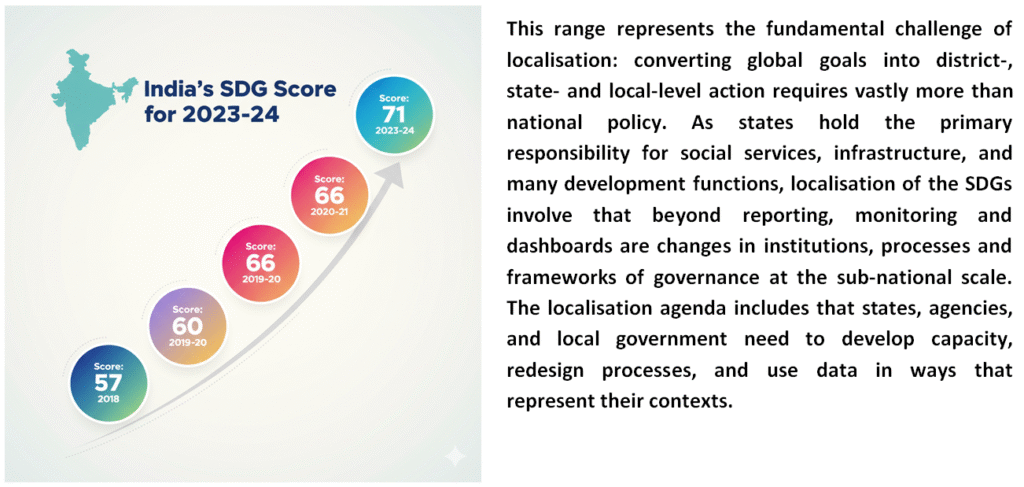
The SDG India Index 2023-24 shows India’s overall composite score has improved to 71 (out of 100) compared to 66 in 2020-21 and 57 in the first 2018 iteration. This demonstrates that at the national level, all indicators suggest a positive direction of travel. However, the range of state-level performance indicates a different story: that in 2023-24, state scores now vary from approximately 57 to 79 (Press Information Bureau).
Leading States: Front-Runner in Localisation
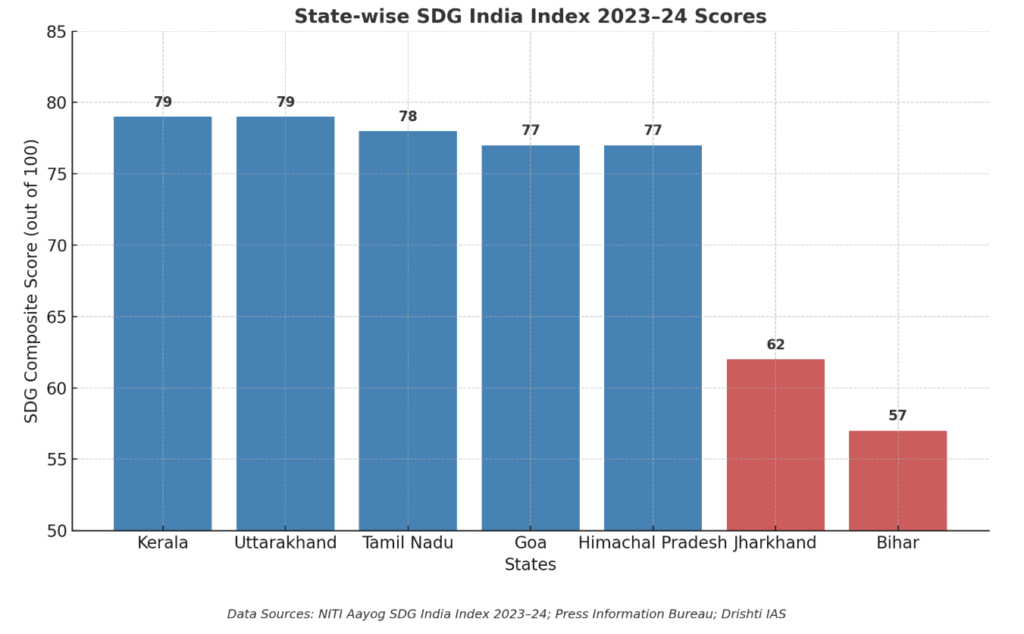
At the top of the scoreboard for 2023-2024 are states like Kerala and Uttarakhand (both scoring 79), followed by Tamil Nadu (78), Goa (77) and Himachal Pradesh (77) (gfst.in). These states show consistently that localisation is “working”: they have taken SDG goals, objectives and targets into state policy, monitoring systems and coordination between departments. For example, Kerala’s ongoing investments in health system, education system and social infrastructure provide a strong platform for monitoring multiple SDG domains at once. Therefore, based on outcome success, a central lesson is that when localisation is part of the state governance structure, outcomes will be improved.
Lagging States: Variation and Governance Gaps
On the other hand, states like Bihar (57) and Jharkhand (62) are still well within the lower bands of the index (Drishti IAS). There are arguments around these differences, particularly with respect to institutional capacity, resource constraints, data gaps and weaker local coordination. Even where national schemes exist to support SDG localisation and transitions to local action, national actions are rarely reflected locally in either a timely or substantial way. For example, a recent study indicates that multiple states still approach SDG localisation as a reporting exercise rather than a process of governance change. Data are generated but they are not always used to direct policy, mobilise actors or shift mindsets.
Sectoral Variation and the its Importance
Variation across goals and indicators, in addition to composite scores, highlights the complexities of localisation. For instance, the SDG India Index indicates that the goals which are characterised as ‘infrastructure driven’ have dramatically improved – the score for SDG 7 (Affordable and Clean Energy) has improved from 51 in 2018 to 96 in 2023-2024, and SDG 6 (Clean Water and Sanitation) improved from 63 to 89 at the same time (Drishti IAS). Several national programmes are central to achieving these goals, with implementation delegated to the state – that is, a similarity across states. Other goals, by contrast, like SDG 5 (Gender Equality) and SDG 10 (Reduced Inequalities), show much slower trajectories – SDG 5 improved from 36 in 2018 to 49 in 2023-2024, for instance (Drishti IAS).
The shift in performance clearly signifies that localisation is not about reproducing programme implementation, but is about contending with localised structural constraints: patriarchal social norms, geography, state fiscal space, and institutional readiness; it possible that a state with a solid social infrastructure will progress more rapidly relative to a state with high inequality, low revenue and weak local institutional frameworks.
Localisation in Practice
Recent governance literature argues successful localisation will require a shift in the way states use the SDGs: from score chasing to system building. For example, a recent study on the SDG India Index methods (Mallick et al, 2024) argued that placing emphasis on scoring may place undue focus on high profile indicators, but countries may also be unwilling to consider difficult governance reforms. Additionally, the Journal of International Economic Review (JIER) Although, in the North-East region of India, a district-level SDG index created specifically for that context shows the way localisation can work when governance structures are situationally appropriate. The North Eastern Region District SDG Index 2023 -2024 showed all districts in Mizoram, Sikkim and Tripura reached the level of “Front Runner”, with the top district (Hnahthial, Mizoram) scoring 81.43 points (UNDP).
Why the State-Level Variation Matters
The variations between states are significant not only for policy implementation but also for the SDGs narrative. To begin with, state variation drives national-level outcomes. Unless states with lower performance catch up, India’s ambition for the SDGs in 2030 may remain insufficient. Second, the extent of differences among states implicates inequities, progress may be made by the states that are faring the best and thus reinforce the poorer or weaker states. Third, the differences among states provide opportunities for learning; what works in one state may require adjustments in another. The localisation framing pivots to context-specific strategies rather than generic responses.
This means policymakers will need to go beyond schematic targets and work with states and districts to engage in localisation plans that are specific to them. States will need to develop diagnostic frameworks as to which SDG domains they are performing the weakest; what governance barriers to implementation exist and which ones they might be able to address; and how they may distribute funding. Many states have yet to integrate SDG tracking into their state budgets, local planning, and departmental accountability frameworks. Those states that have done so are beginning to make faster progress.
Strengthening Localisation
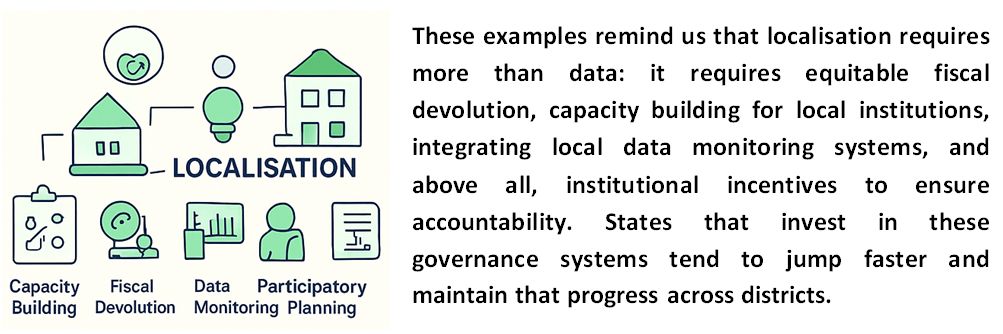
Looking ahead, a number of actions seem critical to accelerate localisation. First, enhanced fiscal devolution to local bodies so that they have the means to act. Second, improve data systems so that they can not only report but also steer policy and have local indicator frameworks that reflect micro-contexts (i.e., informal settlements, tribal areas, peri-urban areas). Third, building local institutional capacity particularly at panchayat and district levels is also vital for transforming plans into implementation. Fourth, we must reform governance: horizontal coordination, participatory planning, and real-time monitoring. The most important thing is for policymakers to shift the mindset from feeling good about how much our scores have increased, to asking how the scores increased and whether they improved lives. States that think it is simply a ranking and use it to try and work their way up will miss the whole localising part.
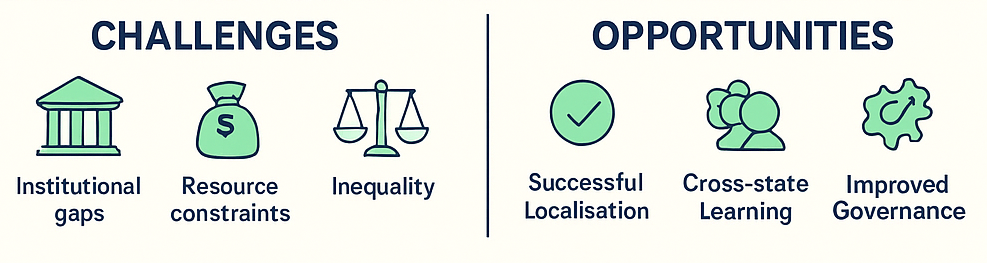
The journey towards the SDGs in India is not one steady upward slope. It is a patchwork of state-and district-level stories shaped by local governance, local capacities, local resources and local context. The upward trend in national averages is positive; the regional states play a role in localising. States that embed the SDGs in local structures, and local budgets and local accountability systems are demonstrating forward movement, states that depend on old structures are at risk of inertia. To realize India’s 2030 ambitions, the localisation of the SDGs needs to be a part of a continuum of state reform that considers each local body, and community, together with each district contextualising the national reform agenda. The evidence shows: localisation works. The challenge is scaling up equally.
Clear Cut Review Desk
New Delhi, UPDATED: Nov 08, 2025 02:30 IST
Written By: Antara Mrinal


Hi there to every one, the contents present at this web page
are actually amazing for people experience, well, keep up the
nice work fellows.
Thank you for your encouraging words.