
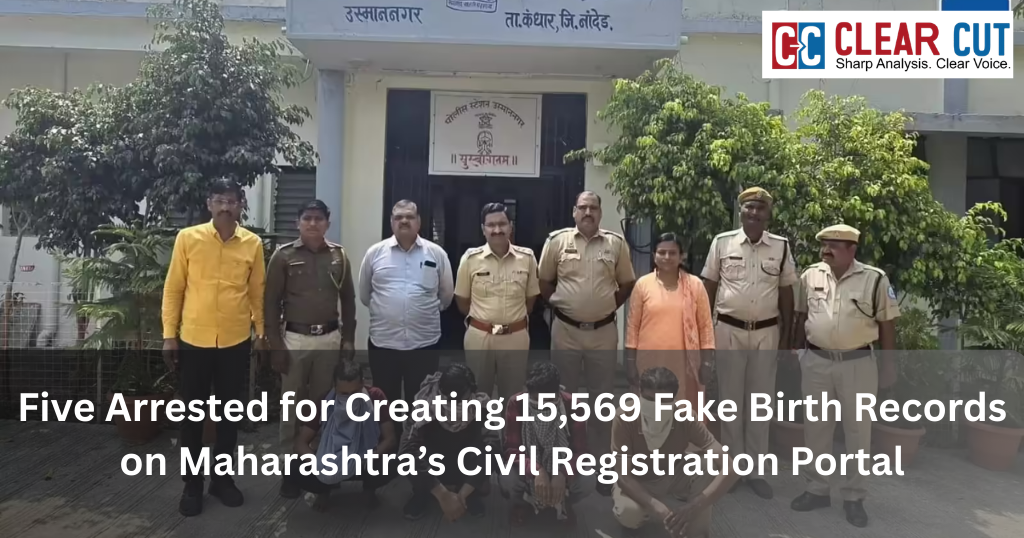
Maharashtra Police arrested five individuals for creating 15,569 fake birth records on the CRS portal. A cyber investigation and security audit are underway.
Police in Maharashtra have arrested five individuals from Jharkhand for allegedly creating 15,569 fake birth records on the state’s Civil Registration System (CRS) portal. In simple terms, the accused are suspected of illegally generating thousands of fraudulent birth certificates using the official government database.
According to senior officers from the Maharashtra Cyber Police and the state’s Registration Department, the forged entries were inserted into the CRS portal, which is used to issue legally valid birth and death certificates. Authorities believe the fraud may have implications for identity verification, government documentation, and potentially national security.

Key Highlights
• Five individuals arrested in connection with fake birth record scam
• 15,569 fraudulent birth entries created on Maharashtra CRS portal
• Case investigated by Maharashtra Cyber Police
• Authorities suspect misuse for identity documentation and benefits
• Portal security audit and technical review underway
How the Fraud Was Detected
Officials from the Maharashtra Registration and Stamps Department flagged irregular patterns in birth registrations during a routine data audit. The audit revealed an unusually high number of entries linked to specific login credentials and IP addresses.
The CRS portal operates under the Registration of Births and Deaths Act, 1969, and integrates with national digital identity systems. The data irregularity triggered an internal review. The matter was then referred to the state cyber crime unit.
Investigators traced digital activity to individuals operating from Jharkhand. Following technical surveillance and coordination between Maharashtra Police and Jharkhand authorities, five suspects were arrested.
According to statements issued by senior police officials, preliminary investigation suggests the accused gained unauthorised access to login credentials or exploited weak authentication systems to create fraudulent entries.
What Is the Civil Registration System
The Civil Registration System (CRS) is a nationwide digital platform managed under the Office of the Registrar General of India (RGI), Ministry of Home Affairs. It records births and deaths across the country and issues certified documents required for passports, Aadhaar enrolment, school admissions, and welfare schemes.
According to official CRS reports, India records over 2.4 crore births annually. Digitalisation aims to increase transparency and accessibility. However, the scale of the system makes cybersecurity crucial.
Authorities confirmed that the 15,569 fake entries were concentrated in specific districts of Maharashtra. Officials have begun verifying whether any of these certificates were used to obtain other documents.
Possible Motives Behind the Fake Records
Investigators suspect that fraudulent birth certificates may have been generated for multiple purposes. Birth certificates serve as foundational identity documents. They enable access to Aadhaar cards, PAN cards, passports, and voter IDs.
Cybercrime experts working with the investigation indicated that forged birth documents can also be used to manipulate age records for school admissions, government job eligibility, or welfare benefits.
Police officials have not ruled out the possibility that the scam was part of a larger identity fraud network. Authorities are examining whether financial transactions occurred in exchange for issuing fake certificates.
Security and Governance Concerns
The incident raises serious questions about digital governance safeguards. The Ministry of Electronics and Information Technology (MeitY) promotes secure digital infrastructure under the Digital India programme. However, experts note that data breaches in critical identity systems can undermine public trust.

Officials confirmed that a technical audit of the Maharashtra CRS portal is underway. Cybersecurity teams are reviewing authentication protocols, IP tracking systems, and administrative access logs.
The state government has directed district registrars to re-verify suspicious entries. Authorities are also considering two-factor authentication and enhanced monitoring systems to prevent similar breaches.
Legal Framework and Charges
The accused have been booked under relevant sections of the Indian Penal Code, the Information Technology Act, 2000, and provisions relating to forgery and identity fraud.
Police officials stated that creating fake birth records constitutes a serious offence because it interferes with public records and government databases.
Under the IT Act, unauthorised access and data manipulation carry significant penalties, including imprisonment and fines. Investigators are working to determine whether insider involvement or compromised credentials facilitated the breach.
Social and National Implications
Birth registration forms the backbone of identity verification systems. According to United Nations data, universal birth registration is critical for legal identity and access to rights. India has achieved over 89% birth registration coverage, as per recent CRS reports.
Fraudulent entries undermine that progress. Fake documents can disrupt welfare delivery, create identity conflicts, and weaken demographic data accuracy.
Public policy experts warn that identity fraud can affect migration records, educational enrollment, and even law enforcement tracking.
The case also highlights the importance of strengthening digital literacy among local administrative staff who manage registration portals.
Government Response and Preventive Measures
Officials from the Maharashtra Home Department confirmed that they are coordinating with central agencies to examine whether similar breaches occurred in other states.
The Registrar General’s office has been informed, and nationwide advisory measures may follow. Authorities are likely to issue updated cybersecurity guidelines to all district registration offices.
Cyber law experts recommend:
• Multi-layer authentication for portal access
• Real-time anomaly detection systems
• Periodic third-party cybersecurity audits
• Mandatory staff training on data protection
Data Verification and Cleanup
District authorities have begun cross-checking suspicious records against hospital data, local health department records, and physical birth registers.
Officials clarified that legitimate birth certificates will remain unaffected. However, any document issued through fraudulent entry will be cancelled after due process.
Affected individuals, if any, will be informed and guided through corrective procedures.
A Wake-Up Call for Digital Security
The arrest of five individuals for creating 15,569 fake birth records underscores the vulnerability of large digital public infrastructure systems.
While India has made rapid progress in digitising governance services, the case demonstrates the need for continuous monitoring, stronger cybersecurity frameworks, and accountability mechanisms.
Birth records are not just administrative data. They define identity, citizenship, and access to rights. Protecting their integrity remains essential for social stability and national security.
Authorities continue to investigate the full scale of the fraud. The outcome of this case will likely influence future reforms in India’s civil registration and digital identity ecosystem.
Clear Cut Child Protection Desk
New Delhi, UPDATED: Feb 21, 2026 01:00 IST
Written By: Samiksha Shambharkar