

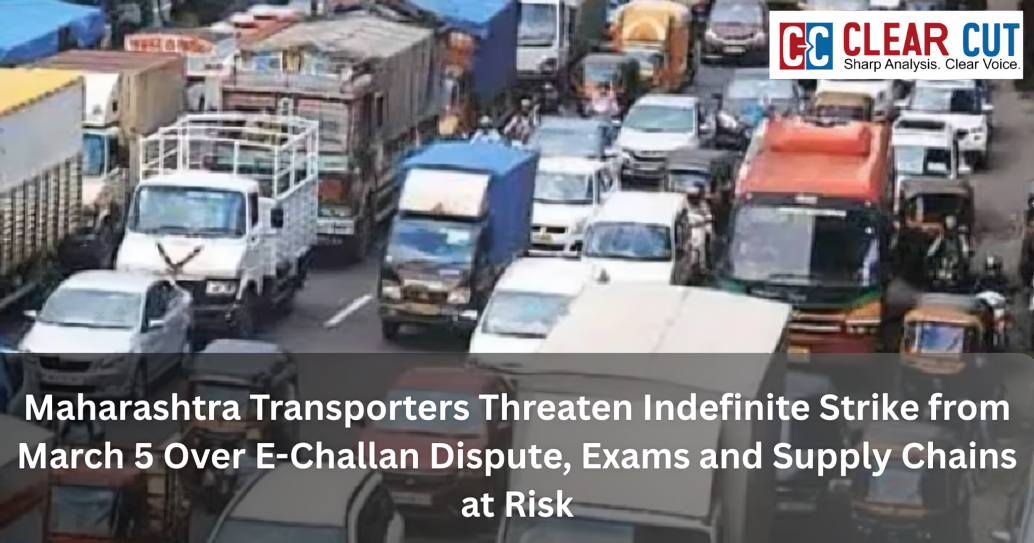
Transporters in Maharashtra have announced an indefinite strike from March 5 against the e-challan system, citing heavy digital traffic fines and financial stress. The protest may disrupt supply chains and board examinations across the state.
Transporters across Maharashtra have warned of an indefinite statewide strike beginning March 5 over unresolved concerns related to the e-challan system. In simple terms, truck operators and transport associations are protesting the way digital traffic fines are being issued and recovered.
If the strike proceeds, it could disrupt essential goods movement, public transport operations, and even examinations scheduled across the state.
The protest call has come from major transport bodies representing truckers, goods carriers, and bus operators. Leaders argue that the current e-challan framework has created financial stress and operational uncertainty for drivers and fleet owners.
Key Highlights
• Statewide transport strike threat from March 5
• Protest against e-challan penalties and recovery mechanisms
• Possible disruption to goods movement and board examinations
• Associations demand policy revision and relief measures
• Government authorities engaged in talks with transport unions
What Triggered the Strike Call
Transport associations have objected to the electronic challan (e-challan) system used by traffic police. The system relies on CCTV cameras and automated monitoring to issue fines for violations such as overspeeding, signal jumping, lane indiscipline, and parking breaches.
Union representatives claim that many drivers received multiple pending fines without timely or clear notification. They argue that accumulated penalties have resulted in vehicle blacklisting, difficulties in permit renewals, and mounting financial burdens.
During press briefings in Mumbai, association leaders stated that some truck owners face pending fines running into lakhs of rupees. They have demanded a waiver or reduction of old penalties and the creation of a transparent grievance redressal mechanism to review disputed challans.
Scope of the Proposed Strike
Transport unions have indicated that the strike could affect commercial goods vehicles, private buses, school buses, and certain segments of passenger transport if negotiations fail.
Officials from the Maharashtra State Transporters Association noted that thousands of trucks operate daily across the state. These vehicles transport essential commodities such as food grains, vegetables, fuel, construction material, and industrial supplies.
If transport movement slows, supply chains may experience disruptions within days. Wholesale markets, including Mumbai’s major agricultural produce markets, rely heavily on daily truck movement.
Education authorities have also raised concerns. Class 10 and 12 board examinations are scheduled in early March. A transport disruption during this period could create serious commuting challenges for students, particularly those travelling from rural and semi-urban areas to designated exam centres.
Government’s Position and Ongoing Discussions
Senior officials from the Maharashtra Home Department and Transport Department have acknowledged receiving representations from transport bodies. Traffic police officials have defended the e-challan system, stating that it promotes transparency and reduces on-the-spot corruption.
The system operates under provisions of the Motor Vehicles Act, 1988, as amended in 2019, which strengthened penalties for traffic violations. Authorities maintain that digital enforcement improves accountability and enhances road safety.
Administrative sources confirm that the government has initiated discussions with union leaders to prevent disruption. Officials are examining demands such as phased payment options, review mechanisms for disputed fines, and improved communication systems for challan notifications.
Data and Financial Implications
Data from the Ministry of Road Transport and Highways (MoRTH) shows that Maharashtra remains one of India’s largest logistics hubs. The state handles a significant share of freight movement, connecting ports, industrial corridors, and agricultural markets.
The introduction of digital enforcement has increased fine collections in major urban centres. However, transporters argue that commercial vehicle drivers face greater exposure to camera-based monitoring because of long hours spent on congested roads.
Industry analysts warn that even a short-term strike could affect fuel distribution, industrial production schedules, and perishable goods supply chains.
Social and Economic Impact
The transport sector employs lakhs of drivers, loaders, and logistics workers. Any prolonged disruption directly affects daily wage earners who depend on continuous freight movement.
If essential goods supply slows, urban consumers may face temporary price increases. Rural producers, especially farmers transporting perishable crops, could suffer losses due to delayed delivery.
Students preparing for board examinations represent another vulnerable group. School administrators and parent associations have urged authorities to resolve the dispute quickly to avoid academic disruption and stress.
Safety Versus Financial Relief Debate
Traffic enforcement authorities argue that e-challans help reduce road accidents by encouraging rule compliance. According to national road safety statistics published by MoRTH, India recorded over 4.6 lakh road accidents in recent years. Authorities believe strict enforcement remains essential.
Transport unions, however, contend that enforcement must balance safety with fairness. They seek structured review mechanisms for disputed violations and financial relief for small fleet operators.
Public policy experts suggest establishing an independent digital grievance portal where drivers can challenge penalties with supporting evidence.
Possible Outcomes and Negotiation Path
Officials involved in discussions indicate that the government is exploring temporary relief measures. These include installment-based payment options for pending fines and faster dispute resolution mechanisms.
The Transport Commissioner’s office is expected to hold further consultations with association leaders before the proposed strike date.
Observers believe that preventing the strike remains a priority due to its potential economic ripple effects across Maharashtra’s logistics ecosystem.
Governance and Accountability
The e-challan system reflects India’s broader digital governance push. Automated enforcement reduces manual intervention and aims to improve transparency.
However, experts stress that digital systems must remain accessible and accountable. Drivers require timely notifications, multilingual communication, and simple appeal procedures.
Transport economists recommend periodic audits of automated enforcement mechanisms to ensure fairness and prevent systemic errors.
Policy Tension Between Enforcement and Livelihood Protection
The proposed transport strike scheduled for March 5 highlights a broader policy dilemma. Authorities aim to strengthen road discipline and transparency through digital enforcement. Transporters seek financial relief and a fair system to address disputed penalties.
The outcome of negotiations will determine whether Maharashtra avoids disruption to supply chains and public examinations.
A durable resolution requires open dialogue, balanced enforcement, and transparent review mechanisms. If policymakers and transport associations collaborate constructively, the state can reinforce road safety while safeguarding the livelihoods of transport workers.
The coming days will serve as a crucial test of governance responsiveness, institutional dialogue, and the ability to align digital enforcement with socio-economic realities in one of India’s most economically significant states.
Clear Cut Livelihood, Education Desk
New Delhi, UPDATED: Feb 21, 2026 05:00 IST
Written By: Samiksha Shambharkar