
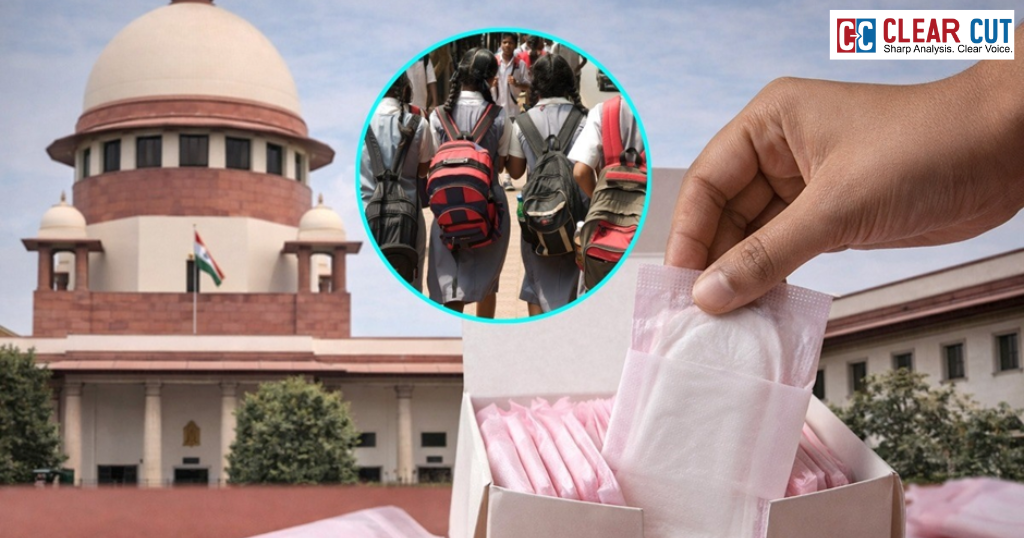
India has taken a major step forward in recognising women’s health and dignity. In a landmark judgment, the Supreme Court of India has declared menstrual hygiene an integral part of the right to life under Article 21 of the Constitution. The Court has directed governments to ensure free sanitary pads, separate functional toilets in schools, and disability-friendly menstrual facilities, especially for students.
In simple terms, the ruling means that menstruation is no longer seen as a private inconvenience but as a constitutional concern that the state must actively address.
What the Court Decided
The Supreme Court held that lack of access to menstrual hygiene facilities violates dignity, health, and equality. The bench observed that girls and women cannot fully exercise their right to education or a healthy life if basic menstrual needs are ignored.
As part of the ruling, the Court issued directions to:
- Ensure free distribution of sanitary pads in government schools
- Provide separate, clean, and functional toilets for girls
- Make menstrual hygiene facilities accessible for girls with disabilities
- Promote awareness and remove stigma around menstruation
The Court emphasised that these measures are not welfare schemes but constitutional obligations flowing from the right to life and equality.
Why Menstrual Health Matters in Everyday Life
Menstruation affects nearly half the population, yet it remains surrounded by silence and stigma. Many girls miss school every month due to lack of toilets, water, privacy, or affordable sanitary products.
Health experts cited in court submissions pointed out that poor menstrual hygiene can lead to infections, anaemia, and long-term reproductive health issues. The Court acknowledged that ignoring these realities places girls at a structural disadvantage from a young age.
By framing menstrual hygiene as a rights issue, the judgment moves the conversation from charity to state accountability.
Education, Dropouts, and Gender Inequality
One of the strongest social dimensions of the ruling relates to education. Studies placed before the Court showed that a significant number of adolescent girls either skip classes or drop out entirely once they start menstruating.
Officials associated with school education departments have repeatedly flagged that absence of toilets and menstrual products directly affects attendance and learning outcomes. The Court linked menstrual health with the right to education, stating that schools cannot be considered inclusive if they fail to meet these basic needs.
The ruling pushes state governments to view infrastructure gaps as violations of fundamental rights, not administrative lapses.
Focus on Girls with Disabilities
A notable aspect of the judgment is its attention to girls with disabilities. The Court noted that menstrual hygiene policies often overlook students with physical or intellectual disabilities, leaving caregivers without guidance or support.
The directions call for disability-friendly toilets, trained staff, and tailored awareness programmes. This reflects a broader constitutional commitment to inclusion and non-discrimination.
Disability rights advocates have welcomed this aspect, stating that it recognises the intersection of gender, health, and disability within public policy.
Role of Governments and Institutions
The Supreme Court has placed responsibility on both the Union and state governments. Ministries dealing with education, health, and women and child development are expected to coordinate implementation.
Senior government officials informed the Court that existing schemes on menstrual hygiene and school infrastructure would need expansion and better monitoring. The judgment makes it clear that fragmented implementation will not suffice.
By invoking constitutional rights, the Court has strengthened the enforceability of these measures across states.
Public Health and Dignity
From a public health perspective, the ruling acknowledges menstruation as a normal biological process requiring systemic support. Doctors and public health professionals have long argued that treating menstrual health as taboo increases health risks and psychological stress.
The Court’s language stresses dignity. It notes that forcing girls to manage menstruation without privacy or resources undermines their self-worth and bodily autonomy. This approach aligns menstrual health with broader discussions on women’s rights and bodily integrity.
Changing Social Attitudes
While legal directions are crucial, the Court also highlighted the need for awareness. It encouraged governments to promote age-appropriate education to break myths and silence around menstruation.
Social workers and educators have pointed out that stigma often begins at home and in classrooms. The judgment implicitly supports comprehensive education that involves boys, teachers, and communities, not just girls.
By acknowledging stigma as a barrier, the ruling recognises that social change must accompany policy reform.
Challenges Ahead
Implementation remains the biggest challenge. Many government schools still struggle with basic water and sanitation facilities. Budget constraints, monitoring gaps, and uneven state capacity could slow progress.
However, constitutional backing gives civil society, parents, and students stronger grounds to demand action. Legal experts note that failure to comply could invite judicial scrutiny in the future.
Key Highlights of the Judgment
- Menstrual hygiene is part of the right to life and dignity
- Free sanitary pads must be provided in government schools
- Separate and functional toilets for girls are mandatory
- Disability-friendly menstrual facilities are required
- Awareness and stigma reduction are essential components
A Step Towards Equal Citizenship
This judgment marks a shift in how the Indian state views women’s everyday realities. By recognising menstrual health as a fundamental right, the Supreme Court has affirmed that equality begins with addressing basic bodily needs.
The ruling does more than improve infrastructure. It sends a clear message that women’s health, education, and dignity are central to constitutional governance. If implemented with seriousness, it has the potential to keep more girls in school, improve health outcomes, and challenge long-standing taboos.
In recognising menstruation as a matter of rights rather than shame, the Court has laid the groundwork for a more inclusive and humane public policy framework.
Clear Cut Health Desk
New Delhi, UPDATED: Feb 03, 2026 09:00 IST
Written By: Samiksha Shambharkar