
Monika Rathore from Madanpur Khadar transformed her passion for art into a career while pursuing higher education, challenging social stereotypes along the way. With support from the Jaishankar Memorial Centre, her journey highlights how education and community support can empower girls to break cycles of poverty.
Monika Rathore is a resident of Madanpur Khadar, one of Asia’s largest urban settlements, housing a population of over 100,000. Most residents here are migrants who make a living through daily wage income. Fathers work as hawkers, auto-rickshaw drivers and guards while mothers are predominantly
engaged as domestic help or work in garment/export units.
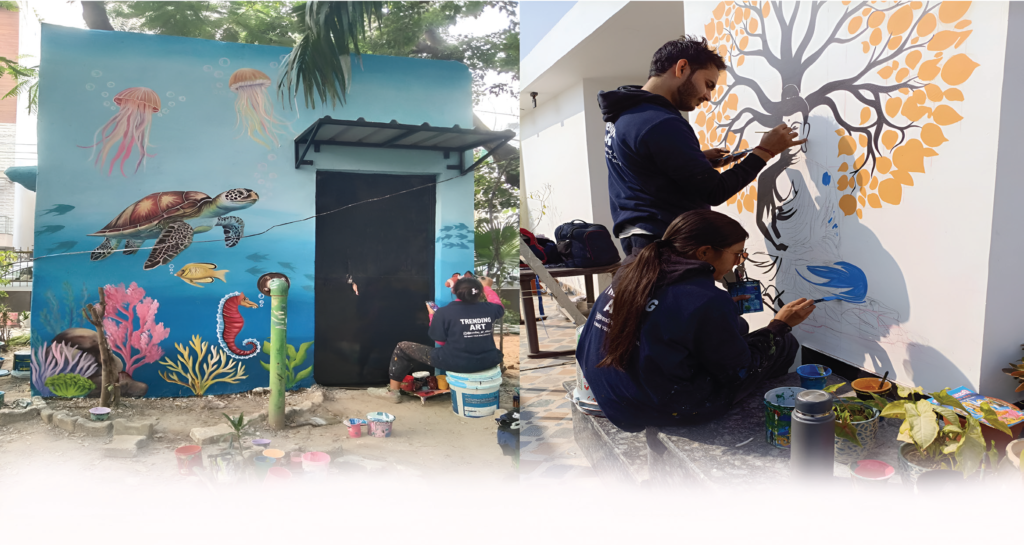
Children in most cases work to support their families. Monika is in many ways an outlier. At 22 years of age she is pursuing her Masters’ degree by correspondence and works as a freelance wall paint artist for 20-22 days a month. Most of her assignments come from agencies that handle government and corporate accountsand they hire her for outdoor media related art work.
It was not easy for her father to let her dabble in art – something he considered a waste of time and later to let her pursue higher studies when girls her age were married with kids. Little did her family know that art was not just a passion and something she was good at, but which would become a source of steady income for her.
A story that challenges stereotypes and celebrates talent
Her journey with the Jaishankar Memorial Centre (JMC) began exactly a decade ago when she was a student of class VI. It was her father who told her that she could visit JMC to find out what all they did. He had heard that they provided free tuition and extra classes on art and craft. It was the latter that struck her as fascinating, compelling her to overcome her shyness and walk into the JMC premises, which is
located at one edge of Madanpur Khadar urban village. Monika credits that decision of hers as one that was life-changing.
The after-school extra classes helped her get past her fear of Maths and score well in her Xth boards. The exposure through the different activities, outdoor excursions and talks by guest faculty shaped her thought process, giving her confidence in her abilities. She recalls how during a visit to the International Book Fair she was mesmerised by the sight of thousands of books and when asked to participate
in an impromptu slogan writing competition, she did so and was surprised to find she had been awarded first prize. Infact, with the exposure and encouragement she received at JMC helped her shine in her school – SKV Madanpur Khadar, where she won awards in drawing competitions every year from Grade VI to XII.
If today her family holds her in high esteem and takes pride in her achievements, she feels it is thanks to JMC field staff who constantly updated her parents on her progress and convinced them on letting her study and pursue her interests in art.
Today, Monika is one of JMC’s biggest advocates. Having grown up in an economically and socially disadvantaged social environment, she understands that education is the most powerful tool for change. She believes young children especially girls can leverage education to break cycles of inequality and shape their own futures. What appears simple for any city-bred child living in a DDA colony or in private residences in the neighbourhood of Madanpur Khadar is an extremely complex task for one who lives in these makeshift settlements.
Here, getting two square meals a day is a challenge, being regular in school and managing to make the cut so they can clear their exams and be promoted to the next class an even bigger challenge. In the middle of these two extremes lie several factors like dealing with domestic violence and drunk dads; eve teasing by local goons; poor health due to starvation, malnutrition and unhygienic living conditions;
and poor follow-up with school authorities for reinstatement.
Soon she hopes to rent a place in an authorised colony and move her family to a secure and respectable neighbourhood. According to her, not many girls can break out of the vicious and debilitating cycle of poverty, malnutrition, disease and unskilled and exploitative employment. What gives many girls like her hope is that JMC is there for them and that “by having a permanent place within the urban sprawl where it conducts its activities and programmes shows they are present and consistent in their approach, offering services the community needs and guiding them on matters they have no one to turn to.”
Remedial education – salvaging many broken dreams
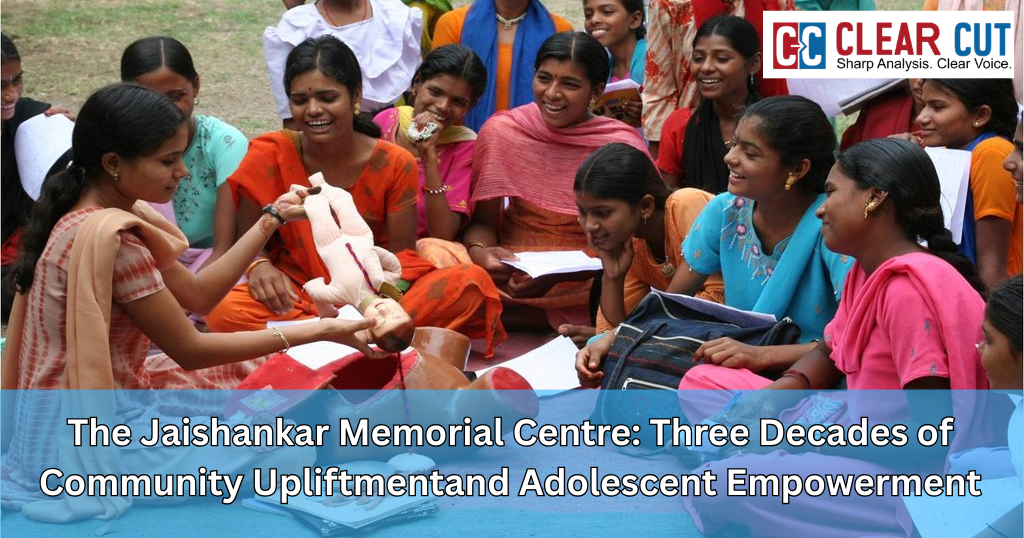
Several parents echo what she says and reinforce that providing a safe and non-threatening environment along with regular outreach has drawn them into JMC’s fold. As a learning centre that serves as a home away from home, JMC has for over two decades worked closely with children in Madanpur Khadar village, institutionalising several programmes based on the needs of local communities.
Seeing the large number of school dropouts due to poor grades and an inability to keep pace with the classroom teaching led to the launch of the Remedial Education (RE) programme in 2005 This became a permanent feature and is managed by a dedicated team that customises education for students in classes
6 to 10. While many are supported through extra classes so they can get better scores in their Class X and XII board exams, others have sought readmission to continue their education.
The exposure children receive through related activities like the Pratham Creativity Club, summer and winter camps, reading library initiative and commemoration of special days like Diwali, Teacher’s Day, Annual Day of JMC, film shows, Taekwondo classes, picnics, and periodic eye camps bring a lot of joy to them. Their spirited performances and bold articulation showcase their talents and growing confidence.
Having a regular inflow of students who enrol in its ongoing batches has also meant that there is a community that can serve as a resource for studies and interventions which are evidence-based. JMC staff has contributed to research projects in collaboration with New Concept Information Systems, UNDP, ILO, Aga Khan, NCW, Room to Read on issues around informal sector, bonded labour and gender equity.
A robust foundation creates opportunity for several offshoots
Many studies conducted by JMC provide insights into the community’s emergent and evolving needs. The findings help them make changes to their own programmes and curricula so they can address challenges and gaps. It validates some of the things they are doing. Like a recent study conducted amongst adolescent girls in the 10-21 age group on “Barriers to Holistic Development of Adolescent Girls in Urban Informal Settlements”, found that education, health, nutrition, safety, and self-esteem are all intertwined. It highlighted how when poverty and gender bias intersect, education becomes the first casualty, and adolescence turns into early adulthood burdened by work, caregiving and/or marriage.
The study found that nearly 38% girls dropped out of school. “Sometimes I miss school not because I don’t want to go, but because someone has to stay home,” was a common response. Other reasons for dropping out of the formal schooling system ranged from housework, financial stress, early marriage, lack of safe transport, and, for migrant families, missing documents that block admissions. Even those who continue are enrolled in under-resourced government schools, often facing dirty toilets, indifferent teachers, or unsafe commutes. Meanwhile, brothers may study in private schools — a quiet reminder of how gender inequality plays out in daily life. Yet, many girls the researchers spoke to, still dream of becoming teachers, nurses and police officers. They see education as their path to dignity and freedom, but not without support from families, communities, and systems.
Today, JMC has expanded its outreach in 10 mohallas of Madanpur Khadar village, and to nearby underserved settlements such as Rajasthani Camp, Shram Vihar, and Priyanka Camp. It has successfully pretested adolescent-based teaching materials for government programmes. A partnership with
Delhi Government’s Gender Resource Centre (2007–2016) saw several self help groups being formed and awareness on legal aid, vocational training and adult literacy provided.
Further, community health initiatives have been implemented like Tuberculosis Awareness Camp in March
2025 as part of support to the National TB Elimination Programme. More than 200+ families were
reached and guided on screening for TB and referred to Government DOTS centres for treatment. Health
camps, eye check-ups, nutrition awareness are ongoing activities. Recently as part of a project with
the Catalyst Management Services, door-to-door outreach and camps helped reach 3000+ families assisting them in accessing health insurance, Labour Cards and e-Shram cards for livelihood assistance.
Expanding the network of like-minded people for expansion
and replication
The JMC which was set up in 1990 as a charitable society under the Societies Registration Act 1860 was
meant to be a tribute to the memory of young Jaishankar who tragically passed away at the age of 23.
It has soldiered on by not creating any dependency on project based funding or by fulfilling any government mandate. It has, without any break, worked quietly but steadfastly to be relevant and meaningful with the belief that a modern city cannot progress and develop without including
those who live on the periphery. With discerning partnerships and funding from individuals who believe
in the values that JMC espouses and corporates whose CSR is aligned with their beliefs, they are ensuring that one of Asia’s largest urban settlements has many more success stories like Monika’s.
About the Author: Taru Bahl, Independent Journalist and Communication Professional with a rich experience of working with mainstream media, the social development sector and CSR. She runs a niche content outfit Words n More Communications and is based out of Gurgaon.
Clear Cut Education, CSR Desk
New Delhi, UPDATED: March 12, 2026 09:00 IST
Written By: Taru Bahl