
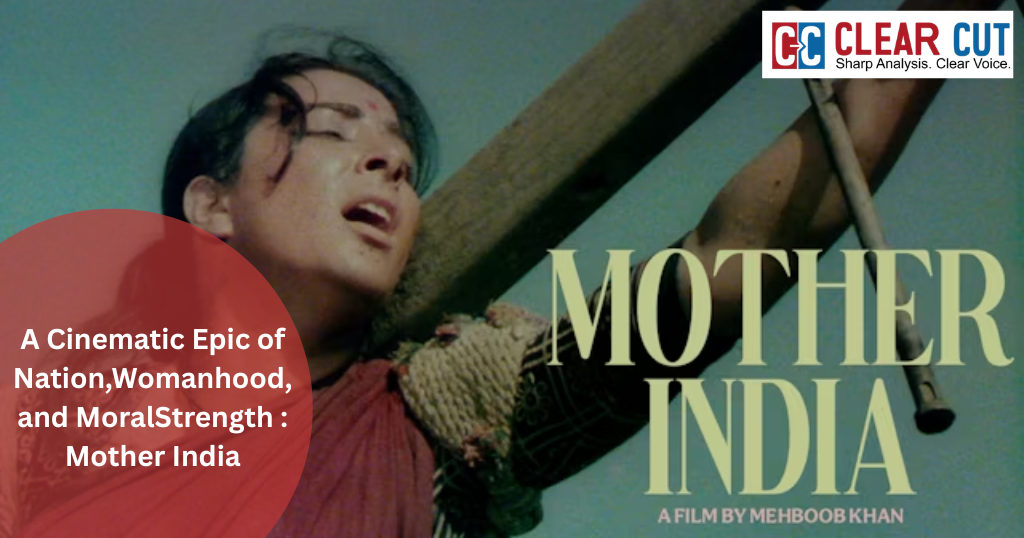
Indian cinema has, in many instances, depicted the lifestyle of the people, showing their troubles, aspirations, and changes in their moral code. One of the movies which not only influenced the cultural imagination of India but also became a source of ideological guidance is Mother India. The movie, which came out in 1957, only ten years after India was freed, went far beyond the limits of fun to become a cultural text that ended up being the very ideals of a country newly born. The film, which had enormous success, is an allegory which can be read at different levels, beyond the most obvious one of the suffering and triumphant experience of a single woman, Mother India is really a metaphor of India, the earth, the people, and the ethical values.
Mother India, a film directed by Mehboob Mother India, a film directed by Mehboob Khan, is considered to be one of It is a combination of social realism and It is a combination of social realism and emotional depth where the personal tragedy of the protagonist is intertwined with the collective experience of the
society. The film stays relevant for generations because of the way it tells a profoundly human story, at the same time, it deals with universal themes like justice, sacrifice, tradition, and change.
Historical and Cultural Context
In order to grasp the significance of Mother India, one has to put it into the time frame of history first. The movie came out when India was recovering from the effects of colonization, extreme poverty, and the suffering of the villages. India was an agrarian country, but the farmers were continuously going into debt and had to rely on moneylenders. Such a social-economic situation is prominently revealed through the movie’s story.
Mother India’s country backdrop is not idealized. Rather, it shows a reality that is characterized by droughts, floods, hunger, and exploitation. Therefore, the movie conforms to the convention of social
realism, which is the use of film as a means to bring to light the injustices that are deeply ingrained in the system. Moreover, the film incorporates extensively the Indian cultural norms, in particular, the highly figurative role of the mother who represents the characteristic traits of the human being, spiritual
supremacy, and the power of giving.
Narrative Overview
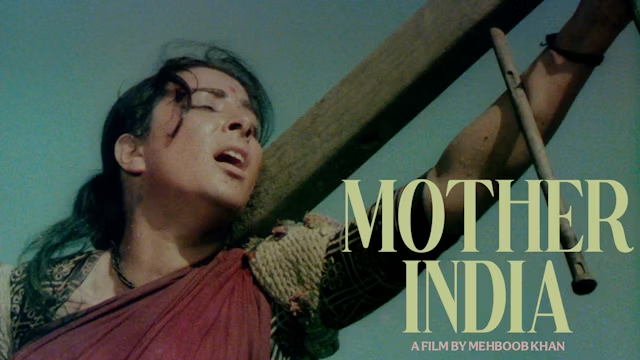
Radha is the central character of the movie, a role that Nargis has brought to life with an impressive and gripping emotional intensity. Initial scenes depict Radha as a fresh and cheerful bride making her way to her husband’s village. But, unfortunately, her story turns out to be an unending fight with poverty,
misfortunes, and the unfair treatment of society, especially a malign moneylender, who makes her suffer mercilessly.
Radha, who may be said to be the personification of misfortune, after losing her husband, suffering physical hardship, and getting emotionally devastated, nevertheless, decided not to give up her dignity or
moral values. She goes on with her sons’ upbringing by her indomitable spirit and arduous labor and therefore becomes a village heroine of the people’s unshakable spirit. The ethical peak of the movie is the
moment when Radha had to sacrifice one of the most unimaginable options, her justice and social order first, then her maternal instinct.
This story structure is one of the elements that moves the tale beyond the confines of a personal tragedy to that of a grand moral epic. The life of Radha can be seen as the odyssey of India itself: a scarred but
resilient, ailing but honorable, and ultimately a martyr for justice, steadfast to the very end.
The Mother as a National Symbol
Mother India’s symbolic use of motherhood is probably one of the most impressive features of the film. Radha, for instance, is more than a mere character she is the earth, the customs, and the moral basis of India. Her relationship with the earth – hoeing the land, feeding the fields, and enduring floods – is what
actually tells us that the country is a mother who gives life to her children even though she is constantly tormented.
This symbolism is derived from Indian cultural traditions where the mother is respected as a moral guide and a protector. Radha’s suffering is the reflection of the stereotyped portrayal of Indian women, which was dominant in the 1950s, the idea that a woman is a self-sacrificing, tough, and morally pure person.
Although contemporary critics might challenge such idealization, it was a fact that the model had a strong hold in the culture at the time the movie was released.
Gender and Womanhood
Mother India, when looked at from the art and culture angle, is a complicated case of how it depicted women. To begin with, Radha is given power via her physical strength, independence, and ethical
leadership. She went against the rule of males, faced up to being exploited, and eventually became the support both of her family and society. During a time when women were mostly given minor roles,
Radha was a striking figure.
However, her power comes from a very sacrificial and suffering kind of a place. The movie propagates the concept that the most supreme quality of a woman is her capacity to bear pain silently when it is for the welfare of others. Such a dual nature makes Mother India not only a significant work for comprehending the stereotyped gender roles and the set of rules that were expected to be followed at that time but also the social-cultural myths of the feminine sex that prevailed in post-independence India.
Performances and Characterization
Mother India, emotionally, is very much a powerful film that owes a great deal to its performances.
Nargis in her role gave one of the most memorable and monumental performances ever in Indian cinema. She played Radha from her young days up to her old age, a touch that was not only visually, but also very emotionally, showing the character’s physical wear, her inner pain, yet at the same time her indomitable will with an incredible faithfulness.
Sunil Dutt plays the role of Birju, the son of Radha, who revolts against the system and shows the rage and discontent that come from being dealt with unfairly by the system. His role depicts the influence
of long-term oppression on one’s sense of right and wrong. Rajendra Kumar, on the other hand, is the portrayal of the dutiful son, filled with self-control and compliance. These characters, thus, form a
continuum of morality that intensifies the film’s metaphysical layer.
Music and Visual Language
One of the main attributes which brightened the film to a great extent was the feature of music which helped in depicting the emotional and cultural sides of Mother India in a highly artistic manner.
All the songs take their roots from the folk traditions and represent the life of the village, the natural cycles of the farm, and the common feelings of the people. The songs not being only the amusement of
the audience, the acts at different times of the film actually move the story forward and get the motifs of fight and hope strengthened.
The film was, in a way, one of the first to use visual elements that later became the standard for cinematography. The film’s color usage, wide-open sceneries, and intense visuals—like the lightning
splitting the sky and Radha standing firm amidst the storm—gives it the aura of a legend interwoven with the truth. In fact, the earth and its soil are portrayed as a new power, the one to decide the fate of
the people who rely on it.
National and International Recognition
Mother India garnered a lot of favorable attention and publicity both in India and abroad. It was the first Indian movie ever to earn an Oscar nomination for the Best Foreign Language Film category, hence, putting Indian cinema on the global map. The film was also presented at the Cannes Film Festival, which definitely contributed to its popularity and prestige abroad.
The movie was a huge success in terms of critical acclaim and recognition at the institutional level in India. At the Filmfare Awards, Mother India was awarded Best Film, Best Director for Mehboob Khan, and Best Actress for Nargis. These honors consolidated the film’s status as a landmark accomplishment in Indian
cinema and acknowledged its artistic, technical, and narrative brilliance at the national level.
Domestically, the film was embraced as a national classic. It resonated with audiences across linguistic and regional boundaries, reinforcing a shared cultural identity during a formative period in India’s nation-building process.
Legacy and Cultural Impact
Still today, more than 20 years after its premiere, Mother India keeps impacting directors, professors, and viewers and is still being referred to as one of the very few morally aware movies made in India. It showed, maybe, for the first time to such an impressive extent, that movies featuring heavy social issues could grab both the critical attention and the large audience. This movie opened the door to the films of the future which dared to merge realism with catchy narratives thereby confirming the stance of cinema
as a double vehicle of art and social critic.
The image of Radha is often brought up as a source to explain the qualities of an The very first point is that Radha’s character is used as a moral reference in the political speeches, literary critiques, and
academic debates, to name just one of the many situations where her influence is felt. Film studies and cultural history departments consider the movie not only as a landmark in Indian cinema but also as a ‘social document’ that records the fears, ideals, and contradictions of the country that came out of the independence struggle.
The main feature that makes the film still relevant to today’s moral and its moral complexity. Instead of providing simple solutions, it challenges the audience with tough questions about justice, obligation,
and individual sacrifice. The decisions of Radha still ignite the controversy, which shows how profoundly the film immerses in the ethical dilemmas that are still topical. Mother India, by its impressive story, emblematic richness, and soulful profundity, is still a landmark in the Indian arts and culture domain – a source that perpetually influences the way films depict society, nation, and human spirit.
Clear Cut Review Desk
New Delhi, UPDATED: Feb 15, 2026 01:00 IST
Written By: Ayushman Meena