

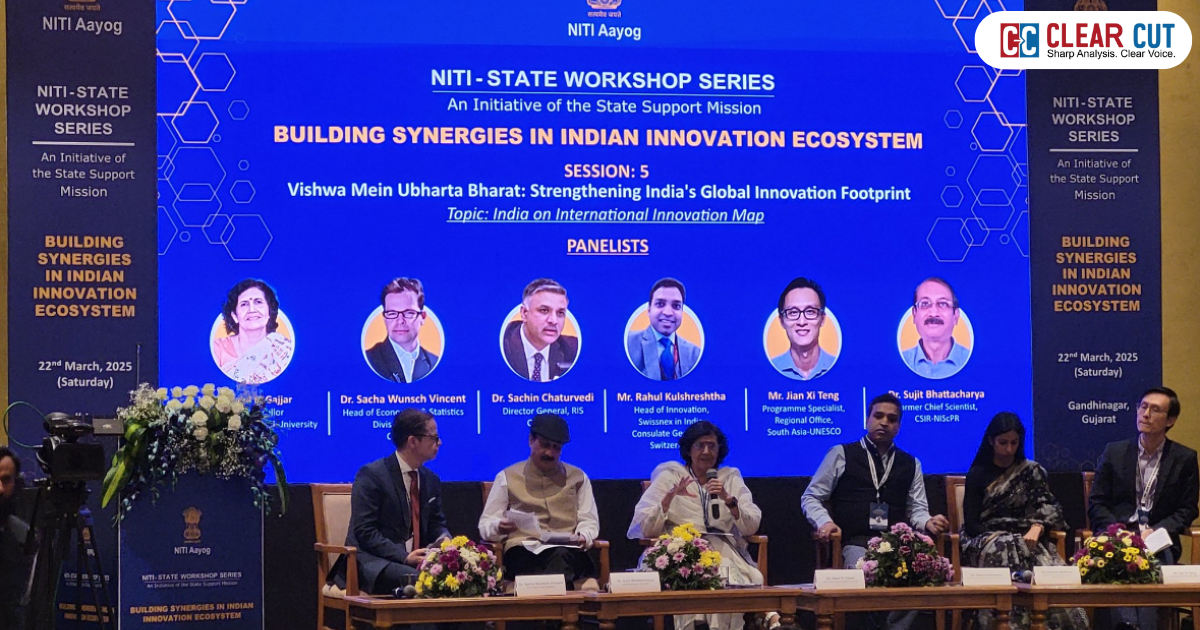
Coimbatore, Tamil Nadu – The NITI Aayog concluded a significant two-day national workshop on January 9. The workshop was organized to focus on improving research and development at the state level. The workshop was held at Amrita Vishwa Vidyapeetham, and representatives from across the nation, including policymakers, scientists, academicians, and industries, attended the workshop, according to India Today Education, confirmed by the Press Information Bureau (PIB).
The workshop, entitled “Sustaining Innovation: Embedding R&D in State Institutions,” aimed at creating robust innovation frameworks in state administration and institutions. The workshop emphasized the need to integrate research initiatives with national development priorities, according to a release published in the Public Information Bureau.
Innovation Must Be Localized and Scalable
In his address, Suman Bery, the Vice Chairman of NITI Aayog, emphasized that in order for the country to achieve technology-based growth and development, there must be a local solution to local problems influenced and supported by science and technology, as reported by PIB.
Bery also reinforced the view of Prime Minister Narendra Modi that challenges facing society could be resolved with the use of technology with purpose and intent. This also resonates with the use of innovation for the public good and the needs of public policy, as discussed by The Economic Times.
Education and Society at the Core
The workshop began with a welcome address by Dr Maneesha Vinodini Ramesh, Pro-Vice Chancellor of Amrita Vishwa Vidyapeetham. She emphasized that universities must play a central role in nurturing sustainable R&D ecosystems, according to PIB.
In a video message, Sri Mata Amritanandamayi Devi, Chancellor of Amrita Vishwa Vidyapeetham, highlighted compassion and inclusion as essential foundations for innovation. Her remarks stressed that research should remain rooted in social impact, as reported by India Today Education and cited by PIB.
MoU Strengthens Association With CSIR
One of the main results was the signing of a Memorandum of Understanding between Amrita Vishwa Vidyapeetham and the CSIR-National Institute of Science Communication and Policy Research (NIScPR), New Delhi. The agreement would reinforce the partnership between the two entities in the fields of research and science policy initiatives, as reported by GKToday.
The MoU was handed over by Dr Maneesha Vinodini Ramesh and Dr Geetha Vani Rayasam, Director of CSIR-NIScPR. The joint efforts are likely to help bridge the gaps between research conducted by academicians and research-driven decisions made by policymakers, according to reports by GKToday.
Strong State Innovation Systems Needed
The technical sessions covered topics such as building State Science & Technology Councils, state missions for innovative institution-building, policy frameworks that link grassroots innovations to state planning, as well as benchmarking for innovation governance. These were captured in the official note of the event, as documented by Amrita University.
Experts have cited the fact that countries need to move from being mere implementers of national plans to becoming co-creators of innovation plans. This will help widen and make the Indian science and technology community resilient and inclusive, as mentioned by PIB.
Patent Growth and Local Innovations
Delegates from the state of Tamil Nadu pointed out that their state tops the country with regards to patents, with close to 5,000 to 6,000 patents every year. The Economic Times reported that it was primarily institutions of higher learning, including Amrita Vishwa Vidyapeetham, which contributed to the increase.
Participants also highlighted the importance of relating grassroots innovation to the research system in an effort to integrate local innovation into the mainstream through initiatives such as the ones presented on the Amrita University website.
Looking Ahead
The workshop was concluded with the realization that state R&D activities have to become an ongoing process in the ruling systems. There was a need for coordination between R&D institutions, industries, and state governments, as per the concluding summary released by PIB.
The attendees were left with some collective recommendations, and these include innovation mentoring and policy action, which were covered by both India Today Education and Amrita University.
Clear Cut Research Desk
New Delhi, UPDATED: Jan 13, 2026 01:00 IST
Written By: Ayushman Meena