
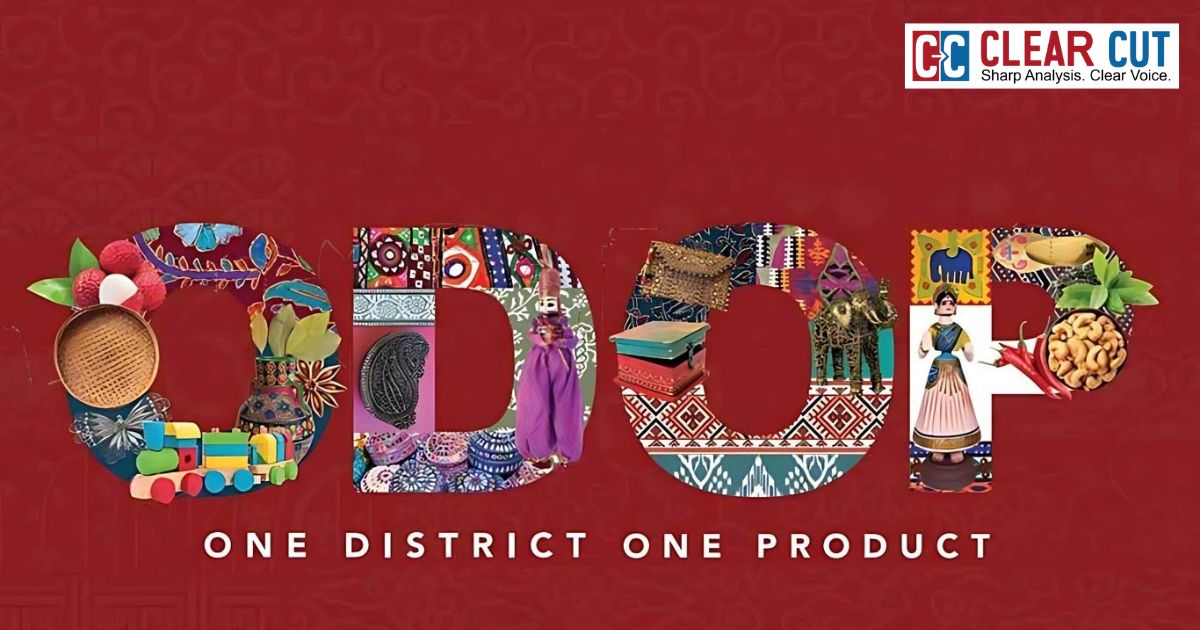
When Uttar Pradesh introduced the One District, One Product (ODOP) scheme in 2018, the aspiration was that each district should lead a single distinctive product that highlights its heritage and skill set. With the passage of time, the concept has developed from a state policy experiment to a model that other states and even national policymakers seek to emulate.
What started as a push to cluster traditional crafts and small industries into recognizable groups has today become an earnest case study in rural industrialization, entrepreneurship, and export development.
A Vision Rooted in Local Strength
ODOP was founded on a straightforward observation that India’s districts are already seeds of enterprise. What lacked was structure, branding, and access. Each district was encouraged to pick one product where it had a relative advantage: perfumes in Kannauj, brass-ware in Moradabad, chikankari embroidery in Lucknow, black pottery Azamgarh, or Kalanamak rice in Siddharthnagar. in The state government’s Department of MSME and Export Promotion, in association with the Micro, Small and Medium Enterprises Development Institute (MSME-DI), started offering infrastructure support, skill training, packaging design, and digital marketing assistance. As per the Uttar Pradesh government’s ODOP dashboard, more than 88 lakh artisans and entrepreneurs are now part of the initiative, and ODOP-linked products account for more than ₹50,000 crore of the state’s exports annuallyBut behind the figures is a greater tale.
Economic Impact: Recent Research Data In a 2024 research titled “Impact of One District One Product Programme on Export Performance” (Ivysci Journal), export data of Jalaun, Jhansi, and Lalitpur for the period 2014-15 to 2023-24 were studied. It concluded that since 2019 there has been a steady increase in ODOP-tied shipments. The overall growth in exports in these three districts has been an average of 23% per year due to improved packaging, quality standards. and logistical support.
JISEM Journal (2024), in its article on “Revitalizing Aspirational Districts through ODOP,” stated that in the case of districts such as Shrawasti and Balrampur, per-artisan income increased between 12-18% over two years of ODOP-associated training and cooperative establishment The research further identified that access to credit via PMEGP and Mudra schemes had direct positive relationship with continuity of production
At the farm end, AJAAR Journal (2024) researched five ODOP crops-potato, onion, garlic, chilli, and nurmeric-over 2018-19 to 2022-23. It reported robust yield growth in potato and onion clusters but cautioned stagnation in chilli and nurmeric clusters, where irrigation and input expenses are high. This difference indicates ODOP’s success is based on ongoing technologi-cal and infrastructural assistance and not branding alone In the Springer Joumal of Knowledge Economy (2025), scholars studied women artisans in the handicraft indus-try. The results revealed that those who went through digital literacy and e-commerce onboarding under ODOP had a 28% higher annual turnover compared to those lacking such training. The study concludes that “digital inclusion has become the decisive factor in ODOP’s next phase.”
Where ODOP Works
The success of ODOP is most apparent in clusters where heritage and innovation converge In Kannauj, the traditional attar indus-try-hitherto languishing under synthetic challenges got rejuvenated with new branding and export certifications. ODOP facilitated laboratories and held international exhibitions Certain distilleries have now got their products registered with the Geographical Indication (GI) tag, thereby acquiring global identity. In Varanasi, ODOP’s promotion of Banarasi silk has assisted the weaving community in broadening the exporting footprint. Exports of silk-based goods from the district grew by 22% from 2020 to 2023, the UP Export Promotion Bureau reported.
In Siddharthnagar, the scented Kalana-mak rice, once on the verge of extinction, reached the retail counters in Delhi and Bengaluru. Marketing and branding were aided by ODOP and the Agricul-nural Export Policy of 2020 and enabled the crop to receive recognition again These achievements follow a pattern: all these clusters already had skill and heritage but not the market perspective, sophistication in packaging, and exposure. ODOP provided the missing link.
Challenges Behind the Progress
Even though these achievements havebeen made, ODOP’s development is still uneven. Several districts contin-ue to face fundamental infrastructure such as cold storage, laboratory testing, dependable transport, and digital connectivity. The AJAAR study points out that districts with improved logis-tics (such as Varanasi, Moradabad, and Agra) registered twice the growth rates than other distant areas.
Skill gaps still exist Although ODOP has conducted more than 500 training workshops and 30 design expos up to 2024, most artisans still make tradition-al designs which may not resonate well with market demand. Lacking market analytics and trend forecasting, sales plateaus are the norm
In addition, quality control and branding are still precarious. The Springer research indicated that 42% of the artisans who participated in their study had no knowledge of certification requirements or export compliance procedures. This results in variable quality, which damages district brands in the long term.
Lastly, the threat of financial sustain-ability hangs over it. Several ODOP clusters survive on subsidization of exhibitions, packaging, and logistics When those supports dwindle, smaller units could find themselves in trouble Growth may stall unless private invest-ment and self-reliant cooperatives take over.
Women at the Center of Change
A positive aspect of ODOP is its focus on women entrepreneurs. The Springer 2025 study revealed that women enterprises under ODOP’S handicraft clusters, especially im Lucknow, Azamgarh, and Mirzapur, exhibited greater consistency and innovativeness. These women were not only breadwinners but leaders in their communities, imparting education to others in digital marketing, bookkeep ing, and product photography. Programs such as Mission Shakti and PM Vishwakarma Yojana have been converged with ODOP to scale up microfinance and digital onboarding for women artisans. This inter-policy coordination is one of the strongest design aspects of ODOP.
Women at the Center of Change
Outside its state limits, ODOP has become part of India’s national export story. In 2022, DPIIT incorporated ODOP into the PM Gati Shakti National chusters with national logistics networks. India Brand Equity Founda-tion (IBEF) had reported in its 2024 study that ODOP products are now showcased in more than 40 global trade exhibitions, with separate ODOP pavil-ions in Dubai, Frankfurt, and Singa-pore. IBEF estimates that districts associated with ODOP contribute approximately 1.2 lakh crore per ammum to India’s overall handicraft and small-scale exports, which is approxi-mately 30% of MSME exports. This data-driven integration has transformed ODOP from a cultural revival program into a serious trade and employment policy.
Women at the Center of Change
For ODOP to become truly transformative, experts agree that few shifts are necessary. First, data transparency. A unified national ODOP dashboard should be created to monitor sales, exports, income, and employment. Current state-level data lacks uniformity, making evaluation difficult. Second, digital and financial inclusion has to be deepened. As the Springer research found, digital literacy has a direct positive impact on income and visibility. Each district cluster needs to have a digital resource center to educate artisans in selling online, managing inventory, and customer engagement.
Clear Cut Research Desk
New Delhi, UPDATED: Jan 19, 2026 01:00 IST
Written By: Janmojaya Barik