
India is building a new CSR pipeline for women and children through the PANKHUDI platform, Anganwadi Centres, and the NSE Social Stock Exchange. However, its success will depend on strong accountability, transparent data, and measurable outcomes.
Three recent moves in India’s CSR and social sector landscape signal a shift in how corporate money reaches women and children. The architecture is new. The accountability gaps are not.
Three Signals in Three Months
Between January and April 2026, three developments quietly reshaped how corporate money is supposed to flow toward women and children in India. In January, the Ministry of Women and Child Development launched PANKHUDI, an integrated digital portal designed to channel CSR and voluntary contributions directly into government programmes for women and child welfare. In February, the Ministry hosted a national CSR workshop specifically focused on strengthening Anganwadi Centres, bringing in corporate leaders, philanthropic foundations, and state government representatives under a single convergence framework. In late March, FUEL, a Mumbai-based education and skilling NGO, listed on the NSE Social Stock Exchange, unlocked structured social funding for scholarships and career pathways with a stated emphasis on young women from government schools and rural communities.
Each of these, taken alone, is a procedural development. Taken together, they represent something more interesting: a serious attempt to solve the chronic friction between corporate CSR intent and on-the-ground delivery in the women and child development sector. Whether the architecture being built is strong enough to carry the weight placed on it is a different question.
What PANKHUDI Actually Changes
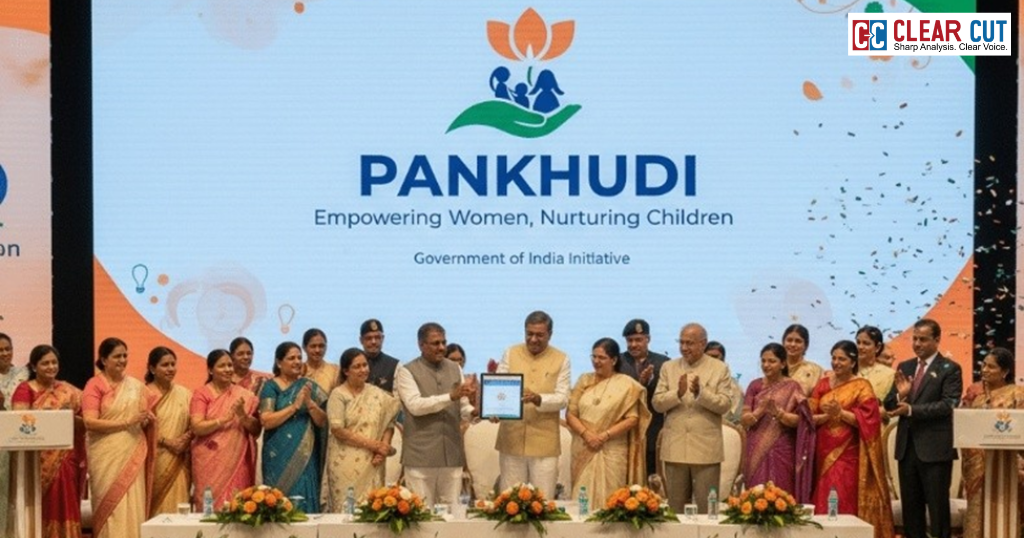
The PANKHUDI portal, launched on January 8, 2026, by Union Minister Annpurna Devi, is designed as a single window digital platform to streamline contributions toward programmes aligned with the Ministry. It enables individuals, NRIs, NGOs, corporate CSR teams, and government agencies to register, submit proposals, and track their contributions. Covering areas such as nutrition, health, early childhood care and education, child welfare, rehabilitation, and women’s safety and empowerment, the platform mandates non cash transactions to ensure traceability. It supports three flagship missions, Mission Saksham Anganwadi and Poshan 2.0, Mission Vatsalya, and Mission Shakti.
What distinguishes PANKHUDI is the scale of the infrastructure it seeks to integrate. With over 14 lakh Anganwadi Centres, nearly 5,000 Child Care Institutions, around 800 One Stop Centres, more than 500 Sakhi Niwas, and over 400 Shakti Sadan, the portal is not a limited pilot but an ambitious effort to digitise a vast and historically fragmented social sector ecosystem. This is infrastructure that has long been underfunded, opaque, and difficult for corporate actors to engage with in a structured manner.
The problem PANKHUDI aims to solve is both real and persistent: while CSR funds, government schemes, and voluntary contributions all exist, the linkages between them have traditionally relied on cumbersome processes, informal networks, and inconsistent implementation. In principle, a unified digital interface that aligns contributions with needs, tracks approvals, and improves visibility is exactly what the sector requires.
However, the platform’s effectiveness will ultimately depend on its uptake and the quality of data it generates. Questions remain around whether states will consistently upload proposals, whether stakeholders will adopt the system at scale, and crucially, whether the Ministry will move beyond reporting aggregate contributions to publishing disaggregated outcome data. Without this, the portal risks becoming another system that tracks inputs efficiently while leaving actual impact insufficiently understood.
Anganwadis as a CSR Priority
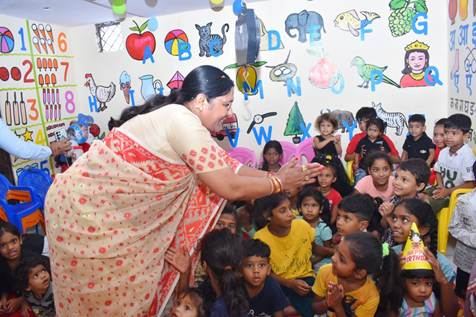
The February 2026 national workshop on Early Childhood Care, Education and Nutrition brought this into sharper focus. Radhika Jha, Joint Secretary at the Ministry, presented the national scale of the Anganwadi network: 14 lakh centres serving 8.7 crore beneficiaries. H.S.H. Prince Max von und zu Liechtenstein, Chairman of LGT and Board Member of LGT Venture Philanthropy, speaking at the event, described India’s Anganwadi platform as “an extraordinary national asset,” stressing that meaningful progress requires health, nutrition, caregiving, and early learning to function as an integrated system rather than siloed interventions.
Vedanta’s Nand Ghar model was highlighted as evidence of what corporate investment in Anganwadi infrastructure can produce: nearly 12,000 Nand Ghars operational across 17 states, combining childcare with women’s skilling in a single community space. The company announced further commitments to strengthen Anganwadi Centres in Odisha, Rajasthan, Jharkhand, and Bihar. Zerodha also expressed support for collaborative adoption frameworks aligned with Ministry guidelines. The pattern emerging from the workshop is that the government is actively marketing Anganwadis to corporate India as a CSR vehicle, recognising that the network is too large and too important to be funded by the state alone.
The Social Stock Exchange Question
FUEL’s listing on the NSE Social Stock Exchange in late March, attended by Maharashtra’s ministers for Higher Education and Skill Development, is a different kind of signal. The Social Stock Exchange, launched by SEBI, is designed to bring capital market discipline to the social sector: organisations list, raise funds publicly, and are held to disclosure and impact reporting standards they would otherwise escape. FUEL’s specific focus on scholarships for underserved girls and first-generation learners, alongside career counselling across Maharashtra, gives the listing a gender dimension that the ministry-level announcements often lack.
The SSE remains nascent. Listings are few, liquidity is thin, and the investor base for social sector securities has not yet developed the depth that makes the model self-sustaining. But FUEL’s listing is a proof of concept that matters: it demonstrates that an NGO with a gender-focused education mandate can access structured capital through a regulated market mechanism, with the transparency obligations that implies.
Conclusion
PANKHUDI, the Anganwadi CSR workshop, and the FUEL SSE listing each respond to a critical gap in how corporate funding reaches women and children in India. While the government is strengthening systems for convergence and offering clearer frameworks for corporate engagement, a key piece is still missing: accountability. This includes outcome-level reporting disaggregated by gender, robust impact metrics, and transparent public data to assess whether these efforts are truly addressing the gaps they aim to close. Without this layer, such platforms risk tracking inputs efficiently but falling short in demonstrating meaningful outcomes—something India can no longer afford.
Sources:
- Ministry of Women and Child Development, Government of India (2026, January 8). Launch of PANKHUDI Portal. https://www.pib.gov.in/PressReleasePage.aspx?PRID=2212400
2. Ministry of Women and Child Development, Government of India (2026, February 20). National CSR Workshop on Early Childhood Care, Education and Nutrition. https://www.pib.gov.in/PressReleasePage.aspx?PRID=2231041
3. India CSR (2026, March). CSR: FUEL Lists on NSE Social Exchange to Expand Education Access. https://indiacsr.in/csr-fuel-lists-on-nse-social-exchange-expand-education-access/
4. India CSR (2026, March). Vedanta Programme Targets 1,800 Women Entrepreneurs in Rajasthan. https://indiacsr.in/vedanta-programme-targets-1800-women-entrepreneurs-rajasthan/
Clear Cut CSR Desk
New Delhi, UPDATED: April 06, 2026 09:00 IST
Written By: Jay