
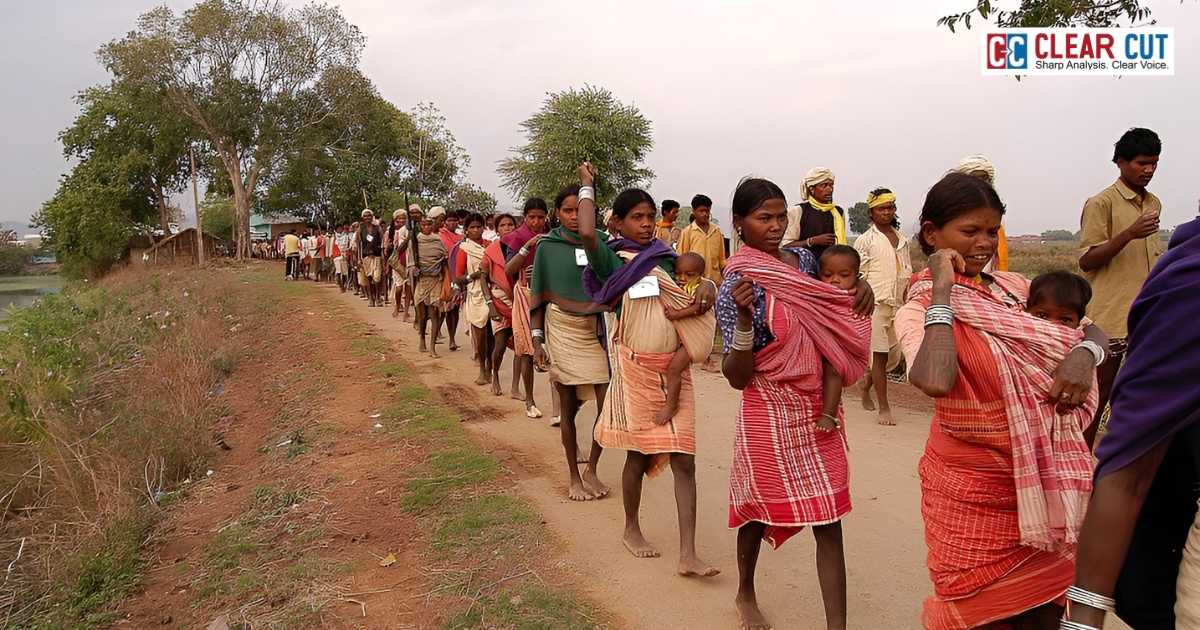
Jharkhand is famously referred to as a state of plenty, with forests, minerals, and a huge population of rural and tribal inhabitants. However, under this prosperity, there is a crude reality of deprivation that defines the day-to-day living in its villages. The latest report by the Azim Premji University, Rural Multidimensional Deprivation in Jharkhand (2025) provides an informative and fact-intensive account of this fact. It goes beyond income poverty to consider access to the basic amenities that render living conditions a possibility.
Looking Beyond Income Poverty
Instead of measuring poverty only through income or consumption, the report uses a Rural Multidimensional Deprivation Index (RDI) to capture multiple forms of deprivation. index is constructed based on the results of the Mission Antyodaya Survey 2019, which surveyed over 95 percent of the villages in Jharkhand. It measures deprivation in terms of 22 indicators. The index is constructed using 22 indicators grouped under three broad categories: infrastructure, health, and education. These include indicators such as access to sanitary toilets, drainage facilities, internet connectivity, primary health centres, anganwadi services, senior secondary schools, and vocational training centres. A village will be termed as multidimensionally deprived when it does not have five or more of these basic amenities. This method is useful in determining not only the number of identified deprived villages, but also the extent and pervasiveness of deprivation.
Jharkhand’s Position at the National Level
The result puts Jharkhand in the list of the most deprived states of the country. It is the 7th most rural multidimensional deprived state in the entire Indian states and Union Territories. In case the northeast states and Ladakh are eliminated because of their special geography, then Jharkhand becomes the most deprived state in India. Villages in Jharkhand are multidimensionally poor, with 75.8 percent of the villages being categorized as poor compared to the national average of 47.8 percent. This implies that every three villages in the state have numerous and similar lacks marginal services.
Rural Jharkhand: What Drives Deprivation?
According to the report, Jharkhand is not deprived in one sector only. However, health-related indicators contribute the most, followed by infrastructure and education.
Some of the most striking findings include:
- Nearly 86 per cent of the rural population resides in villages in which at least one household does not have a sanitary toilet.
- More than 77 percent of the rural population resides in villages that lack internet or broadband connectivity.
- Over 50 percent of the rural population lives in villages with lack of drainage.
- About 50 percent of the population resides in those villages with no vocational training centre within 10 km.
- Only 5 indicators. These include the absence of sanitary toilets, drainage facilities, internet or broadband connectivity, vocational training centres, and senior secondary schools, together contributing to over 40 percent of total deprivation. These include a shortage of sanitary toilets, vocational training centres, drainage systems, senior secondary schools as well as internet connectivity.
Uneven Development Across Districts
The deprivation is general in Jharkhand but varies in different districts. Districts like Sahebganj, Simdega, Gumla, Garhwa, and West Singhbhum are considered among the most deprived districts, while districts that are centrally located are comparatively better ones, which include Ramgarh, Ranchi, and Lohardaga.
For example, Sahebganj district has the highest deprivation score in the state, with villages deprived of basic facilities across almost all dimensions. Contrastingly, Ramgarh, which is the least deprived district, shows significant gaps, consisting of many villages that lack essential services. This highlights that even the “better-performing” districts are far from adequately developed.
The Social Meaning of These Numbers
These statistics are not just numbers; they represent daily struggles faced by rural households.
Lack of toilets and drainage affects women’s dignity and health. The absence of nearby health centres elevates the risks that occur during childbirth and medical emergencies. The young generation’s educational and employment opportunities are threatened by poor internet access and the lack of senior secondary schools, especially in a rapidly digitising economy.
The report also highlights a crucial policy gap. Many of the amenities where Jharkhand performs poorly, such as toilets and anganwadi centres, are already mandated under national programmes like Swachh Bharat Mission and ICDS. The persistence of deprivation indicates problems not just of policy design, but of implementation and local capacity.
This deprivation intersects with historical marginalisation, geographical isolation, and limited political voice for Jharkhand’s large tribal population. Due to this, development gaps become entrenched across generations.
Why the RDI Matters for Policy?
Village-level focus is one of the key strengths of the RDI. RDI allows for targeted and practical interventions byidentifying exactly which amenities are missing in which villages. Instead of broad, district-level initiatives, policymakers and Panchayats can prioritise specific indicators such as drainage, toilets, or vocational training centres in the most deprived villages.
The report argues that current deprivation requires working on basic provisioning first. The improvements in education, health outcomes, or livelihoods remain difficult to sustain without minimum infrastructure and services
A Clear Message from the Data
The central message of the report indicates that the rural deprivation in Jharkhand is deep, widespread, and multidimensional, and addressing it requires more than economic growth or headline welfare schemes. It demands focused attention on everyday amenities that shape people’s ability to live with dignity.
By having its foundation in the analysis of village-level data, the RDI provides both a warning and a roadmap. It shows both the sides, i.e, where Jharkhand is falling behind and where necessary action is urgently needed. For a state like Jharkhand, which is rich in resources but poor in human development, the challenge is no longer about identifying the problem. The data has already done that. The real task lies in translating this knowledge into sustained and inclusive action.
References
- Azim Premji University. (2025). Rural Multidimensional Deprivation in Jharkhand: A Data-Driven Analysis. Development Dialogues with Data Initiative.
Clear Cut Livelihoods Desk
New Delhi, UPDATED: Jan 10, 2026 09:00 IST
Written By: Samiksha