
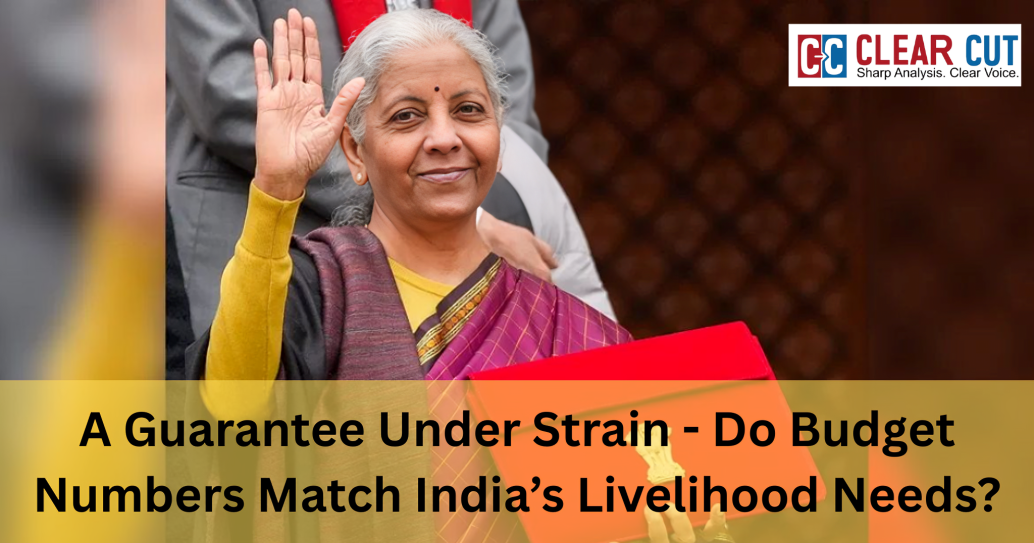
The Union Budget has placed employment and livelihoods at the centre of the government’s long-term vision under what it calls the “Viksit Bharat Guarantee”. The Budget promises to strengthen rural jobs, self-employment, and basic services so that economic growth translates into everyday security for ordinary households. Two major pillars of this promise are VB–G Ram–G (rural employment and livelihoods) and the Jal Jeevan Mission, both of which received substantial allocations.
However, budget numbers alone do not tell the full story. A closer look shows a gap between ambition and ground-level capacity, raising questions about how far these allocations can actually meet employment and livelihood needs.
What the Budget Has Announced
The Union Budget has allocated ₹95,692 crore for VB–G Ram–G, which covers rural employment and livelihood-related guarantees. At the same time, the Jal Jeevan Mission has seen its outlay rise to ₹67,670 crore, signalling continued emphasis on rural water supply, infrastructure, and associated jobs.
Senior officials from the Ministry of Finance have stated that these allocations are designed to support employment generation, asset creation, and income stability in rural India, while aligning with the long-term goal of making India a developed economy by 2047.
Understanding VB–G Ram–G and Rural Employment
VB–G Ram–G functions as a broad umbrella for rural employment and livelihood assurance. It aims to provide wage employment, support self-help groups, and strengthen village-level economic activity.
However, experts tracking employment programmes point out that the current allocation may not be sufficient to meet the promised number of workdays. Based on average wage rates and past demand, analysts estimate that the allocated amount would fall short of covering 125 days of assured employment for all eligible households.
Officials associated with rural development departments have acknowledged that demand for rural employment rises sharply during periods of agrarian stress, climate shocks, or price instability.
Employment Demand vs Budget Reality
The social dimension becomes clearer when viewed from the perspective of rural households. For many families, wage employment programmes are not supplementary income but a primary safety net.
Economists and former members of advisory committees to the Ministry of Rural Development have highlighted that rising input costs, irregular rainfall, and shrinking farm margins have increased dependence on public employment schemes.
If allocations do not keep pace with demand, the burden shifts back to households, leading to distress migration, borrowing, or reduced spending on health and education.

Aajeevika Mission and Women’s Livelihoods
A key component of the Viksit Bharat narrative is Aajeevika, which focuses on self-employment, particularly through women’s self-help groups (SHGs). The Budget continues to position SHGs as engines of rural entrepreneurship, credit access, and local enterprise.
Officials involved in SHG programmes have noted that investments in Aajeevika yield strong social returns. Women’s income tends to improve nutrition, children’s schooling, and community resilience. However, these outcomes depend on sustained credit flow, market access, and training, not just headline allocations.
Without adequate backend support, SHGs risk becoming credit-linked groups without viable income opportunities.
Jal Jeevan Mission as Livelihood Infrastructure
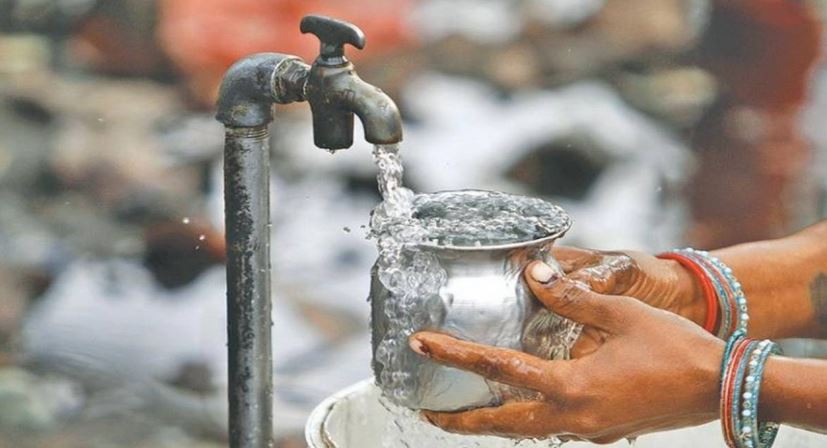
The increased allocation for the Jal Jeevan Mission has both social and employment implications. Beyond providing tap water to households, the mission creates jobs in construction, plumbing, maintenance, and local governance.
Engineers and programme managers associated with the mission have repeatedly stressed that water infrastructure projects generate local employment, especially for semi-skilled workers. They also reduce women’s unpaid labour by cutting the time spent fetching water.
In this sense, water access functions as both a public health measure and a livelihood enabler.
Social Equity and Regional Imbalances
One concern raised by policy researchers is uneven regional absorption capacity. States with stronger administrative systems tend to utilise allocations more effectively, while poorer or disaster-prone regions struggle with delays and under-spending.
Former members of state-level employment councils argue that budget success depends as much on institutional capacity as on money. Without timely fund release, transparent monitoring, and local planning, allocations remain numbers on paper.
This unevenness risks widening regional inequalities, undermining the inclusive intent of the Viksit Bharat framework.
Fiscal Prudence vs Welfare Commitments
From the government’s perspective, balancing fiscal discipline with welfare commitments is a constant challenge. Officials from the finance establishment have defended the allocations, stating that efficiency, convergence of schemes, and digital monitoring will improve outcomes even with limited resources.
However, social policy experts caution that efficiency cannot replace adequacy. When demand exceeds supply, exclusion becomes inevitable, particularly for the poorest households who lack alternative income sources.
What the Budget Highlights Tell Us
- ₹95,692 crore allocated for VB–G Ram–G to support rural employment and livelihoods
- Allocation may not cover 125 days of assured employment for all households
- Jal Jeevan Mission receives ₹67,670 crore, boosting rural infrastructure and jobs
- SHGs remain central to women’s livelihood strategy under Aajeevika
- Implementation capacity and demand responsiveness remain key challenges
Looking Beyond the Numbers
The Union Budget sends a clear signal that employment and livelihoods remain politically and socially central to India’s development story. The language of “guarantee” under Viksit Bharat reflects an attempt to reassure citizens facing economic uncertainty.
Yet, the true test will lie in implementation. For rural workers, women in SHGs, and marginal households, outcomes matter more than intent. Adequate funding, flexible response to demand, and strong local institutions will decide whether these missions function as real guarantees or aspirational promises.
As India moves toward its long-term development goals, the success of VB–G Ram–G and allied missions will shape not just employment figures, but the credibility of the social contract between the state and its citizens.
Clear Cut Livelihood Desk
New Delhi, UPDATED: Feb 04, 2026 09:00 IST
Written By: Samiksha Shambharkar