

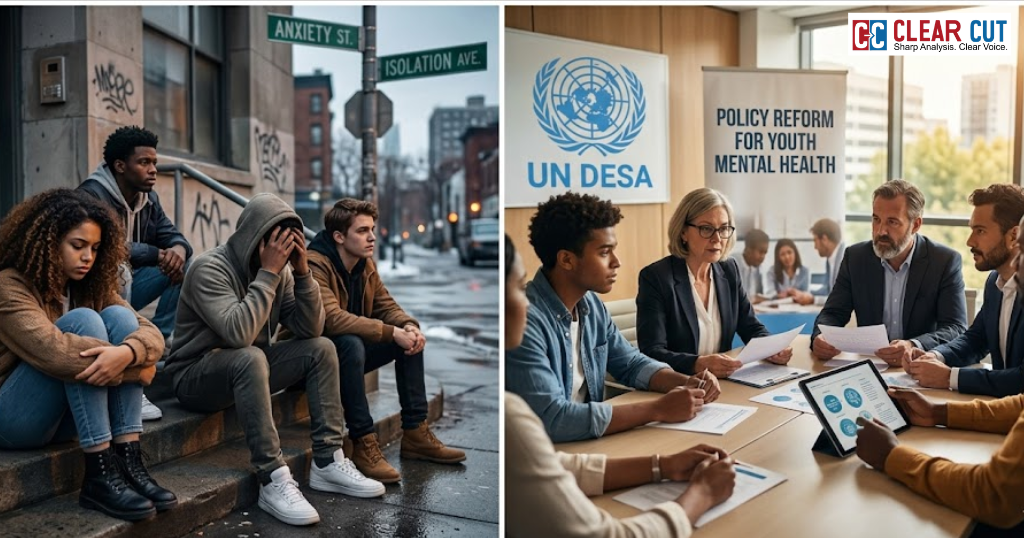
UN DESA reports warn that youth mental health is worsening globally due to inequality, digital stress, and economic uncertainty, with many cases going untreated. They call for urgent, inclusive policy reforms that prioritize youth voices and expand access to mental health support.
The United Nations Department of Economic and Social Affairs (UN DESA) has released two landmark reports placing young people at the centre of global development conversations. Together, the World Youth Report on Youth Mental Health and Well-being and the World Population Highlights 2026: Youth present a sobering picture of a generation under pressure and a policy landscape struggling to keep pace.

A Generation Under Pressure
The World Youth Report examines how youth mental health is shaped by six social determinants: education, employment, family dynamics, poverty, technology, and societal attitudes. It highlights how inequalities in these areas create disparities in mental health outcomes, with stigma, discrimination, and unequal access to opportunities compounding risks for young people.
The World Health Organization reports that 14 percent of individuals aged 10 to 19 suffer from a mental disorder, making it the primary cause of disability during adolescence. Experts warn that this figure is likely an undercount due to persistent stigma and weak screening systems in schools and communities.
The WHO has also flagged that 50 percent of all mental health conditions begin by age 18, underscoring that the world is witnessing a generational emergency. Yet most cases remain untreated due to stigma, lack of access to care, and insufficient services.
Key Voices at the Report Launch
The World Youth Report was launched during the 64th session of the Commission for Social Development in February 2026. The event brought together Member States, UN entities, civil society, and youth delegates.
In her keynote address, Bjørg Sandkjær, Assistant Secretary-General for Policy Coordination at UN DESA, stated that “addressing youth mental health requires confronting inequality itself through coordinated, equitable, and inclusive social policies that expand opportunity, reduce exclusion, and strengthen solidarity.”
Masumi Ono, Chief of the Social Inclusion and Participation Branch at UN DESA, presented findings showing that inequalities in opportunities are closely linked to disparities in mental health outcomes, that stigma continues to block access to care and work, and that preventive, community-based approaches are essential to closing mental health gaps.
Youth voices were central to the launch. UN Youth Delegate Jorina Kaminski of Switzerland stated: “Being young means having options. It means having a whole life ahead of you. But today, being young also means not being sure whether the world will allow you to have a future in it. This growing uncertainty is what drives mental health problems experienced by so many young people today.”

The Population Picture
The companion report, World Population Highlights 2026: Youth, produced by UN DESA’s Population Division, provides an evidence base for building more inclusive and resilient futures. It offers governments, youth advocates, and civil society data on expected changes in the size and geographic distribution of the global youth population.
The report identifies priority actions to reduce disparities, promote sustainable livelihoods, improve health outcomes including sexual and reproductive health, and strengthen the protection of young people’s rights. Its goal is to help policymakers use demographic foresight to plan for the needs of an evolving global youth population.
Digital Stress and Economic Uncertainty
The reports are released against a backdrop of worsening data. Global figures presented at the Second Lancet Commission on Adolescent Health and Wellbeing in October 2025 showed that one in seven adolescents worldwide lives with a mental disorder and that suicide is the third leading cause of death among people aged 15 to 29. Governments allocate a median of just 2.1 percent of health budgets to mental health.
At the World Economic Forum, Mario Nava, Director-General at the European Commission’s DG Employment, Social Affairs and Inclusion, wrote in the Youth Alliance’s white paper: “Now more than ever, we need to foster partnerships that create real, sustainable impact. I encourage all stakeholders to join us in this mission to empower the next generation, ensuring that Europe’s youth are not just beneficiaries of our policies, but active contributors to shaping the future of the Union.”
The Case for Youth-Informed Policy
The reports argue that traditional mental health systems were not designed for today’s youth. Economic anxiety, climate stress, digital overload, and post-pandemic uncertainty demand a different approach.
The World Youth Report adopts a youth-informed social determinants framework, examining how education, work, family dynamics, poverty, digital environments, societal attitudes, and climate change intersect to shape mental health outcomes. It calls for cross-sectoral collaboration and youth-led initiatives rather than top-down clinical responses alone.
Dr. Renato Oliveira of the Pan American Health Organization (PAHO), speaking at the Lancet Commission’s US launch, described the Americas as facing a profound adolescent mental health crisis and pointed to promising models such as Chile’s nationwide effort to train teachers to identify and support youth in distress. He emphasised the need to increase resources, integrate mental health into primary care, and elevate youth voices in national policy development.
What Comes Next
Both reports send a clear signal that the time for incremental change has passed. The World Youth Report calls for a future where no young person is left behind in accessing mental health support, while the population data report equips policymakers with the insights needed to shape that future with intention and foresight.
At its core, the message from UN DESA is transformative. Mental well-being is not a peripheral concern, it is a defining measure of how societies value dignity, equity, and the potential of the next generation. The choices made today will determine whether we build systems that truly empower young people or continue to fall short of that promise.
Clear Cut Health Desk
New Delhi, UPDATED: March 27, 2026 01:00 IST
Written By: Ayushman Meena