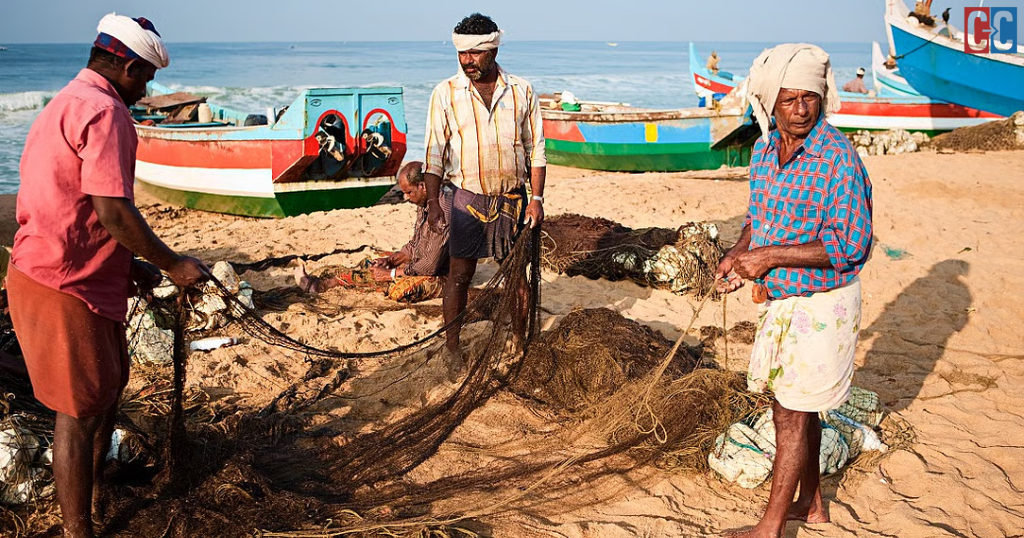
Kerala’s government and fish worker unions warn that rules meant to unlock India’s deep-sea fishing potential could favour corporate players over the cooperatives and traditional fishers they are pitched to protect.
PUDUCHERRY, September 2 — Union Minister for Fisheries, Animal Husbandry and Dairying and Panchayati Raj Rajiv Ranjan Singh inaugurated three fisheries infrastructure projects worth Rs 36.49 crore at Kamarajar Manimadapam, Puducherry, on September 1, the Department of Fisheries said, as part of a wider push to expand India’s coastal and deep-sea fishing economy that has drawn a mixed response from fishing communities.
The event, organised under the Pradhan Mantri Matsya Sampada Yojana (PMMSY) alongside a capacity-building conclave on cooperative-led seaweed farming, covered the upgrade of the Nallavadu Fish Landing Centre, improvements to Puducherry’s Thengaithittu Fishing Harbour, and a new seaweed-innovation centre at Karaikal. Officials said the seaweed initiative is meant to give coastal women an alternative income stream as pressure on near-shore catch volumes grows, a theme official returned to repeatedly through the day’s proceedings.

Table 1: The Rs 36.49-crore project break-up
| Project | Location | Amount (Rs crore) |
| Fish Landing Centre upgrade | Nallavadu | 18.94 |
| Fishing Harbour upgrade | Thengaithittu, Puducherry | 15.63 |
| Advanced Centre for Innovation & Capacity Development in Seaweed Farming | Karaikal | 1.92 |
| Total | — | 36.49 |
Source: Department of Fisheries / ANI, September 1, 2026.
The Union government also confirmed a larger regional pipeline: a Rs 119.94-crore Smart and Integrated Fishing Harbour under construction at Karaikal, and a fresh commitment to fund the Rs 67-crore Mahe Fishing Harbour project.
Singh linked the local launch to national reforms, citing figures ministry officials say show fisheries as a livelihood success story: India’s fish production rose from 95.7 lakh tonnes in 2013-14 to 197.7 lakh tonnes in 2024-25, while seafood exports more than doubled over the same period, from Rs 30,213 crore to Rs 62,408 crore, according to Marine Products Export Development Authority data. He said the Department has reduced the fee for a high-seas fishing authorisation from Rs 25,000 to Rs 5,000 to broaden access for cooperatives, and promised greater support for deep-sea vessels under the upcoming PMMSY 2.0.
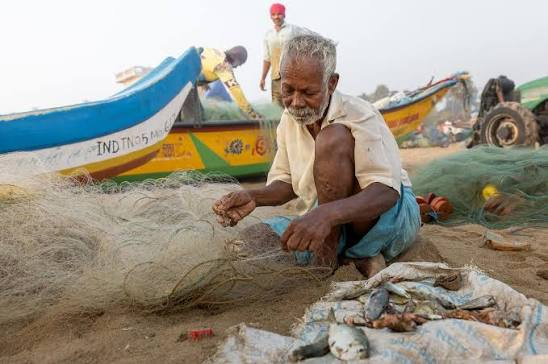
These changes build on the Rules for Sustainable Harnessing of Fisheries in the Exclusive Economic Zone, notified in November 2025, which introduced a digital Access Pass for mechanised vessels and a “mother-and-child vessel” model allowing catch transhipment at sea — provisions the government says prioritise fishing cooperatives and Fish Farmer Producer Organisations over large operators. Access Passes and high-seas Letters of Authorisation are being issued on a priority basis to fisheries cooperatives, women’s cooperatives and self-help groups, the Ministry has said, rather than to individual commercial operators — a distinction officials cite as central to the “cooperative-led approach” framing Tuesday’s launch.
Not every coastal state agrees. Kerala’s government has formally objected to the EEZ Rules, telling its Assembly in February that a broad definition of “vessel owner” could let corporate entities operate on the same footing as small fishers, and warning that mid-sea transhipment could open the door to unregulated fishing. The state, whose waters support an estimated 1.5 million people, directly or indirectly dependent on fishing, has asked the Centre to exclude large companies from the definition of ownership and to build in a revenue-sharing mechanism with states — demands officials say remain unanswered.
Fish worker representatives describe a similar unease closer to the ground. Jackson Polayil, state president of the Kerala Swathantra Matsya Thozhilali Federation, told South First that traditional fishers are willing to adapt to the Blue Economy push, but stressed that change “cannot come at the cost of our very survival,” adding that the benefits of such reforms have historically skewed toward corporate players rather than small operators.
The stakes are considerable: a policy analysis by the US-based Mercatus Centre estimated that roughly two-thirds of India’s fisher families live below the poverty line, underscoring why infrastructure announcements such as Tuesday’s carry weight beyond their rupee value for coastal households.
Singh, for his part, sought to pre-empt such concerns at the Puducherry event itself, telling attendees the EEZ and high-seas provisions were designed to improve livelihoods for traditional fishing communities rather than to favour corporate interests. Minister of State S.P. Singh Baghel and Puducherry Chief Minister N. Rangasamy both framed the projects as part of a continuing effort to strengthen coastal livelihoods, food security, and employment under the scheme.
Clear Cut Livelihood Desk
New Delhi, UPDATED: September 02, 2026 18:30 IST
Written By: Yatharth Pathak