

- Simhon’s recovery journey in Assam shows how counselling, rehabilitation, meditation, yoga and vocational guidance through a District De-Addiction Centre helped him regain confidence and direction.
- His story highlights the human impact of substance use and the importance of accessible de-addiction and rehabilitation services for young people.
- With 768 de-addiction centres across India, government efforts are increasingly focused on helping individuals rebuild their lives and reconnect with their goals.
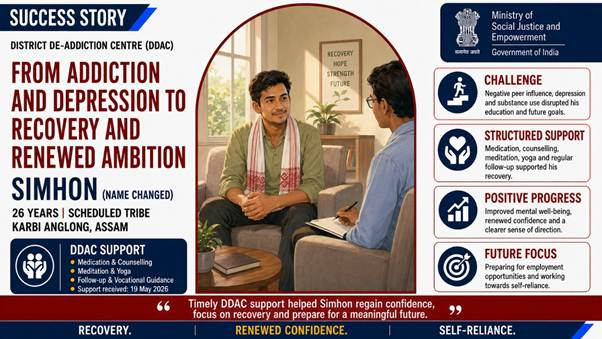
Someone, somewhere, says, “Let me try again,” and behind every recovery is that moment. For Simhon a 26-year-old Scheduled Tribe beneficiary from Karbi Anglong district of Assam, that moment came after years of personal struggle.

Simhon had received an education up to intermediate level and had once aspired to join the police service — a career that symbolized discipline, public service, and stability. But depression and negative peer influence took his life in another direction, slowly. His education was disrupted by drug use, which eroded his self-esteem and left him without a job even when his family was financially well off. As time went on, he felt increasingly alienated from the goals he once had. Simhon’s experience is personal, but the surrounding situation is one faced by millions of young Indians confronting substance use and emotional distress.
The human stories behind the national challenge
The extent of substance use in India indicates that this is much more than a separate social problem. It has become a major public health challenge. The Ministry of Social Justice & Empowerment’s national survey reveals that more than 7 crore people in India are affected by substance use disorder. This includes some 1.2 crore children and 58 lakh women. Independent research has put the figure even higher, with some estimates putting the number of Indians suffering from some form of substance dependence close to 7.5 crore.
The impact is equally visible at the state level. Over 15,000 beneficiaries were helped by the government-sponsored de-addiction programs in Assam in 2020-21. The following year, the figure jumped to over 26,000. The numbers underscore that substance use is not just a national statistic — it is a challenge for communities and families on the ground.
When Substance Use Starts Taking More Than It Gives
Addiction rarely impacts just the person dealing with it. Its impact often spills over into families, education, employment, and wider communities. For families, the emotional fallout can involve fractured relationships, loss of trust, and a slow erosion of hope. Simhon’s family was fairly well-off, but they, too, were affected by the disruption.
That is why effective intervention is more than judgment or critique. With timely treatment, counselling, and structured rehabilitation, people can be given the assistance they need to begin rebuilding their lives.
Why Rehabilitation Matters Beyond the Individual
The effects of substance use extend beyond individual and family hardship. They also impose high economic and social costs on the country. Peer-reviewed studies have estimated that alcohol consumption alone costs India nearly 1.45% of GDP every year. The total burden on society, including costs for health care, lost productivity, and law enforcement, runs into tens of crores of rupees annually. The social consequences are no less important. And families can be split up, schools can lose pupils, public health systems can be overwhelmed, and the cycle of addiction can be handed down from one generation to the next. So, for a country looking to maximize its demographic dividend, helping young people overcome substance use is not simply a welfare issue. It is also an investment in human potential and in the economy’s productivity.
This is where institutions like District De-Addiction Centres (DDACs) come into the picture, providing a structured support system that can help an individual move from dependency to recovery and independence.
Turning Point of Karbi Anglong
Simhon’s transformation began on 19 May 2026 when he joined the Integrated Society for Development, a Grant-in-Aid Centre working as a District De-Addiction Centre (DDAC) in Karbi Anglong. He was treated with something more than medicine. He had counselling, meditation, and yoga sessions, as well as regular, personalized guidance. Follow-up services and continued motivation kept him involved in the recovery process.
Over time, his mental health and his confidence started to improve as his treatment continued slowly. The intervention also exceeded recovery from substance use. Simhon received vocational guidance that enabled him to explore livelihood prospects, grasp the value of setting clear goals, and appreciate the significance of financial independence.
His experience is part of a much broader national effort.
The Ministry now operates 768 de-addiction and rehabilitation centres across India. Treatment-seeking has increased by 294%, rising from 2.08 lakh people in 2020 to more than 8.20 lakh in 2025. The national helpline, 14446, has received 4.69 lakh calls, providing an important first point of contact for individuals and families seeking help.
Behind each of these figures is a person, a family, or a community attempting to move towards recovery.
The First Signs of a New Future
Simhon’s story does not end with a job offer or an immediate improvement in income. He has not yet found employment, and no change in income has been recorded. But recovery does not always begin with visible financial outcomes. What has returned is something more fundamental: clarity. Simhon now has a better understanding of what he wants and what he needs to do to move towards that goal. After years of uncertainty, he once again has a sense of direction.
His journey demonstrates why de-addiction cannot be viewed simply as the treatment of a dependency. With timely medical support, empathetic counselling, rehabilitation, and vocational guidance, recovery can also become a process of rebuilding confidence, restoring purpose, and reconnecting young people with ambitions they may have thought were already lost.
In a country where crores of people are affected by substance use, stories such as Simhon’s show the human value of intervention. His recovery is still a work in progress — but finding the direction forward is itself an important beginning.
Clear Cut Health Desk
New Delhi, UPDATED: September 03, 2026 15:00 IST
Written By: RAAG