
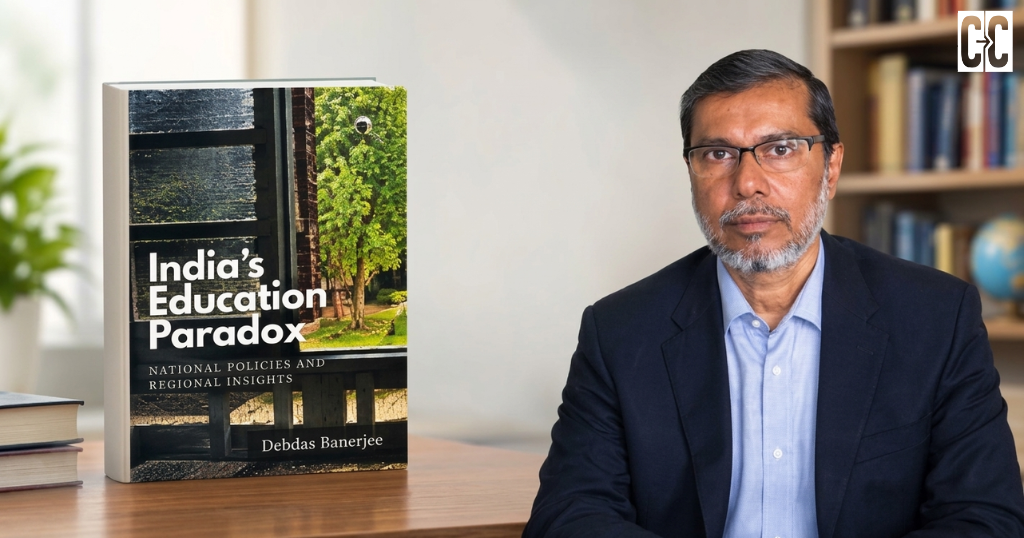
India’s Education Paradox by Debdas Banerjee examines regional inequalities in India’s education system and highlights how national averages can hide differences between states. The book explores school education, vocational training, higher education and NEP 2020, calling for more region-specific education planning.
India now enrolls more children in education than at any time in the country’s history; however,
the standards and uniformity of the education provided continue to depend to a great degree on the state into which a child has been born. Such are the inherent contradictions that economist Debdas Banerjee analyses in his 2024 book, India’s Education Paradox: National Policies and Regional Insights, published by Orient BlackSwan. Mr. Banerjee is a Fulbright post-doctoral fellow at the Massachusetts Institute of Technology (MIT) and a former professor at the Central University of South Bihar and the Institute of Development Studies, Kolkata. He brings decades of research on regional disparity and human development to a single sustained argument. India’s national education policies routinely fail to account for different ways the states experience schooling, skilling, and higher education.

Spanning 328 pages across 3 sections, the book reads like a data-driven audit of Indian
education policy. The central provocation of the book is that national indicators such as
literacy rates, enrolment ratios, and learning outcomes are usually reported as averages.
Education economist J.B.G. Tilak notes that this volume pushes readers towards the
analytical models. It further highlights the need to understand state-level divergence in
outcomes, despite receiving similar policy inputs from the Centre.
Section 1: Equity, Not Just Equality.
The book begins by setting out a theoretical foundation. Mr. Banerjee describes education
as a contested good, falling somewhere between a pure public good, a private good, and a merit good. He uses this uncertainty to argue for ongoing state involvement, citing market failure, fair access, and social unity as reasons. Mr. Banerjee compares 2 major ideas of fairness: John Rawls’s justice-as-fairness and equality of opportunity, and Amartya
Sen’s capability approach. In the end, Mr. Banerjee favours Sen’s view, saying that equality
in Indian education should be measured by the real chance children everywhere have to
learn and turn schooling into real opportunities.
Section 2: The Uneven Classrooms
The 2nd section makes the regional inequality argument more specific by focusing on school education. Mr. Banerjee shares data that show some surprising trends. For instance, average years of schooling do not clearly align with income inequality or poverty levels. In several states, dropout rates for people aged 5-29 are actually lower among poorer groups than
many would expect. Instead of seeing this as a positive sign, Mr. Banerjee argues it points to both obvious and hidden exclusion. Many children are still listed as enrolled, but they are not
really taking part in meaningful learning.
He is particularly critical about how budget cuts are changing government schools from the
inside. Poorer families still prefer these schools. But closing or merging schools with few
students and hiring untrained teachers gradually weakens the schools that poor communities
rely on most. He believes this leads to a system that shifts from helping children think and
imagine to focusing solely on test preparation, undermining the core of the education system.
The book surveys vocational education and training and accounts for persistently low enrolment in India’s skilling programmes at both school and higher-education levels. Mr.
Banerjee resists romanticising vocational tracks either; his comparison of Finland, China, and South Korea, each with a different state-market configuration for vocational training, is used to show that no single model transfers cleanly to India. That low uptake here reflects deeper structural and social-perception problems rather than a simple shortage of programmes.
In addition, the book takes stock of vocational education and training, noting consistently low enrolment rates in India’s skilling initiatives at the secondary and higher education levels.
Once again, Banerjee refrains from glorifying vocational streams; his comparative assessment of Finland, China, and South Korea, each with distinct state-market configurations in its vocational training system, is intended to show that there is no single model of vocational skills
development suitable for India. At the same time, low enrolment is due to structural issues and social perception, rather than a lack of programmes.
Section 3: Isolated excellence of higher education institutions
The last section of the book is arguably its strongest. Mr. Banerjee criticizes the policy of directing large sums of money into a few top-class institutions, which he considers a strategy
of creating ‘islands in the ocean of mediocrity’, rather than helping the overall system bear responsibility for developing a capable workforce. At the same time, he attributes this strategy to a decline in India’s Academic Freedom Index and increasing centralisation in policy-making, evident in the constant flow of guidelines issued by the University Grants Commission and in the one-agency approach of the newly created National Testing Agency, conducting entrance exams for undergraduate and postgraduate admissions and fellowships in India.
The strongest statement in the book refers to the autonomy of higher education institutions. Banerjee claims that the recently acquired autonomy of higher education institutions actually means autonomy in fee increases, thus excluding more and more low-income students from participation in the process of higher education, which was considered the goal of such reform. This financial problem is largely attributed to the erosion of federalism, in which funding responsibilities between the federal government and the states are not clearly delineated and are fulfilled collectively.
The regional inequality argument, and where NEP
2020 fits
What ties the 3 parts together is Mr. Banerjee’s emphasis on regional breakdowns. He is not stating that the ambition is missing from the Indian education policy. However, the draft versions prepared by the MoE before the NEP outlined ambitious targets regarding equity and quality of education. His thesis is that policies rely on national averages for evaluation; therefore, they fail to address issues appropriately.
An honest assessment
The book’s merit lies in the vast amount of data used in its preparation. The author gathers
the majority of the data in his capacity as a Senior Fellow of the ICSSR, hosted by IDSK
in Kolkata. Hence, it becomes an excellent reference book for researchers, educators, and
policy planners, rather than an easy read. With the book packed full of statistical analysis
and spanning 328 pages, it requires careful reading. Those looking for a concise account
of NEP 2020 would find Banerjee’s analytical approach more appropriate once they have
become familiar with the issue at hand.
A call for disaggregated planning
India’s Education Paradox emerges as the country grapples with the consequences of the
NEP 2020. Its caution is timely – the idea of a single national policy does not do justice to the
problem of understanding how differently states perceive and feel the education issue. Banerjee calls for strengthening institutions, adopting fiscal federalism as a shared responsibility, and assessing performance by regional capabilities rather than national averages. His recommendations deserve serious consideration from policymakers, whom he questions in the book. If the planners of Indian education wish to bridge the gap between constitutional promise and reality, they would have to consider Banerjee’s recommendations.
Clear Cut Education Desk
New Delhi, UPDATED: September 29, 2026 13:00 IST
Written By: Tanmay J. Urs