
The inaugural Clear-Cut Education Awards 2026 recognised four organisations working to improve learning opportunities for vulnerable children across India. Katha, Jamghat Pathshala, NEAID and Agrasar Foundation were honoured for their innovative approaches to community-led education, school transformation and inclusive learning.
Thirty-three years separate the oldest and youngest of this year’s winners. Katha began in 1988 and went on to build a school in a Delhi slum. Jamghat Pathshala began in 2021, with about eight children studying under a tree outside a Noida temple.
On 30 September, at the closing session of the inaugural Clear-Cut Education Summit at Silver Oak, India Habitat Centre, the first Clear-Cut Education Awards 2026 — presented by renowned author and motivational speaker Shiv Khera — honoured both, together with two organisations from Assam and Gurugram.
What links them is not size, age or geography but an answer to one question: what happens
to the child the school system does not reach? For these four, the answer was a pavement
classroom, a story-led lab school, a whole-school makeover in Assam and a learning centre for migrant workers children. Hosted by Clear Cut Magazine, the awards carried a single uncompromising motto – recognition of a commitment to creating meaningful learning opportunities for vulnerable children.
The awards were built to look past big budgets and big brands. The CommunityLed Education Transformation Award goes to initiatives where communities are “not merely beneficiaries but active partners” in educational change. The NGO and Civil Society Innovation Award rewards
organisations that have turned innovative programmes into measurable gains in learning, access, equity or teacher development. The Jury Award honours leadership that has shaped Indian education over years rather than through a single programme. Size was never the test: the community category capped annual budgets at ₹1 crore, the NGO category used budget bands only for peer benchmarking, and the Jury Award set no financial threshold.
How the Jury Judged
Every nomination was independently reviewed against a weighted framework, summarised below.
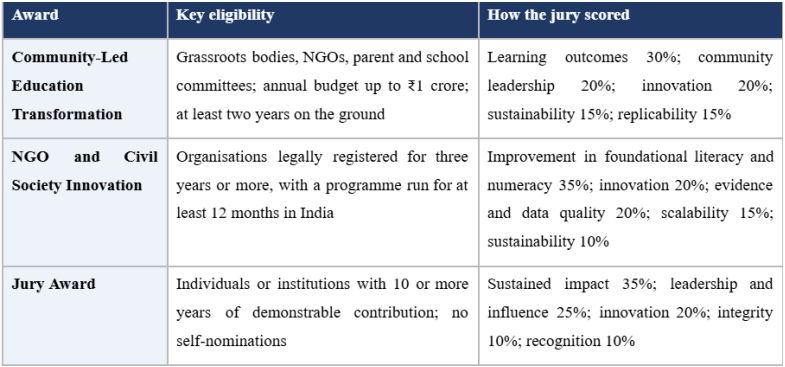
The weights tell their own story. Evidence of learning carried the most marks in both competitive categories, 30 percent in the community award and 35 percent in the NGO award, where gains had to be shown through baseline, midline and end line data. Good intentions without results did not score. Branches of large national NGOs nominated to fit the budget ceiling were excluded, as were organisations doing only research, advocacy, grant-making or consulting. The Jury Award could not be self-nominated, and the jury could decline to confer it if no nominee met the standard.
The Jury panel comprised Dr P.K. Biswas, Visiting Professor at Nalanda University; Paresh Kumar, Managing Editor of Clear-Cut Magazine; and KK Upadhyay, Professor of Sustainability and CSR at BIMTECH.
The Winners
Jamghat Pathshala | Jury Special Award: the school with no walls
Every morning, as soon as founder Richa Anirudh’s car arrives, the children rush to spread floor mats on a pavement in Noida’s Sector 137. That is the classroom. Anirudh, a journalist, started it in 2021 after seeing a few children sitting outside a temple, and by April 2022 around 200 children were attending from Monday to Saturday, taught in three groups by volunteers and two teachers. Neighbours chipped in with stationery, fruit and clothes. The aim has never
changed: put every child back in school.
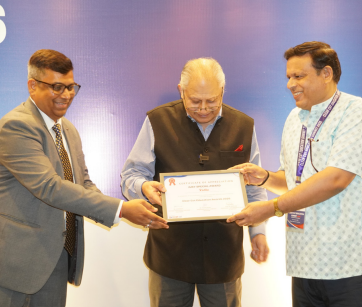
Katha | Jury Special Award: where stories do the teaching
Geeta Dharmarajan, an Ashoka Fellow since 2025, founded Katha in 1988 on a simple bet that children learn best through stories. Its Katha Lab School in the slums of Govindpuri is a low-cost community school. According to its Give.do profile, Lab School students have a 100 per cent pass rate in NIOS Class X and XII examinations, while its I Love Reading programme runs in over 1,000 schools with 400,000 children and has trained more than 6,000 government school teachers. The same profile is candid about the harder number: 32.7 per cent of children reached grade-level reading.
NEAID | NGO and Civil Society Innovation: Rebuilding the whole school
In Assam, the share of Std III children who could read at Std II level fell from 19.9 per cent to 17.9 per cent between 2018 and 2022, the Guwahati-based Northeast Centre for Equity Action on Integrated Development (NEAID) notes in its 2022-23 annual report. Its answer is Whole School Transformation: baseline assessments in 78 schools, vision-setting workshops across 45, and orientation for over 100 teachers on NEP 2020 and foundational learning. Its STEM for Girls programme reached 200 government secondary schools in 28 districts and trained 424
teachers.
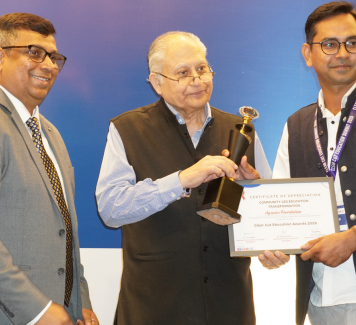
Agrasar Foundation | Community-Led Education Transformation: Ten expected, 80 came
When Agrasar opened Agrasar Bachpan, a nonformal learning centre in Gurugram, it prepared for ten children. More than 80 came on the first day, says Prerit Rana, who leads the organisation. The government school was too far, admission asked for documents migrant families often lack, and private fees were out of reach. The centres keep parents involved and work to move children into formal schools; its Give.do profile records 234 out-of-school children enrolled for mainstreaming in 2018-19. Agrasar also tackles corporal punishment, citing research that 65 percent of children are physically punished by teachers, migrant workers’ children worst of all.
Clear Cut Education, Awards & Event Desk
New Delhi, UPDATED: November 02, 2026 15:00 IST
Written By: Yatharth Pathak