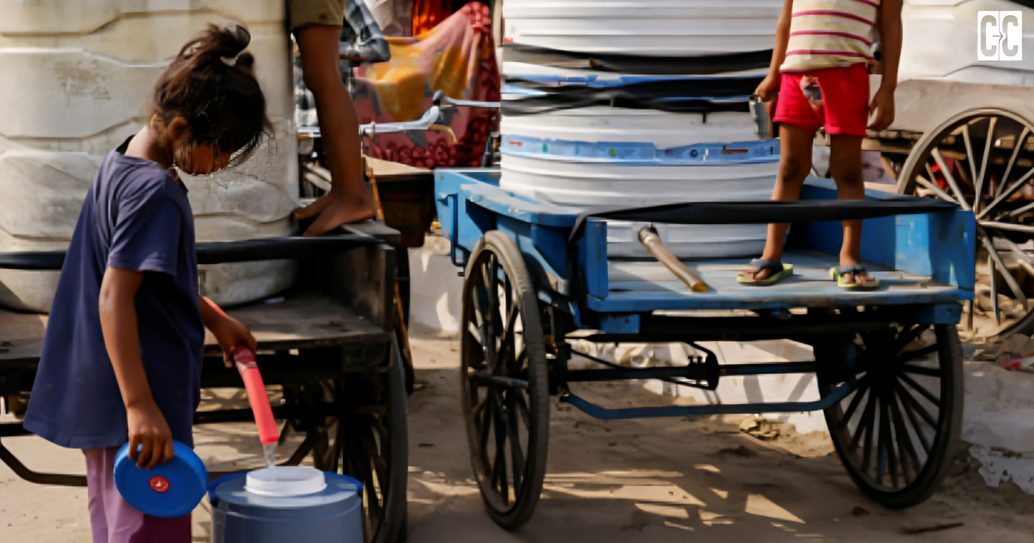

Moving beyond infrastructure coverage to understand whether water, sanitation, and hygiene interventions deliver safe, reliable, and equitable services.
The infrastructure paradox: Access does not always mean water security
Imagine a village where every household has a tap connection. On paper, the village has made substantial progress towards universal access to drinking water. But what happens when the taps run dry for several days, the supply is insufficient for daily needs, or water quality tests reveal contamination?
This is the distinction between infrastructure provision and effective service delivery.
India’s Jal Jeevan Mission (JJM) offers a useful illustration. According to the Ministry of Jal Shakti’s Functionality Assessment of Household Tap Connections National Report 2024, tap connections were available in 98.1% of households surveyed in villages covered by the assessment. However, 86.5% had working connections, 80.2% received water in adequate quantities, 83.6% received water regularly according to the prescribed supply schedule, and 76% received water meeting prescribed quality standards.
The independent third-party assessment covered 237,608 households across 19,812 villages in 761 districts across 34 States and Union Territories (UTs).
These findings demonstrate why infrastructure coverage alone cannot establish whether households are receiving an adequate water service. They also highlight the need to examine different aspects of service performance separately: a connection may exist without functioning consistently, and a functioning connection does not automatically guarantee sufficient or safe water.
For programmes working across water, sanitation and hygiene (WASH), the challenge is therefore not simply to deliver infrastructure. It is to ensure that the infrastructure translates into sustained, safe and equitable access to essential services.
What does water security actually mean?
Water security is broader than the availability of a water source. At the household level, it involves having sufficient water of acceptable quality, when needed, without unreasonable financial, physical or time-related burdens.
The World Health Organization (WHO) and UNICEF Joint Monitoring Programme (JMP) provides an important benchmark through its definition of safely managed drinking-water services. These require an improved water source that is accessible on premises, available when needed and free from faecal and priority chemical contamination.
However, household access is only one part of the wider water-security challenge. Long-term water security also depends on the sustainability of water sources, groundwater conditions, seasonal availability, climate variability and the capacity of institutions to manage competing demands.
A village may receive piped water today but remain vulnerable to seasonal shortages if its source is unreliable. Similarly, a household may have a nearby water source but still face difficulties if supply interruptions force it to purchase water from private vendors or collect it from distant alternatives. World Health Organization’s Domestic water quantity, service level and health guide 2020 emphasizes that adequate household water supplies are essential for drinking, food preparation and personal hygiene, supporting public health, well-being and overall quality of life.
World Health Organization’s (WHO) Guidelines for Drinking-water Quality: Fourth Edition Incorporating the First and Second Addenda (2022) recommends setting health-based targets, implementing Water Safety Plans to identify and manage risks across the entire water supply chain, and conducting independent surveillance to verify water safety. The guidelines also provide recommendations on microbial, chemical and radiological contaminants, water quality monitoring, and the management of emerging risks.
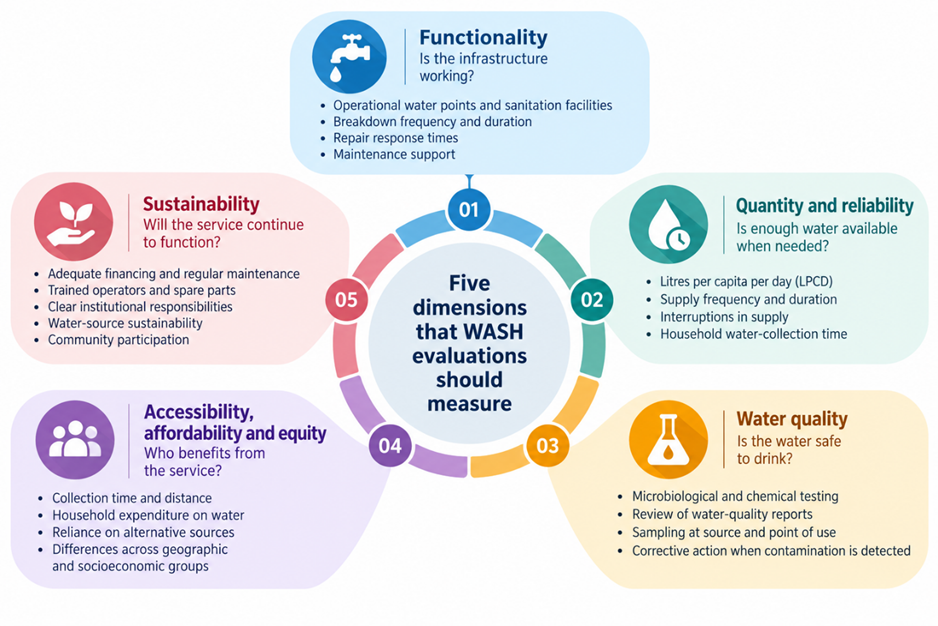
For WASH programmes, this distinction matters. An evaluation must establish not only whether an intervention has improved access, but also whether that access is dependable, safe, affordable and likely to continue.
The measurement gap: What administrative data cannot tell us
Administrative data track programme coverage, expenditure and infrastructure delivery, but may not reflect households’ actual experiences. A recorded water connection may supply water irregularly, while water-quality compliance at the source does not guarantee safety throughout the distribution system.
Combining data sources provides a more complete picture. Household surveys assess access, reliability and affordability; physical inspections verify functionality; water-quality tests assess safety; and interviews with communities and operators help explain service gaps. Repeat assessments can also capture seasonal shortages and intermittent failures.
The goal is not simply to collect more data, but to understand what is happening, for whom and why.
From measurement to action: Designing stronger WASH evaluations
Effective WASH evaluations begin with clearly defined outcomes and relevant indicators covering functionality, water quantity, regularity, quality, accessibility, equity and sustainability.
Baseline and follow-up assessments can track changes over time, while household surveys, interviews, inspections and water-quality tests help verify reported progress. Routine monitoring assesses service delivery, outcome evaluations examine changes in access and experience, and impact evaluations use appropriate designs to assess causal effects.
Most importantly, findings should inform corrective action. Repeated breakdowns may require better maintenance, contamination may demand stronger testing and response protocols, and unequal access may call for targeted investments.
Evaluation creates value when evidence leads to better decisions, clear accountability and sustained improvements in WASH services.
Rethinking success: From assets delivered to services sustained
WASH interventions play a vital role in expanding access to essential services. Yet the number of facilities constructed or connections provided is only one part of the story.
For programme managers, policymakers, CSR funders and evaluators, the challenge is to establish whether infrastructure translates into services that are safe, reliable, accessible and sustainable. Doing so requires a combination of administrative records, household-level evidence, physical verification, water-quality testing and meaningful community engagement.
The lesson is not that infrastructure coverage is unimportant. It is that coverage must be complemented by evidence of service performance and the outcomes that services are intended to support.
Ultimately, the success of a WASH intervention should not be measured only by whether a water point exists, but by whether people can depend on it for safe and sufficient water, today and over time.
Clear Cut Health Desk
New Delhi, UPDATED: November 11, 2026 16:00 IST
Written By: Clear Cut Editorial Team