
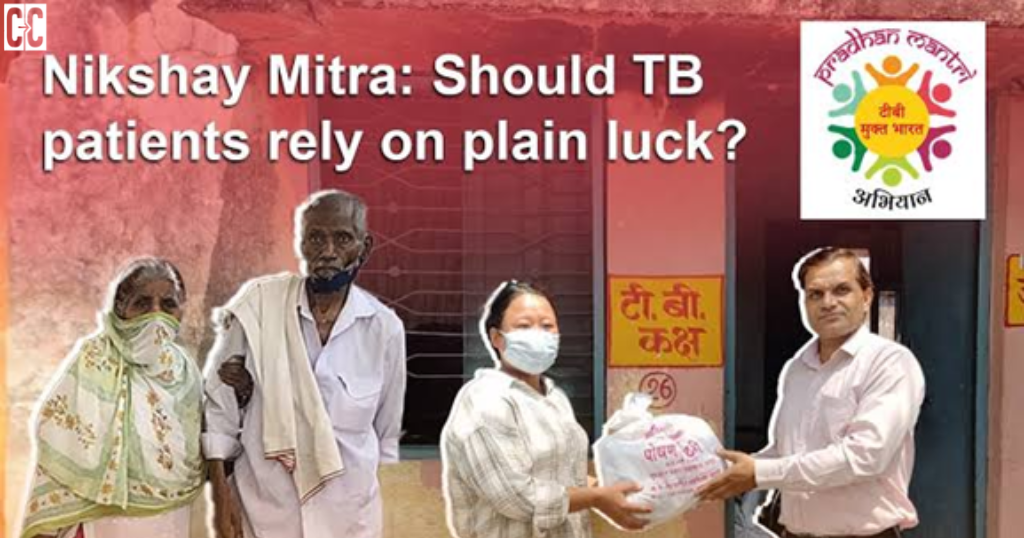
A study from Vadodara highlights gaps in the Ni-kshay Mitra scheme, revealing how donor availability, patient consent and inconsistent CSR support affect nutritional assistance for tuberculosis patients. It emphasises the need for reliable donor commitments, better distribution systems and sustained nutritional support throughout TB treatment.
Three numbers from one city
2,068 persons with drug-sensitive TB in Vadodara were informed of their right to a monthly food kit from a donor under the Ni-kshay Mitra scheme between January and June 2025. Of them, 1,238 (60%) opted to take the kits. Of these, 666 (32%) received one kit. Sixty-eight people (3%) received six or more kits, which would be sufficient for the whole course of treatment (Chavda et al., 2026).
This data is obtained from an operational study conducted by the researchers of GMERS Medical College, the Vadodara Municipal Corporation, and the Union, published on 24 August 2026.
The operation of the scheme
The Government of India launched Ni-kshay Mitra in September 2022. An individual or organisation adopts a TB patient and donates a monthly food kit worth at least ₹800. The donors in Vadodara are NGOs, service clubs, elected representatives and CSR units. As per the latest guidelines, there are about 23 lakh TB patients who benefit from about 7 lakh Ni-kshay Mitras (National Tuberculosis Elimination Programme, 2026).
Where the gaps were
The patient’s access to the kits depended largely on donor availability. There were specific urban primary health centres which were associated with donors. Hence, several patients remained uncovered due to no active donors, despite staying close to the centre and being in need. The medical officers often gave priority to the underweight or poorer patients whenever the supplies ran short.
The consent provided by the pateints varied highly, which made a big difference to the scheme’s impact too. The notifications passed by public sectors received 82% of the patients’ consent, whereas only 29% of patients gave their consent among those who were referred privately. Patients also cited social stigma, confidentiality, and willingness to offer support for the needy. Some patients had problems because of early withdrawal of one of the major donors midway through the cohort treatment.
Programme managers reported NGOs as the most dependable donors. Individual donors and elected representatives became disinterested over time. CSR donors struggled to handle procurement and distribution. This conclusion comes from interviews with just three donors, including one CSR manager, and should be seen as a signal rather than a measure (Chavda et al., 2026).
Outcome improvement analysis
The unsuccessful treatment outcomes reduced from 7% in January-June 2022 to 6% in January-June 2023. This difference was not significant. Several authors highlighted that the coverage was too low, to produce an effect. They noted that a before-and-after comparison could not establish a cause (Chavda et al., 2026).
287 out of 304 patients in Haridwar of Uttarakhand, completed their treatment regime successfully through a CSR and NGO model (Singh et al., 2025). 517 of the 1,055 patients who consented in Puducherry for the donor food kits, received atleast 3 food baskets (Gouroumourty et al., 2025).
The Vadodara authors do not question the case for nutritional support. They cite earlier research showing that it improves treatment outcomes. Their finding is about delivery.
Lessons for corporate donors
The authors propose that donors in CSR, who can serve large numbers of patients, would be more appropriate through NGOs or through bulk procurement along with home delivery. This way would reduce the cost for patients to visit camps. They also recommend prioritizing the malnourished patients in case of scarcity of supply.
Another issue that arises but has not been tested in the study is that of the standard duration of treatment for TB patients. The duration of treatment for TB patients is six months. The budget for CSR programs is planned on a yearly basis. Is an annual cycle for planning appropriate in a case where a person begins his/her treatment late in the financial year? Only the Vadodara data indicates that the withdrawal of donors midway through the treatment period affected treatment.
Practical solutions were also provided by programme staff. First, kits as per initial requirements were bulky in nature. With the replacement of cereals with other nutritious items like pulses, it became easier for the patients to accept them. The staff added items that were ready-to-eat, such as groundnuts and jaggery, as patients shared kits among their families. Long waiting hours, loss of wages, and transportation costs were treated as the reason for no distribution camps around.
These minute design changes determined whether the donated kits reached the patients it was meant for. A high consent rate from the patients would still mean nothing, if the donor commitments would not match the length of the treatment.
Clear Cut Health Desk
New Delhi, UPDATED: November 17, 2026 23:00 IST
Written By: Tanmay J. Urs