

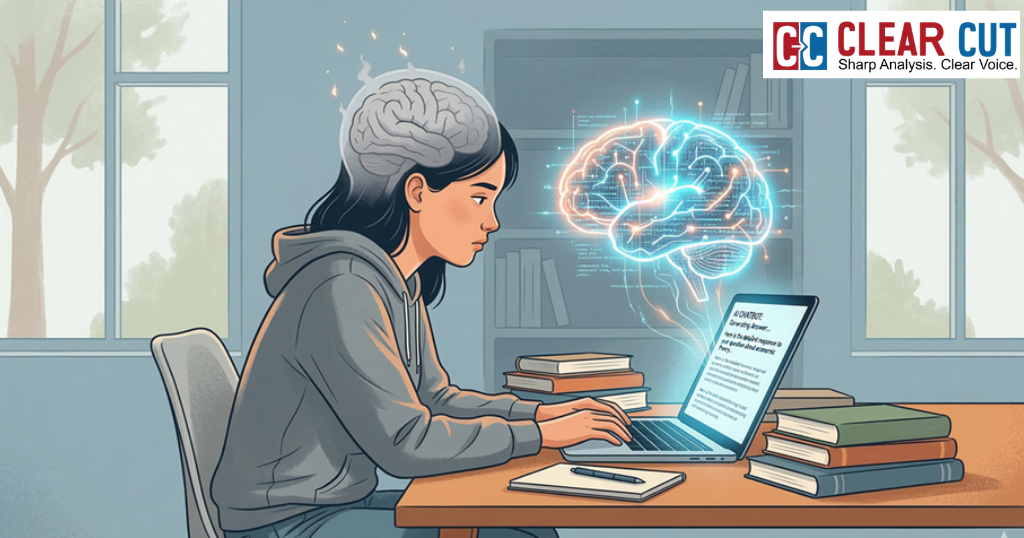
A recent study in Social Sciences & Humanities Open found that students who used ChatGPT while studying finished tasks faster but remembered less information after 45 days. The research suggests the impact of AI on learning may lead to faster work but weaker long-term knowledge retention.
A university student sits in front of her laptop, struggling to understand a concept for an assignment. Instead of opening a textbook or searching through lecture notes, she types a question into an AI chatbot. Within seconds, the answer appears, which is clear, structured, and ready to use.
The task becomes easy. The assignment gets finished quickly.
But there is a quiet question researchers are beginning to ask: If machines start doing the thinking for us, what happens to our own ability to learn?
A recent scientific study published in Social Sciences & Humanities Open explores this concern. The research examined how using ChatGPT during study affects what students actually remember weeks later. The results raise an uncomfortable possibility. While AI may make learning faster, it may also make it shallower.
A simple experiment with an important question
To investigate the effect of AI on learning, researchers conducted a randomized controlled experiment with 120 university students studying business administration.
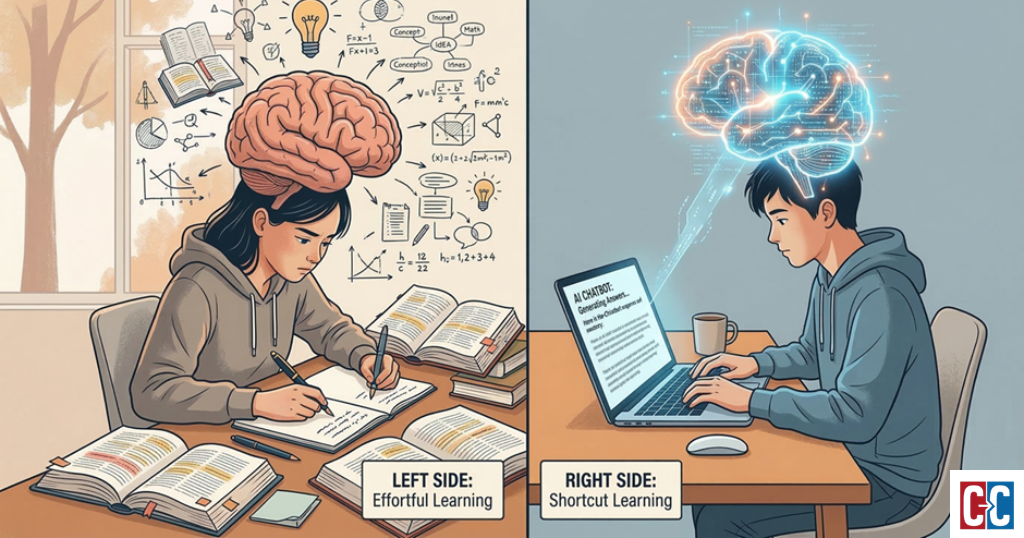
The students were divided into two groups.
- AI-assisted group: Students were allowed to use ChatGPT while studying.
- Traditional group: Students studied using normal resources such as textbooks, articles, and search engines but without AI tools.
Both groups were asked to learn topics related to artificial intelligence and machine learning and then prepare short presentations explaining the concepts.
The design of the study was simple but clever.
Instead of testing students immediately after learning the researchers conducted a surprise test 45 days later.
The goal was to measure long-term knowledge retention: what students truly remembered after more than a month.
What the researchers discovered
The results showed a clear difference between the two groups.
Students who studied using traditional methods performed better on the surprise test than those who relied on ChatGPT.
- Traditional learners: average score 6.85 out of 10
- AI-assisted learners: average score 5.75 out of 10
The gap may appear small, but it represents about an 11% difference in retained knowledge after 45 days.
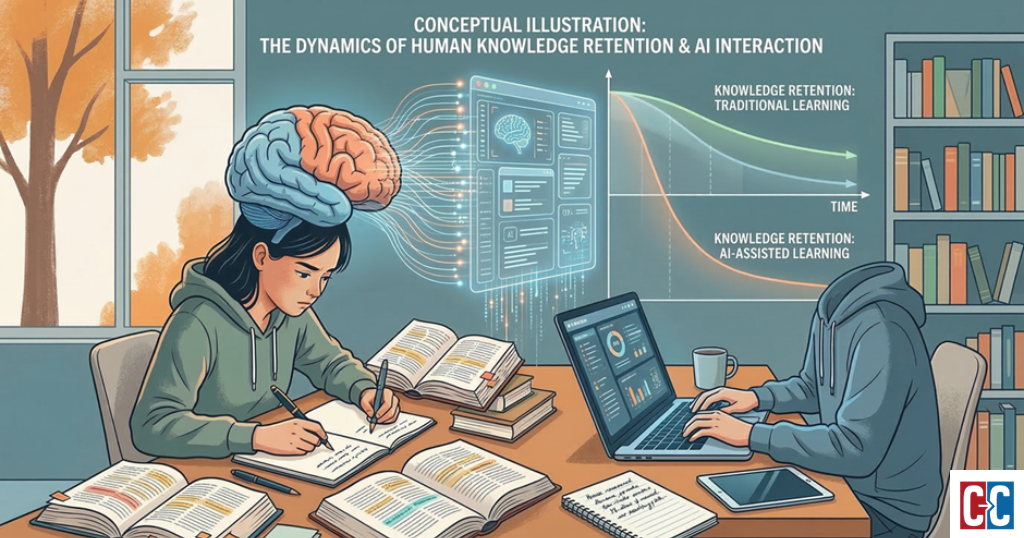
In many academic settings, the authors note, such a difference could easily translate into a full letter-grade gap between students.
Another finding was equally revealing.
Students who used AI spent far less time studying:
- Traditional learners studied about 5.8 hours
- AI users studied about 3.2 hours
In other words, AI helped students finish the task faster, but they also remembered less.
Even after researchers adjusted for the difference in study time, the learning gap still remained.
Why might this happen?
The researchers explain the findings using a concept known as cognitive offloading.
Human beings often rely on external tools to reduce mental effort. Writing things down in notebooks, setting reminders on phones, or using calculators are all examples of this behavior.
AI, however, goes much further.
Instead of simply storing information, AI can generate explanations, organize ideas, and even produce arguments or essays.
When students rely heavily on such tools, much of the thinking process may be shifted away from their own minds.
The brain, in effect, does less work.
The role of struggle in learning
Another key idea behind the study comes from educational psychology: “desirable difficulties.”
This theory suggests that learning often becomes stronger when it involves effort and struggle. Trying to recall information, solving problems independently, and grappling with difficult concepts all help strengthen memory.
These challenges force the brain to actively process and reorganize knowledge.
But when AI provides immediate answers, those struggles can disappear.
Students may understand a concept quickly, yet the information may not be deeply encoded in memory.
The study found evidence supporting this explanation. The group that relied on ChatGPT showed a steeper decline in knowledge over time, suggesting that the information was stored less strongly from the beginning.
Experience with AI did not help
Interestingly, the researchers also examined whether students who were already familiar with AI tools performed better.
They did not.
The relationship between prior AI experience and test scores was weak and statistically insignificant.
In other words, even frequent users of AI did not appear immune to the learning effect.
The researchers describe a possible explanation they call “borrowed competence.”
AI can produce answers that sound sophisticated and well structured. When students read or present such material, they may feel they have mastered the concept — even if they have not deeply processed it themselves.
The confidence is real, but the learning may be shallow.
Should AI be avoided in education?
The authors are careful not to argue that AI should be banned from classrooms.
Artificial intelligence can still be extremely useful for learning. It can explain difficult topics, provide examples, and help students explore ideas quickly.
The problem arises when AI replaces the thinking process instead of supporting it.
The researchers suggest that AI should be used after students attempt problems themselves, rather than before.
For example:
- Students could first try solving a problem.
- Then they could ask AI to check their reasoning or explain gaps.
This approach keeps the mental effort — the “desirable difficulty” — while still benefiting from AI’s guidance.
A technology that changes how we think
Artificial intelligence is spreading rapidly through education and professional life. Students use it to write essays. Professionals use it to draft reports. Researchers use it to brainstorm ideas.
These tools save time and improve productivity.
But the study highlights a deeper issue: tools that reduce effort can also reshape how we think and learn.
Learning has always required patience, repetition, and struggle.
If those struggles disappear, the question is not whether tasks become easier. They clearly do. The question is whether our understanding becomes weaker in the process.
As AI becomes a constant companion in everyday work, the challenge for educators and professionals may not be how to stop using it.
The real challenge may be learning when not to use it.
Clear Cut Research, Education Desk
New Delhi, UPDATED: March 12, 2026 01:00 IST
Written By: Paresh Kumar