
India’s CSR model focuses on spending, not accountability—allowing child labour to persist deep within supply chains. Real change requires shifting from charity-based CSR to strict human rights due diligence.
Introduction
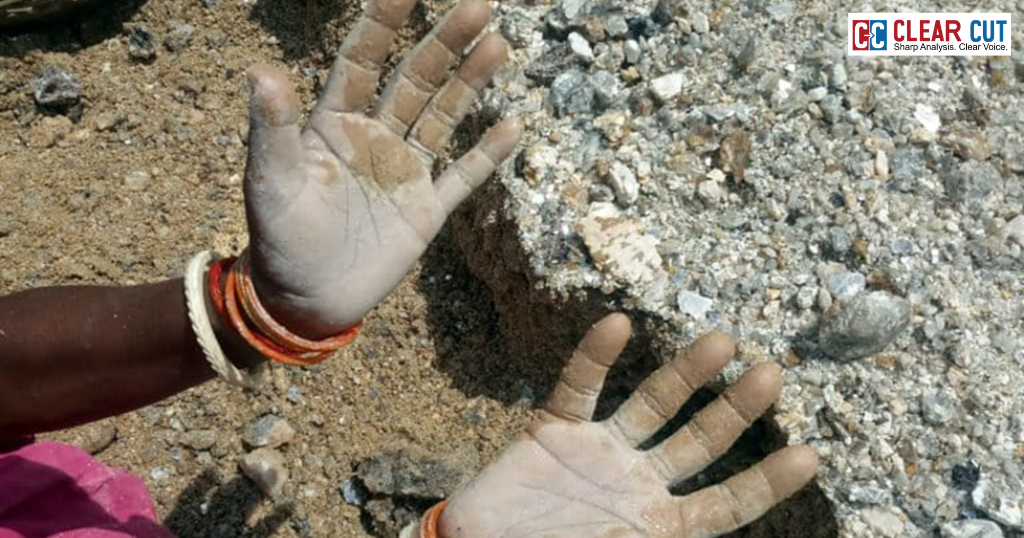
In the forested hills of Giridih district, Jharkhand, a 12-year-old girl named Priya helped her mother sift mica from the earth before school. On days when orders came in, there was no school. Mica is a shimmering mineral used in cosmetics, electronics, and automotive paint. The generations of families who dug these hills, never had a formal employment or a contract while serving. Priya’s mother knew the name of none of the companies whose products her work eventually entered. None of those companies knew Priya’s name either.
That invisibility is not accidental. It is architectural. It is built into the way Indian and global supply chains are structured. It is also the most critical accountability gap in India’s corporate social responsibility landscape today.
India is a global manufacturing hub. Its textile, mining, agriculture, and automotive sectors connect village-level informal labour to boardrooms in Mumbai, London, and New York. Somewhere along that chain, child labour persists. And somewhere along that same chain, a company’s CSR committee is deciding which school to fund this fiscal year.
The Scale of The Problem
According to the International Labour Organization, child labour stays widespread in global supply chains, with concentration in labour-intensive sectors relying on seasonal and informal workers. Both descriptions fit substantial portions of India’s export economy. India’s informal employment accounts for 84% of non-agricultural workers, according to supply chain accountability research by the Skoll Foundation. It is in this informal, subcontracted layer that child labour is most prevalent and most difficult to trace.
An investigative report by The Age revealed that 86% of India’s mica exports in 2010–11 was unregulated, with child labour endemic to the sector. A decade of audits and certifications later, the problem has been submerged, not solved. Social audits reach only first-tier factories. They do not reach the informal mines, home workers, or piece-rate labourers who form the true base of the production pyramid.
As Joost Kooijmans, Senior Advisor on Child Labour at UNICEF, has noted: look at the lower tiers of production chains, and few organisations have ability in doing this. Dan Viederman of Humanity United put it more bluntly: the number of companies that have successfully, on a sustained basis, dealt with child labour is far too close to zero.
The Structural Contradiction
Here is the central contradiction. Under Section 135 of the Companies Act, 2013, large Indian companies must spend 2% of their net profits on CSR activities. Education consistently receives the largest share: Rs. 10,085 crore in FY 2023–24.

And yet, a peer-reviewed November 2025 study on corporate accountability and CSR in India’s energy PSUs found that companies can satisfy the legal mandate through spending in entirely unrelated areas, even while their supply chains involve bonded labour, child labour, and poverty wages. The study called this “disguised voluntarism.” It is a system where compliance and accountability are formally separated, letting companies claim the CSR badge without addressing the harms their business model produces.
A cosmetics brand can fund a rural girls’ school in Rajasthan through its CSR arm while sourcing mica from unregulated mines in Jharkhand. Both are real. One is reported. One is not.
What Global Standards Demand vs. What India Requires
The gap between what global accountability frameworks now require and what India’s CSR law demands is widening rapidly. The UN Guiding Principles on Business and Human Rights (UNGPs, 2011) require companies to conduct ongoing human rights due diligence across all operations and supply chains, not as a CSR add-on, but as a core governance obligation. The EU’s Corporate Sustainability Due Diligence Directive (CSDDD, 2022) makes this legally binding for large companies working in EU markets, including those sourcing from India.
India’s Companies Act mandates spending. It does not mandate due diligence. A company is legally required to write a cheque for education. It is not legally required to verify that its tier-three suppliers employ no children. The result is a CSR framework that addresses symptoms while leaving the disease untouched.
The Centre for Child Rights and Business, which provides consulting services to Indian sourcing brands, noted in 2024 that child labour risks are particularly acute in agriculture. In 2025, it launched a Child Rights Action Hub in India’s peppermint sector, where child labour in harvesting has been documented but ignored by brands that source from it.
Accountability Points: What Must Change
Three shifts are both necessary and achievable. First, India’s CSR framework must expand from spend-based compliance to due diligence-based accountability. The MCA’s 2025 amendments tightened implementing agency requirements. The next amendment must require companies above a defined turnover threshold to show child labour risk assessments across tier-one and tier-two supply chains as part of their annual CSR report.
Second, social audits must go deeper. Multi-tier supply chain mapping, using NGO-mediated traceability rather than corporate self-reporting, is the only method that reaches informal workers where risk is concentrated.
Third, India should align with the UNGP framework through domestic legislation. The EU’s CSDDD is already creating de facto compliance requirements for Indian exporters. A domestic Human Rights Due Diligence law would bring accountability home and protect children like Priya from being the invisible cost of someone else’s profit.
Conclusion
Priya is not a statistic. She is a consequence. A consequence of a supply chain architecture that places profit extraction at the top and moral accountability at the bottom. She is also, indirectly, a consequence of a CSR system that measures virtue in crores spent rather than in harms prevented.
India’s corporate sector has the resources, the scale, and increasingly the regulatory pressure to change this. The EU’s CSDDD means Indian exporters will face supply chain due diligence requirements whether or not domestic law mandates it. The question is whether Indian companies wait to be compelled by foreign regulation or choose, of their own accord, to know what happens at the bottom of their supply chains.
The logo on the product Priya’s labour enters belongs to a company with the power to change her life. It has not yet chosen to use it. That choice is still available. It will not remain available indefinitely. A nation that calls itself a global manufacturing leader cannot sustain that title on the labour of children it refuses to see. The time for looking is now, and the tools to do so exist. What is missing is the will.
Clear Cut Child Protection, CSR Desk
New Delhi, UPDATED: April 26, 2026 09:00 IST
Written By: Tanmay J Urs