

Women’s empowerment is not just about access but about agency, control, and decision-making. Across rural and urban India, true empowerment remains constrained by deeply rooted structural and social barriers.
What if women’s empowerment is not about lifting women up rather about examining what has been holding them down? Who is being empowered? How? Under what conditions? And with what long-term impact? To move beyond conventional framing, we must dissect how empowerment is conceptualized, implemented, and lived — especially in the vastly different contexts of rural and urban India.
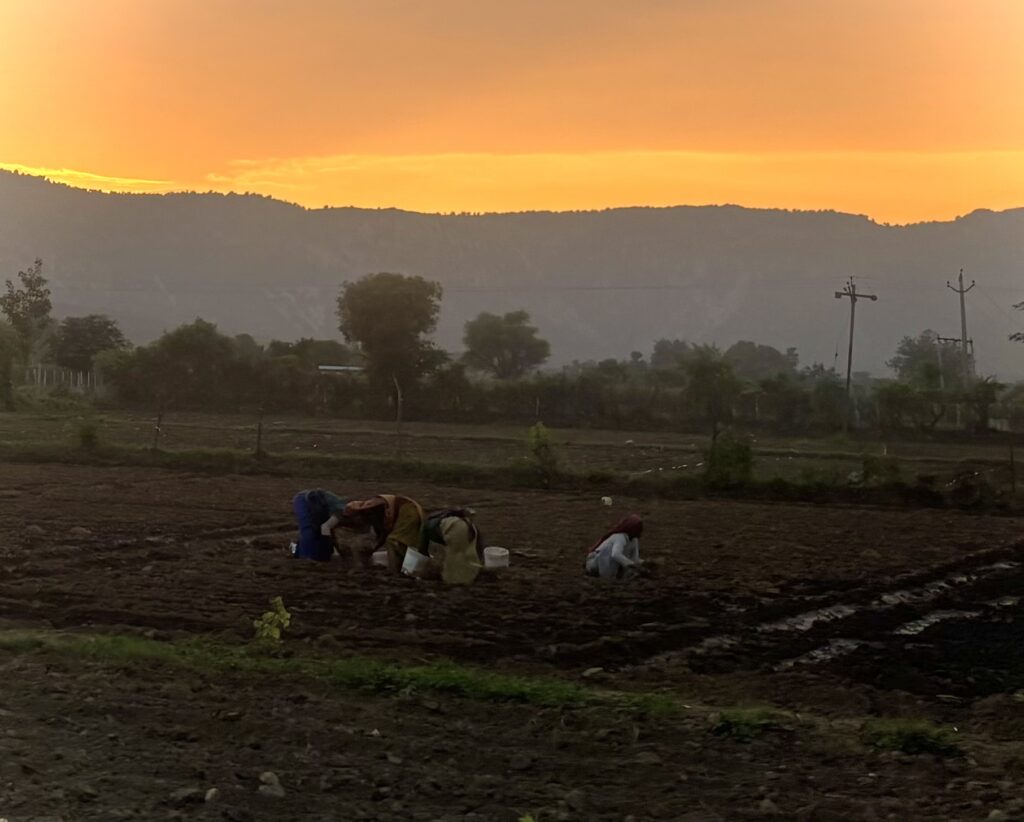
Let’s begin with a simple image. In a rural village, a woman attends a self-help group meeting. She signs her name on a bank document for the first time. In a metropolitan office tower, a woman presents quarterly results to a room full of senior executives. Two very different worlds. Yet both women are negotiating something deeply similar i.e. institutional recognition.
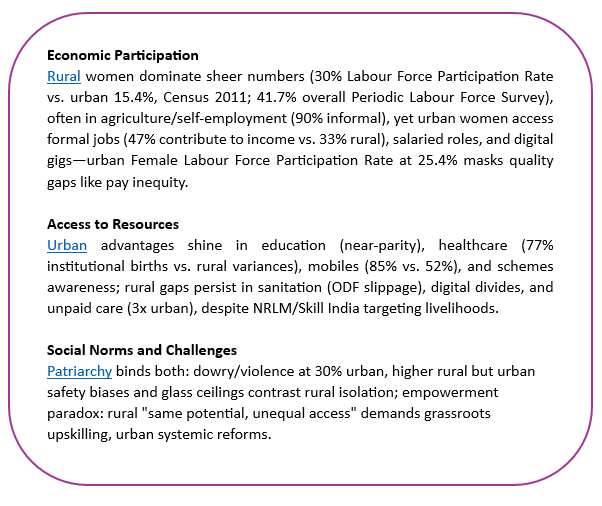
A ScienceDirect piece ssects India’s dual realities: urban women leverage education/politics, rural via economics, but both stall without holistic reforms, cultural patriarchy, informal labor traps, proposing lived-experience reforms over top-down quotas.
Across India’s villages and cities, women’s empowerment programs operate within vastly different landscapes. Women’s empowerment is often described through visible milestones. In rural contexts, empowerment programs focus on first-generation access like literacy, credit, and livelihoods. These are foundational and transformative. But they operate within tightly woven social norms that regulate mobility, ambition, and financial control.
In urban settings, women may have degrees, networks, and employment and focus shifts toward leadership pipelines, corporate diversity, entrepreneurship, and economic mobility. Yet glass ceilings, unpaid care burdens, and subtle workplace biases limit upward mobility.
So, the architecture differs.
The language differs.
The delivery models differ.
Yet the obstacles that delay true transformation are remarkably similar.
A Deeper Rationale
A program that equips women with a sewing machine, for example, may report an “empowerment success” if the machine is delivered and training completed. Yet if the revenue from the machine is collected by a male family member or if time for production is negotiated daily with other caretaking duties, empowerment has not substantively occurred.
A rural woman who joins a self-help group, an urban woman professional who secures a managerial role, a gig women worker who earns through a digital platform each represents movement. But does movement always translate into agency? Does income automatically convert into influence? Does access to technology guarantee autonomy?
At its core, women’s empowerment is not a programmatic outcome, is not merely entry into spaces. It is influence within them. This is why true empowerment must be judged not by inputs (training, assets) but by outcomes that reflect agency, decision-making power, and control over income and future choices.
Control over income remains contested.
Unpaid care work continues to shape time and mobility.
Social norms quietly dictate what is acceptable ambition.
Decision-making spaces whether in village councils or corporate boardrooms remain gender-skewed.
Rural vs Urban Empowerment Programs: Different Realities, Shared Goals
Women’s empowerment initiatives have mushroomed over the past few decades from self-help groups and microcredit schemes in villages to corporate gender diversity programs in urban centers. While the goal may be common, the ecosystems in which these programs operate are starkly different.
| Rural Context: Limited Access, High Aspirations | Urban Context: Skill with Opportunity, But Structural Gaps |
| In rural areas, programs often focus on: Self-Help Groups (SHGs) and microenterprises Skill development for livelihood diversification Financial inclusion (bank accounts, microcredit) Basic health and reproductive services | Urban programs tend to emphasize: Workforce participation Professional training and placement Leadership and entrepreneurship programs Corporate diversity, equity, and inclusion (DEI) initiatives |
| Rural empowerment programs often contend with: Limited mobility due to social norms Lower literacy and digital access Inadequate market linkages Seasonal livelihood constraints | Empowerment here is hindered by: Unpaid care responsibilities Workplace discrimination Culture of unpaid internships Glass ceilings |
| Underlying Biases in Both Contexts – Despite different settings, common biases emerge: Assumption of female ‘deficit’ (e.g., women lack skills/knowledge), instead of systemic bottlenecks. One-size-fits-all training models that do not account for local economic ecology. Tokenistic recognition rather than structural inclusion in decision-making. Emphasis on participation rather than power and control (who owns resources, who controls income). The geography changes; the gendered power structure does not. | |
The Platform Economy: A New Frontier, A Familiar Pattern
In today’s platform-driven and technology-mediated economy, empowerment is acquiring new dimensions. The platform economy may reduce physical mobility constraints like digital marketplaces promise flexible work, social commerce allows home-based entrepreneurship, gig platforms offer income without formal gatekeepers, financial technology connects women to credit without traditional intermediaries. All this is great and sounds revolutionary. And in many ways, it is. But does all this automatically neutralize gendered power relations?
Algorithms mirror social hierarchies.
Digital literacy gaps mirror educational inequalities.
Platform participation often replicates precarious work conditions without social protection.
Without safeguards, technology can scale opportunity and inequality simultaneously. Hence, the digital revolution should level the field to enable women for expansion of choice without penalty, ability to earn without surrendering control, lead without apology, speak without consequence, participate without permission.
Lived Transformation – From Celebration to Structural Change
Empowerment is a transformation of systems that have historically restricted, discounted, and invisible-ized women’s contributions. And it often gets stall at the intersection of policy intent and household power dynamics.
As International Women’s Day approaches, conversations around equality will intensify. We will celebrate resilience, leadership, and progress. And we should and rightly so. Celebration has symbolic power. Recognition matters.
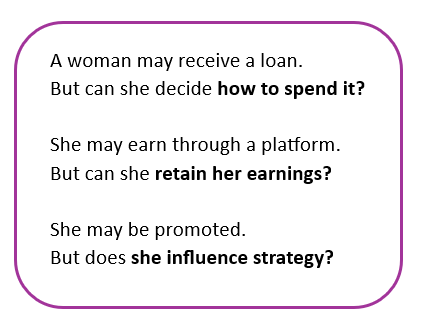
But this moment also calls for introspection. Perhaps the real call to action this year is not to limit applaud till participation but intentionally reframing programs around agency, access, acceptance and recalibrate what stakeholders, policy makers, corporates, resource agencies define as results and to audit power.
The behavioural shifts, renegotiated household dynamics, increased mobility, and subtle redistribution of decision-making power are “softer” indicators which are often dismissed as intangible because they resist immediate quantification. Yet they are precursors to structural change and the very foundations upon which durable change rests and.
To honor women’s leadership be it in cities, villages, markets, homes design policies and implementation frameworks shall be designed to see power as the true metric of empowerment. True transformation, particularly in patriarchal contexts is intergenerational and not linear and immediate. The question, therefore, is not only whether women are ready to lead change but also whether institutions commitments are patient enough to accommodate?
Deeper. And not louder.
Structural. And not symbolic.
Sustained. And not structural.
Clear Cut Gender, Livelihood Desk
New Delhi, UPDATED: April 08, 2026 05:46 IST
Written By: Sonali Maheshwari