
India has increased women’s participation in politics, business, and finance, but real decision-making power remains limited. The “agency gap” highlights the need to move from symbolic inclusion to true authority and control.
Along the path to becoming a global economic power by 2047, women’s empowerment in India has shifted from a social welfare concern to a strategic imperative. But now there is a shocking paradox of the modern landscape. Although the number of women on the ballots and boardrooms lists is increasing, the very question of the distribution of authority, the ability to make decisions, use the money, and be in charge, remains one of the most crucial structural bottlenecks of the development of the country. To be aware of the prevailing condition of equality, we have to move beyond the face value of membership measures and consider the “Agency Gap” across critical pillars: the political platform, the corporate high ground, financial autonomy and the social sector ecosystem.
The Political Paradox: From Village Squares to Judicial Benches
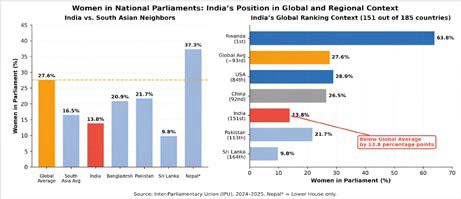
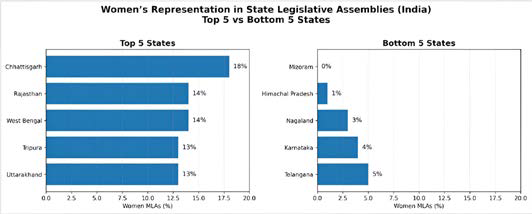
India’s political architecture for women is currently “bottom-heavy.” The 73rd and 74th Constitutional Amendments sparked a grassroots revolution, giving rise to a pipeline of leadership unmatched anywhere in the world. It has roughly 46% of female political leaders in local government and more than 1.45 million elected women representatives (EWRs) in the Panchayati Raj Institutions (PRIs). There is also a provision of 50% reservation for women in PRIs in 21 states. Currently, nationwide, women represent only 9% of members of state legislative assemblies (MLAs). The distribution at the state-level gives a glimpse of severe regional imbalance: Chhattisgarh has a maximum share of women MLAs – 18%; Himachal Pradesh has only one woman representative, and Mizoram reports zero. Not one state has come close to 20% female representation in its assembly. As attention shifts to the upper echelons of governance, representation remains low. In the 18th Lok Sabha (2024), women’s representation is only 13.8% (74 of 543),
far below the global average of 27.6%. In the rankings, India ranks 151st out of 185 countries. Even where formal representation is assured, especially at the village level, authority tends to be informal and gendered. In many cases, women have the legal signature, but men are still the functional voice. This, in practice, frequently takes the form of a woman sarpanch chairing the next meeting on the paper. At the same time, the more important bargaining, contractor decisions, block-level coordination, and political bargaining are made informally by male relatives or party agents. The matter of participation of women is documented in the institution, yet the ecosystem denies women legitimate power. Perhaps the most noticeable lag is the Temple of Justice. The India Justice Report 2025 indicates that women constitute only 14% of judges in High Courts and only 3.1% in the Supreme Court. While lower courts show a comparatively healthier 38%, the “Glass Ceiling” in the higher judiciary remains intact.
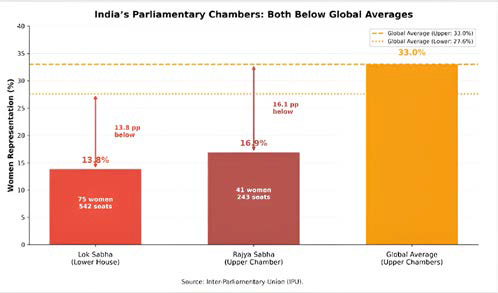
The Nari Shakti Vandan Adhiniyam (2023) is a historic attempt to address this by reserving 33% of Lok Sabha seats for women. However, with its implementation tied to the future census and delimitation, the authority of women in national policymaking is effectively on hold until the 2029 elections.
Leading at the Corporate Mid-Market, Missing at the Top
In the corporate world, India presents a story of rapid acceleration meeting stagnant peaks.
- The Indian Mid-Market Lead: Surprisingly, as per the Grant Thornton 2025 Women in Business report, women hold 36.5% of senior management positions in Indian mid-market businesses. The figure surpasses the global average of 34%.
- The “Broken Rung” and Functional Silos: Despite this, a look into the nature of these roles reveals a persistent lag:
- o P&L vs. Support: Women are often funnelled into “Support Functions” rather than Profit & Loss (P&L) roles. While women hold 48.5% of CFO roles, they hold only 11% of Chairperson roles.
- o The Attrition Trap: Retention remains a critical issue, cited as a low priority by nearly 75% of firms. Without systemic support for the “Double Burden” of unpaid care work, in which Indian women spend 299 minutes a day compared with men’s 97 minutes, the leadership pipeline remains “leaky” precisely at the mid-career stage.
The Financial Autonomy Myth: Accounts vs. Agency
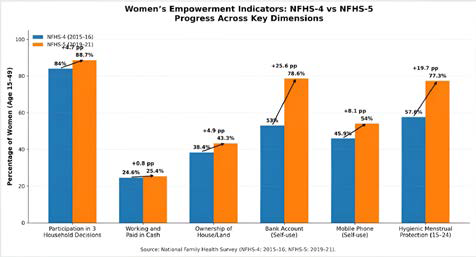
If political and corporate power are the visible branches of empowerment, financial agency is the root. India has a significant “inclusion miracle” to its credit in the form of the Pradhan Mantri Jan Dhan Yojana (PMJDY), which has successfully bridged the gap in account ownership. As of 2026, over 31 crore (310 million) women hold bank accounts, making up 56% of all Jan Dhan accounts. Data from the National Family Health Survey (NFHS-5) and the World Bank Gender Data (2024) make one reality clear: access is not the same as agency. While most married women (88.7%) report being involved in household decisions, only one in five (18%) say they can make high-value purchases independently. The digital divide further constrains this. Although bank account ownership is near universal in some areas, only half of women have a personal mobile phone, limiting their ability to spend money on their terms in an increasingly digital economy.
The Social Sector Blind Spot: When Empowerment Becomes a Box to Tick
The problem isn’t limited to government or corporations. Even in the social sector, NGOs, development programs, and empowerment initiatives often make mistakes between activities and impacts. Refer to any program report. The numbers look great: 50,000 women trained. 2,000 self-help Deep Dive / The Illusion of Empowerment 46 / clearcutmedia.co.in / March 2026 Edition groups formed. 100,000 bank accounts opened, or 85% attendance at panchayat meetings.
But here’s what those numbers don’t reveal: Can the “trained” women actually open a business loan independently? Do those SHG members make real decisions collectively, or does decision-making remain concentrated? Are those bank accounts used by the women who own them for their own choices? When women attend meetings, do they actively participate? Most programmes in the development sector measure outputs. A training can be photographed. Attendance can be tallied. Listing of account numbers can be made. Much more elusive is whether a woman can now make a purchase on her own, chair a meeting with authority, or access her own finances without permission. When empowerment becomes a Key Performance Indicator, organisations begin to optimise for metrics rather than for genuine shifts in power.
V. Beyond the Threshold: The Shift to Radical Agency
To move forward, the focus must pivot from Descriptive Representation, the mere counting of heads, to Radical Agency. Empowerment is not a gift to be bestowed; it is a power dynamic that must be recalibrated. The path to substantive power requires dismantling the “Double Burden.” Until the care economy is institutionalised, the professional authority of women will be compromised. We must move from mentorship (giving advice) to actively influencing or promoting women into high-risk, high-reward roles. We also need to separate financial access from domestic authorisation and make a Jan Dhan account not only a digital locker for family finances but also an instrument of personal agency.
It is time to ensure that women are not merely present in power but fully empowered to wield it. Closing the agency gap requires moving from symbolic inclusion to structural transfer of authority. This demands four shifts:
- Measuring women’s decision-making power, not only participation, across governance and programmes.
- Treating the care economy as economic infrastructure so that women can sustain leadership roles.
- Ensuring women are placed in high-stakes roles with budget and P&L authority; and
- Redefining financial inclusion to include digital control, device access and independent usage, rather than account ownership alone.
- Rebuilding the social sector’s definition of empowerment, so it is the agency outcomes that are tracked (control over resources, mobility, digital access, and leadership), and not only output metrics.
Only then will women’s empowerment be recognised for what it truly is: a central pillar of India’s democratic and economic future.
Clear Cut Gender Desk
New Delhi, UPDATED: April 09, 2026 09:00 IST
Written By: Asmita Yadav