
Tamil Nadu is transforming mental healthcare through community-based models like ECRC and Home Again, shifting from institutionalisation to rehabilitation and reintegration. While still small in scale, it marks a significant move toward rights-based, inclusive mental health systems in India.
A man was rescued from the streets of Sivaganga district. He was disoriented and homeless, with no identification and no known family. Years had passed before he entered a home again, supported by housing unit in Tamil Nadu. Eventually, social workers traced his family to Bihar. They had believed he was dead for two decades. His reunion with them was quiet. This is the kind of outcome that mental health systems rarely produce or even try to.
Tamil Nadu is making significant efforts in improving mental health treatment. In early 2026, the state announced plans to enhance the Community Based Mental Health with the ECRC programme (Emergency Care and Recovery Centre) and the Home Again housing initiative, which will create access to service in every district within the state. One month after announcing these projects, the state released the draft Tamil Nadu State Mental Healthcare Regulations (2026), a regulatory document that includes a total of 68 pages. This includes a comprehensive legal framework with a focus on ending institutionalizing individuals who have mental illnesses and setting up a rights-based care approach. All these changes stand for one of the most thorough rewrites of the services available for individuals with mental illness in any state in India; see reference 3.
Size and Scope of the Challenge
The scope of the need is difficult to decide. Tamil Nadu’s health officials estimate that there are 67 lakh adults, who have at least one mental health condition. Additionally, the adolescents within the state who have mental health conditions can be estimated to add upwards of 3.8 lakh individuals to this total. The increasing rate of urbanization has created stressors on the individuals who are experiencing mental illness; both poverty and homelessness create not only a systemic barrier to accessing the care needed, but there are also many barriers to accessing care that are physical.
India has long treated mental illness as something to be hidden in families, in institutions, behind walls. The National Mental Health Survey has consistently documented a massive treatment gap: many people with serious mental health conditions in India receive no care at all. Tamil Nadu, like every other state, has lived inside that gap. What it is attempting now is a structural exit from it.
The ECRC Model: Rescue Through Reintegration
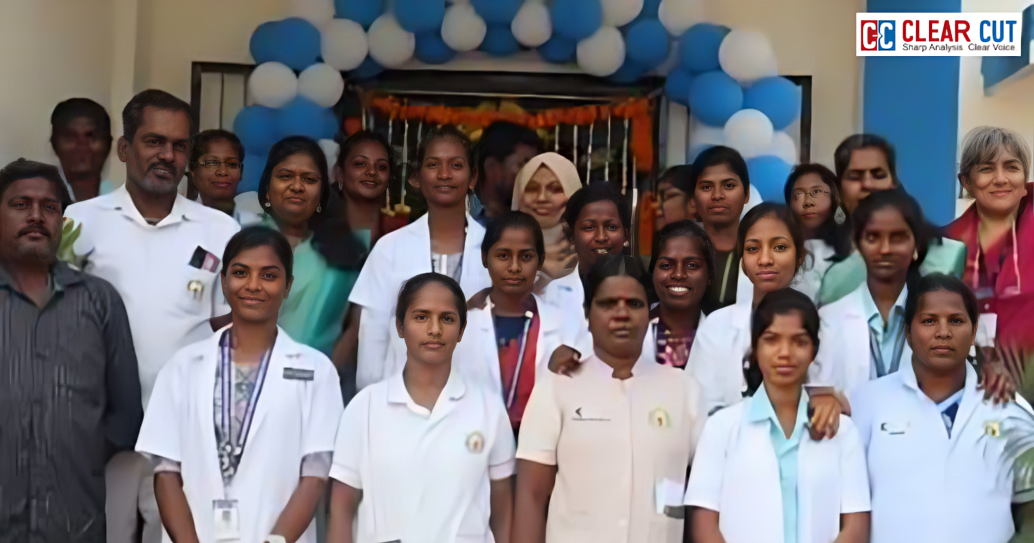
The ECRC model was developed by a Chennai based NGO called, The Banyan, in 1993. It began as a crisis intervention centre for homeless women with mental illness. The approach is rescue, immediate care, recovery, rehabilitation, and reintegration as a continuous chain, rather than a one-time admission. The goal is not to house people in institutions indefinitely. It is to help them find their way back to community life, whether with family or independently.
Since 2020, the Tamil Nadu government has formally embedded ECRCs within the public health system. The model uses through an agreement between the National Health Mission, civil society organisations, and the Institute of Mental Health. As of December 2025, ECRCs function across 31 districts in the state, running inside district hospitals. The government has committed to extending the model to all districts.
The reach of this model has already extended beyond Tamil Nadu’s borders. The ECRC approach has been adopted in Karnataka, Kerala, Maharashtra, and Odisha. This shows a quiet but meaningful sign, that what began as an NGO experiment is becoming a replicable governance model.
Home Again: Living in the Neighbourhood, Not the Ward
Home Again is the final stage of this care pipeline. It is a supported housing programme for people with long-term mental health conditions, who have experienced prolonged homelessness or institutionalisation. Participants live in small groups in rented homes in ordinary residential neighbourhoods and not wards or shelters. They receive support from personal assistants, case managers, and community health workers, with access to healthcare and welfare services as needed.
The evidence is not anecdotal. A prospective 18-month evaluation of 53 Home Again participants found significant improvements in community integration compared to those in institutional care. Disabilities reduced meaningfully over time. In Tamil Nadu, the programme currently runs in Chengalpattu, Trichy, Tiruvallur, Coimbatore, and Thoothukudi. 40 people are currently living in Home Again houses. 6 have been reunited with their families. 10 have achieved independent livelihoods.
These are not large numbers in absolute terms. But they stand for something the Indian mental health system has historically failed to produce exits. Paths out of the ward, back into life.
The 2026 Regulations: Codifying the Rights Turn
Running alongside this programmatic expansion is a legal overhaul. In March 2026, the Tamil Nadu State Mental Health Authority published the draft State Mental Healthcare Regulations 2026, framed under the Mental Healthcare Act of 2017. The 68-page document is currently open for public comment until April 30, 2026. This is a window that mental health professionals, civil society groups, and service users have been invited to use.
The regulations are significant in several ways. They impose mandatory infrastructure and staffing standards on all Mental Health Establishments, classified into five categories. They restrict the use of physical restraint, allowing it only as a final measure, sanctioned by a psychiatrist and recorded in a dedicated Restraint Register, with the patient’s family or nominated representative notified within 24 hours. This last provision, modest as it sounds, stands for a formal break with the coercive history of Indian psychiatry.
A Model, With Limits
Tamil Nadu’s approach is not without gaps. The treatment gap stays vast. 40 people in Home Again houses is a proof of concept, not a system at scale. The regulations are still in draft, and implementation will depend on sustained funding, trained personnel, and political continuity; all of which are uncertain in any state context.
The ECRC model also leans heavily on civil society organisations as operational partners. This has been a strength that The Banyan’s expertise and community trust, are difficult to replicate through government agencies alone. But it also means the model’s expansion depends on finding and sustaining capable NGO partners in every district. That is a logistical and financial challenge the state has not yet fully resolved.
Nationally, the Tele-MANAS programme has provided a parallel infrastructure. As of March 2026, 30 states and union territories have set up Tele-MANAS cells, handling over 34 lakh calls since start, in 20 languages. But a phone line and a supported housing unit are distinct categories of intervention. One manages distress at a distance. The other reshapes the conditions of a life. Tamil Nadu is trying both which is itself unusual, in the context of India’s mental health crisis.
What Tamil Nadu is building imperfectly and incrementally, is a model that treats mental illness as a public health matter, and its sufferers as citizens with rights. It is redefining every standard for mental healthcare and aid. The gaze is finally shifting from containment to connecting people, isolation to dignity & most importantly survival to belonging. It is a different premise than the one most Indian state still uses on. Whether it produces a different outcome at scale is the question the next decade will answer.
References
1. The News Minute. (2026, February 8). Tamil Nadu plans statewide rollout of ECRC, Home Again mental health programmes. https://www.thenewsminute.com/tamil-nadu/tamil-nadu-plans-statewide-rollout-of-ecrc-home-again-mental-health-programmes
2. Medical Dialogues. (2026, March 23). Tamil Nadu invites public comments on Mental Healthcare Regulations 2026. https://medicaldialogues.in/news/health/tamil-nadu-invites-public-comments-on-mental-healthcare-regulations-2026-167048
3. Psychologs. (2026, April). Ending the ‘Asylum’ Era: Tamil Nadu’s 2026 Mental Health Draft. https://www.psychologs.com/ending-the-asylum-era-tamil-nadus-2026-mental-health-draft/
4. Psychologs. (2025, July). Tamil Nadu to Create Policy for Homeless Persons with Mental Illness. https://www.psychologs.com/tamil-nadu-to-create-policy-for-homeless-persons-with-mental-illness/
5. The Banyan. (2024). Annual Report 2023–24. https://thebanyan.org/wp-content/uploads/2025/04/TB-AReport-2023-24.pdf
6. Gopikumar, V. et al. (2019). Responsive mental health systems to address the poverty, homelessness and mental illness nexus: The Banyan experience from India. International Journal of Mental Health Systems. https://pmc.ncbi.nlm.nih.gov/articles/PMC6689864/
7. PMC / NIH. (2014). Integrating mental health into public health: The community mental health development project in India. https://pmc.ncbi.nlm.nih.gov/articles/PMC4181175/
8. Organiser. (2026, March 31). National Tele Mental Health Programme: Transforming lives via multiple languages. https://organiser.org/2026/03/31/346415/bharat/national-tele-mental-health-programme-transforming-lives-via-multiple-languages/
9. The Hindu. (2026, March 28). T.N. government releases draft State Mental Healthcare Regulations, 2026. https://www.thehindu.com/news/national/tamil-nadu/tn-government-releases-draft-state-mental-healthcare-regulations-2026/article70792168.ece
Clear Cut Health, Research Desk
New Delhi, UPDATED: April 10, 2026 01:00 IST
Written By: Tanmay J Urs