
- India’s demographic dividend can only drive inclusive growth when skills, livelihoods, and labour systems are aligned to create sustainable employment opportunities.
- Women’s economic participation remains limited due to unpaid care work, skill mismatches, safety concerns, and barriers to formal employment.
- Strengthening gender-responsive skilling, care economy investments, and inclusive labour policies can help India build a more equitable and resilient economy.
India’s Path to Inclusive Growth From Demographic Dividend to Economic Participation
India stands at a defining moment in its development trajectory. It’s growth story is often framed through the lens of its demographic dividend. With one of the world’s youngest populations, the country’s demographic dividend offers immense potential. Yet, the real test lies not in the size of this workforce, but in how effectively the country connects skills, livelihoods, and labour markets into a coherent and responsive system. Too often, these three elements, i.e., skill (capability), livelihood (income generation), and labour (market participation) are addressed in silos and for decades, these three pillars have evolved in parallel rather than in partnership. The need of the hour is to view these not as isolated domains, but as a trilogy of interdependent systems, each reinforcing the other. When aligned, they form the backbone of inclusive economic growth and social equity.
Skill, Livelihood & Labour: Shift from Silos to a System
Over decades, in India skill development initiatives have expanded rapidly and often operated independently of labour market realities. Livelihood programmeshave deepened community-level engagement, however
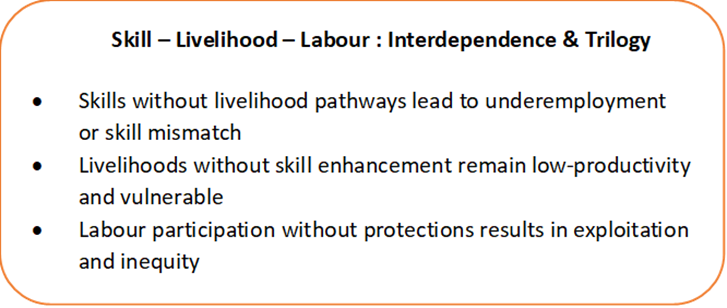
Skills build capability, livelihoods create income pathways, and labour markets provide the platform for participation. When these elements are aligned, they reinforce one another, creating a virtuous cycle of productivity, income security, and economic mobility. More recently, the Viksit Bharat Guarantee for Rozgar and Ajeevika Mission (Gramin) framework signals a further step in this direction. It attempts to move beyond shortterm wage employment toward a model that links skilling, livelihoods, and asset-based local economies, reinforcing the idea of a connected system rather than isolated interventions.
Progress, but Not Without Gaps
What makes this approach distinctive is its scale, diversity, and adaptability. By embedding convergence within flagship programmes, leveraging community institutions such as self-help groups, and aligning with industry demand, India is not only addressing domestic challenges but also creating a replicable framework for other developing nations facing similar demographic and labour market transitions.
Despite these efforts, gaps remain. Many individuals are trained, but do not find suitable jobs. Skill-job mismatches persist. Transitions from training to stable livelihoods are often weak. The system is evolving, but not yet fully aligned.
Women and Work – Unequal Participation – The Structural Gap
One of the biggest gaps in this continuum is women’s participation. A large number of women remain concentrated in informal, low-paying, or home-based work. Many are self-employed, but with limited income security and growth. Entry into formal jobs is restricted by multiple barriers. These include skill mismatches, safety concerns, mobility challenges, and social norms. While women’s employability is improving, this has not translated into sustained participation. Many continue to move in and out of the workforce or remain in low-productivity roles.
The Invisible Constraint – Care Work
At the centre of this challenge is the care economy. Women carry a disproportionate burden of unpaid work including childcare, elder care, and household responsibilities. This “invisible labour” limits their ability to work, learn new skills, or take up better opportunities. Women spend far more time on unpaid care than men. This reduces their availability for economic participation. As a result, many remain outside education, employment, or training—not due to lack of aspiration, but due to structural barriers. Without addressing care work, investments in skills and livelihoods will continue to fall short. The continuum cannot function effectively unless care is part of the system.
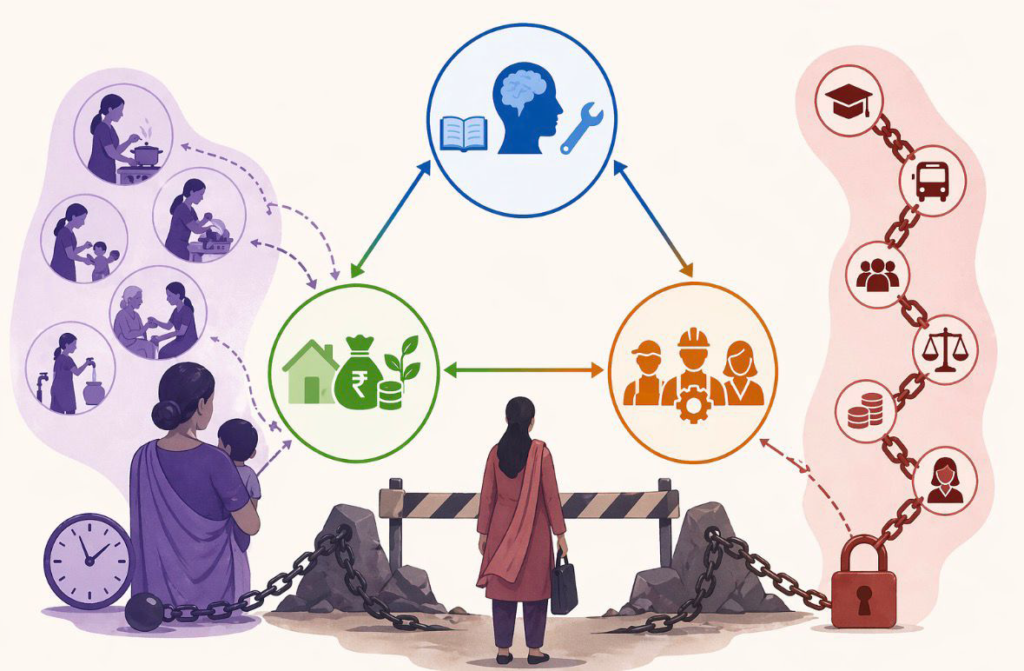
An Untapped Growth Opportunity Bridging the Divide Skill meets Opportunity
Addressing this requires a more systemic and gender-responsive approach. Skilling systems must become more flexible and accessible. Localised training, digital options, and adaptive schedules can help women participate better. At the same time, investments in the care economy such as childcare centres and workplace creches, are essential to reduce the unpaid burden. Labour markets must also become safer and more inclusive. This means better workplace policies, reliable transport, and stronger enforcement of protections. Livelihood programmes need to move beyond subsistence and enable women to enter higher-value sectors and markets.
Most importantly, convergence must deepen. Better planning at the district level, stronger partnerships, and use of data can help ensure that skills lead to livelihoods, and livelihoods lead to decent work. The economic case for this shift is strong. Increasing women’s participation can significantly boost India’s GDP . Investments in the care economy can create jobs while enabling more people to work. In a country with immense potential, this is one of the most powerful levers for growth.
The Road Ahead – Beyond Skilling: Building Pathways – From Growth to Inclusion
India has laid the foundation for an integrated system linking skills, livelihoods, and labour. Emerging frameworks like Viksit Bharat – Guarantee for Rozgar and Ajeevika Mission (Gramin) (VB – G RAM G) further reinforce this direction by promoting local economic systems and stronger convergence.
The next step is to deepen this approach with a focus on inclusion with gender equity at focus. Systems tems must reflect the realities of women, migrants, and informal workers. As India moves toward becoming a global economic powerhouse, the question is no longer just about creating jobs. It is about who gets to participate, and how. And since India has already begun to demonstrate how aligning skills, livelihoods, and labour systems can drive inclusive development at scale. The opportunity now lies in deepening this convergence through an equity and inclusion lens, particularly by enabling women to fully participate in and benefit from economic growth. By doing so, India can move beyond incremental gains to leapfrog into a model of development that is not only fast-growing, but fundamentally inclusive, resilient, and equitable setting a benchmark for the Global South and beyond.
About the Author:
Sonali Maheshwari is a development sector practitioner and thought contributor with 17 years of experience in designing and advancing programmes at the intersection of policy, systems, and partnerships. Her work centres on bridging policy intent with on-ground impact through evidence-driven programme design and cross-sector collaboration
Clear Cut Livelihood, Gender Desk
New Delhi, UPDATED: May 19, 2026 09:00 IST
Written By: Sonali Maheshwari