

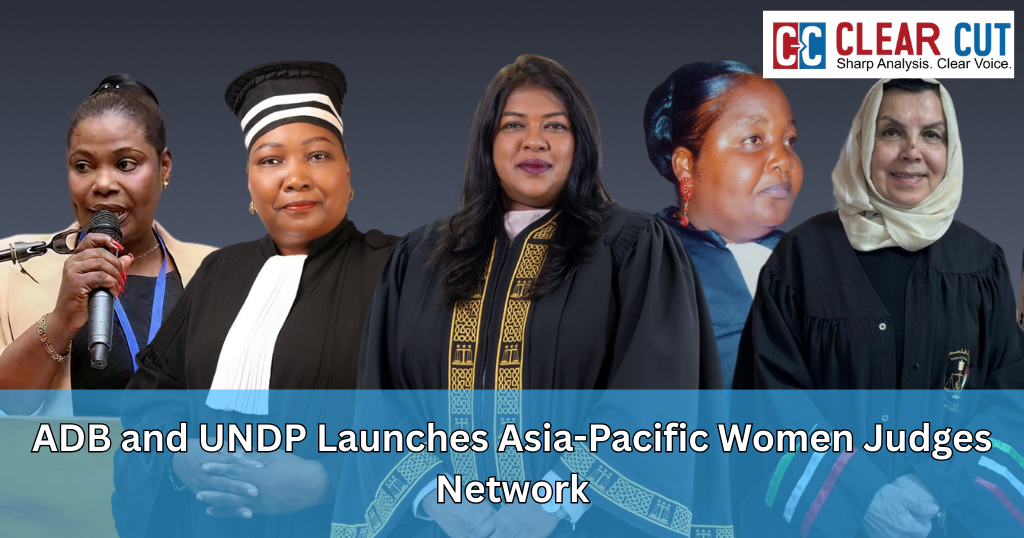
The Asian Development Bank (ADB) and United Nations Development Programme (UNDP) have launched the Asia-Pacific Women Judges Network (APWJN) to strengthen women’s leadership in the judiciary and promote gender equality in justice systems. The initiative will support women judges through collaboration, training, and data sharing, helping address structural barriers and gender bias in courts across the Asia-Pacific region.
The Asian Development Bank and the United Nations Development Programme have announced a new regional partnership to establish the Asia-Pacific Women Judges Network (APWJN). The initiative aims to strengthen women’s leadership in the judiciary and address long-standing structural barriers that limit their advancement to senior judicial positions across the region.

The announcement comes at a time when several countries in Asia and the Pacific have recorded progress in the representation of women in courts. However, women remain underrepresented in leadership roles within judicial systems. According to data referenced in the UNDP Asia-Pacific press release, structural barriers, gender bias, and unequal access to leadership pathways still affect career progression for many women judges.
The network will focus on peer support, capacity building, and improved data collection on gender representation in the judiciary. By connecting judges across countries, the initiative aims to strengthen collaboration and share strategies that promote inclusive and gender-responsive justice systems.
Why the Network Matters
Justice systems play a crucial role in shaping social and economic outcomes. Courts influence how rights are interpreted, how laws are implemented, and how societies address inequality. Experts say a more diverse judiciary helps build public trust and improves the fairness of legal decisions.

Damien J. Eastman, Deputy General Counsel at the Asian Development Bank, highlighted the importance of representation while announcing the partnership. He said the judiciary “plays a unique role in shaping and upholding the rights of individuals and businesses, and in enforcing accountability.” Eastman added that greater participation of women judges in decision-making positions is essential for strengthening governance and the rule of law.
Officials from the United Nations Development Programme also emphasised that improving gender representation in the judiciary goes beyond symbolism. Beate Trankmann, Deputy Regional Director for Asia and the Pacific at UNDP, said strengthening women’s leadership in courts helps justice systems better understand the experiences of women and girls and deliver fair outcomes.
According to Trankmann, building gender-responsive institutions requires long-term cooperation between governments, judicial institutions, and international partners.
Structural Barriers Continue to Limit Progress
Despite improvements in recent years, several studies show that women still face significant obstacles within judicial systems. Research and consultations conducted under the UNDP Global Gender Justice Platform indicate that women judges often encounter workplace harassment, online abuse, and threats, alongside unequal domestic responsibilities. These factors contribute to slower career progression and higher attrition rates among women in the legal profession.
Justice Sapana Pradhan Malla of the Supreme Court of Nepal stressed the importance of regional collaboration among women judges. She noted that professional networks can help women learn from one another, strengthen leadership strategies, and amplify their collective voice in the judiciary.
Legal scholars also point out that representation in the judiciary remains uneven across Asia. According to UNDP research initiatives on women’s judicial leadership, structural and cultural barriers often discourage women from pursuing senior judicial roles despite gender-neutral appointment systems.
These challenges highlight the need for mentoring programmes, leadership training, and institutional reforms that support women throughout their judicial careers.
How the APWJN Will Work
The Asia-Pacific Women Judges Network will operate as a regional platform connecting women judges from different jurisdictions. Through workshops, research initiatives, and collaborative forums, the network aims to provide professional development opportunities and facilitate policy dialogue on gender equality in the judiciary.
ADB and UNDP will also support initiatives that improve the availability of reliable data on women’s representation in judicial institutions. Better data will help governments track progress toward the United Nations Sustainable Development Goal indicator related to participation in decision-making institutions.
A key component of the network involves capacity development programmes tailored specifically for women judges. These programmes will focus on leadership skills, judicial ethics, and strategies for navigating professional challenges.
Building Inclusive Justice Systems
Experts believe that strengthening women’s participation in the judiciary is critical for building fair and inclusive institutions. When courts reflect the diversity of society, they are more likely to deliver decisions that address complex social realities.
Regional dialogues organised by UNDP and partner organisations have already highlighted the importance of such initiatives. At a judicial leadership convening in Bangkok, Honourable Justice Muntharee Ujjin of Thailand’s Court of Appeal said women judges have contributed significantly to strengthening access to justice and enhancing public confidence in the rule of law across Asia.
Similarly, legal researchers involved in UNDP’s regional studies have argued that gender equality in the judiciary is essential for strengthening public trust and ensuring equal protection under the law.
A Long-Term Regional Effort
The launch of the Asia-Pacific Women Judges Network reflects a broader push by international institutions to strengthen gender equality in governance systems. It also aligns with global efforts to advance the United Nations Sustainable Development Goals, particularly those related to gender equality and strong institutions.
Through collaboration between development banks, international organisations, and judicial institutions, the initiative aims to create a supportive ecosystem for women judges across Asia and the Pacific.
As the network begins its work, policymakers and legal experts hope it will accelerate progress toward a judiciary that is more representative, inclusive, and responsive to the needs of all citizens.
Clear Cut Gender Desk
New Delhi, UPDATED: March 10, 2026 01:30 IST
Written By: Ayushman Meena