

AKSHAY KUMAR From a film about household toilets to beach bio-toilets and ministry campaigns, the actor’s decade on water, sanitation and hygiene shows both the reach and the limits of celebrity advocacy
As of 17 September 2026, a government factsheet shows, rural India has built over 12.22 crore household toilets under the Swachh Bharat Mission-Grameen, and 5.69 lakh villages have reached ODF Plus status, meaning they sustain open-defecation-free conditions and manage solid and liquid waste. Globally, the picture is harsher: the WHO–UNICEF Joint Monitoring Programme estimates that 3.4 billion people still lack safely managed sanitation, including 354 million who practise open defecation. The same report finds that people in least developed countries are more than twice as likely as others to lack basic drinking water and sanitation, and more than three times as likely to lack basic hygiene. Between building a toilet and sustaining a service lies the sector’s unfinished work, and it is where celebrity philanthropy must prove its worth.
Akshay Kumar’s engagement with that gap spans a decade and runs along three strands. The best known is storytelling.
, which he co-produced and starred in, opened on 11 August 2017 around a bride’s demand for a household toilet. Around the release he unveiled “24 toilets in 24 hours” across Rajasthan, Haryana, Punjab and Delhi-NCR, an initiative tied to the film’s promotion. In a pre-release video he urged people to give a tenth of their donations at places of worship to build toilets for the poor. The producers also gave Swachh Bharat Mission (Grameen) teams non-commercial screening rights for villages, and Kumar fronted the mission’s twin-pit toilet advertisement. He has noted that research links households’ hesitation to stigma around emptying pits, even though a pit takes roughly five years to fill for a family of six. The research group RICE Institute commended the advertisement for confronting untouchabilitylinked stigma around handling decomposed faecal matter.
Hygiene is the second strand. Padman, produced by Twinkle Khanna and released in February 2018, brought menstrual health to mass audiences, and Kumar installed a sanitary-pad vending machine at Mumbai Central’s ST bus depot, hoping to place more across the state. The need persists. Use of hygienic menstrual protection among women aged 15–24 rose only from 77.6 per cent in NFHS-5 to 79.2 percent in NFHS-6, and NFHS-5 found a steep wealth gap: 54 per cent among women in the poorest fifth of households against 95 per cent in the richest.
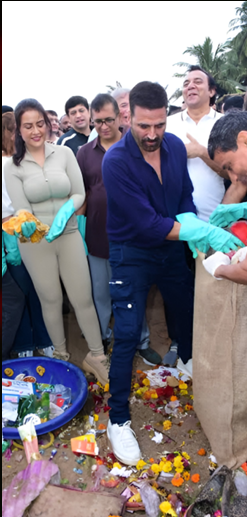
His direct funding is modest but specific. In April 2016 he gave ₹50 lakh to Maharashtra’s Jalyukt Shivar Abhiyan, a state programme for ponds and other water-harvesting structures in drought-prone villages. In April 2018 he funded a bio-toilet at Juhu beach for about ₹10 lakh, installed in coordination with the Brihanmumbai Municipal Corporation (BMC), eight months after a social-media row over open defecation on a Mumbai beach in which critics pointed out that nearby slum residents had no public toilets. In September 2025 he was still showing up, joining a post-immersion beach clean-up at Juhu.
The third strand is institutional. Kumar has served as a brand ambassador of the Swachh Bharat Mission and, since July 2018, of Harpic. As campaign ambassador for the Harpic–News18 Mission Swachhta aur Paani, he presented Jal Shakti Minister Gajendra Singh Shekhawat a five-point mandate on World Toilet Day 2022: access to clean toilets, shared responsibility, dignity for everyone in sanitation facilities, sanitation as health, and leaving no one behind. He also urged mandatory toilet-etiquette classes in schools. The campaign’s sponsor announced in 2021 that its World Toilet Colleges, which train sanitation workers, would grow from six to 15. Even so, these are state-aligned and corporate-sponsored campaigns rather than personal philanthropy, a distinction worth keeping in view: the Jal Shakti ministry itself told the Rajya Sabha in July 2024 that celebrities have been roped in as brand ambassadors for the mission.
The harder questions lie downstream. In a video from a Mumbai polling booth in November 2024, a resident told Celebrity in Philanthropy / Akshay Kumar Kumar that municipal staff were not maintaining the Juhu toilet; he said he would raise it with the BMC, adding that upkeep was the civic body’s responsibility. The exchange illustrates a familiar WASH gap: construction is easier to fund and photograph than operation and maintenance, which depend on civic budgets and on workers. Those workers carry the greatest risk. The Centre has told the Lok Sabha that 498 sanitation workers died cleaning sewers and septic tanks between January 2019 and June 2026, a toll the Safai Karamchari Andolan says is understated. Among identified manual scavengers whose caste is recorded, 97.25 per cent are Scheduled Castes, according to government data from 2021. This year’s Swachhata Hi Seva campaign lists the safety and dignity of sanitation workers among its focus areas.
Water is the precondition for usable toilets, and the Harpic–News18 campaign itself acknowledges that lack of it is a key barrier to keeping household toilets clean. The Jal Jeevan Mission reports tap connections in 81.57 percent of rural households as of January 2026, leaving nearly one in five without. Celebrity advocacy does what budgets rarely do: it makes sanitation speakable, and that has value. It cannot replace public financing for maintenance, safe working conditions for sanitation workers or dependable water. As Global Handwashing Day on 15 October and World Toilet Day on 19 November approach, the sharper test for Kumar, and for every celebrity ambassador, is whether the next campaign asks audiences and governments to fund what keeps toilets working and to protect the people who keep them clean.
Clear Cut WASH, Health Desk
New Delhi, UPDATED: October 31, 2026 18:00 IST
Written By: Yatharth Pathak