
India’s dry states, Bihar and Gujarat, continue to report alcohol consumption despite prohibition laws. NFHS data and research on Bihar’s alcohol ban highlight changing drinking patterns, enforcement challenges, underreporting and the policy’s potential impact on domestic violence and harmful drinking.
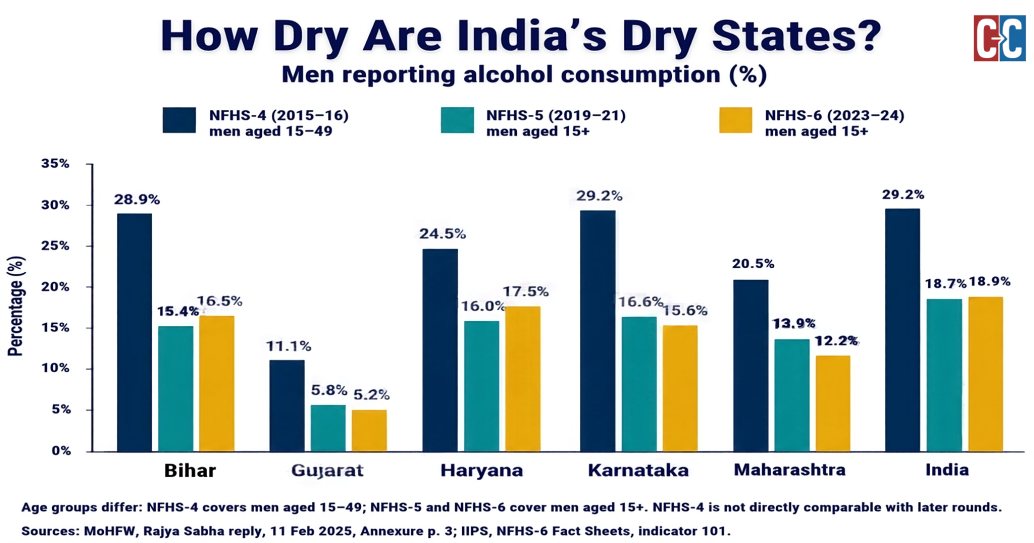
What does a ban on alcohol achieve if people continue to drink? Fair question! Bihar’s fact sheet from the latest National Family Health Survey (NFHS 6) figures bring that question back into focus. 16.5% of men aged 15 and above report consuming alcohol, up from 15.4% in the previous round. Gujarat, which also practises prohibition, records a decline from 5.8% to 5.2%.
These figures deserve a bit of scrutiny. So does the temptation to judge prohibition entirely by them.
What changed after Bihar’s ban?
Bihar introduced complete prohibition in April 2016. The state’s NFHS-4 interviews had taken place between March and August 2015, before the ban. They recorded alcohol consumption among 28.9% of men aged 15–49. By NFHS-5, this had fallen to 17%. That is a reduction of 11.9 percentage points.
Bihar’s decline was larger than the national fall, from 29.2% to 22.4%, for the same age group. But drinking also declined where alcohol remained available legally. For instance, Haryana went from 24.5% to 17.9% (6.6 percentage points); Karnataka from 29.2% to 23.1% (6.1 percentage points); and Maharashtra from 20.5% to 17.2% (3.3 percentage points). Gujarat’s figure fell from 11.1% to 5.9% (5.2 percentage points).
Prohibition may have contributed to Bihar’s reduction. These comparisons alone cannot tell us how much.
There is a qualification to reading the graphic. NFHS-4 figures cover men aged 15–49, while the figures shown for NFHS-5 and NFHS-6 cover men aged 15 and above. They cannot form one directly comparable series.
For the latter age group, Bihar’s reported consumption rose from 15.4% to 16.5% between NFHS-5 and NFHS-6. Gujarat’s fell from 5.8% to 5.2%. Nationally, the estimate barely moved: 18.7% to 18.9%.
Why is Bihar close to Haryana and Karnataka?
The latest figures place Bihar’s 16.5% close to Haryana’s 17.5%, above Karnataka’s 15.6%, and above Maharashtra’s 12.2%. A state banning alcohol therefore reports drinking at a level comparable to states that permit its sale.
That does raise questions about availability and enforcement. It also needs context. Before prohibition, Bihar already recorded higher consumption than Haryana and Maharashtra among men aged 15–49.
People’s drinking habits depend on more than access to a shop. Research using NFHS-4 identifies differences associated with education, wealth, religion and geography. These factors help explain why states with different laws may still report similar averages.
There is another limitation. Both an occasional drinker and someone drinking every day count as consumers. A prevalence figure does not reveal how much they drink, what they spend, or whether their drinking harms their family.
How much goes unreported?
Could respondents in non-prohibition states also be understating their drinking? It is possible. Legal permission does not necessarily remove social disapproval. In prohibition states, admitting to drinking could carry an additional fear of consequences.
These are possible explanations, however. The published tables cannot establish which state under-reports more.
Among women, NFHS-6 records consumption of 0.4% in Bihar, 0.3% in Gujarat and 1.1% nationally. Those estimates may reflect low consumption, incomplete disclosure, or a combination. The fact sheets cannot separate them.
Rising sales would not settle the matter either. Population growth and larger purchases by existing drinkers can raise sales without increasing the percentage who drink.
What did the ban achieve?
Research on Bihar suggests that the ban helped. A study published in The Lancet Regional Health – Southeast Asia in 2024 estimated that prohibition prevented 24 lakh cases of daily or weekly drinking and 21 lakh cases of intimate partner violence. Researchers arrived at these estimates by comparing Bihar with neighbouring states using earlier survey data. The study does not cover NFHS-6, but its findings give us reason to look beyond the number of people who still drink.
Bihar’s recent increase merits investigation. Gujarat’s lower and declining prevalence deserves acknowledgement. For both, the assessment needs to extend to harmful drinking, illicit supply, and domestic violence. Counting drinkers tells us something important about a dry state. It does not tell us everything.
Clear Cut Research Desk
New Delhi, UPDATED: October 24, 2026 11:25 IST
Written By: Paresh Kumar
[The Author serves as the managing editor and the CEO of DevInsights]