
The GARBH-INi initiative is a government-led program that uses advanced research, AI, and indigenous data to predict and prevent preterm births, improving maternal and child health outcomes in India. It combines science, technology, and collaboration to create more effective, population-specific healthcare solutions.
Introduction
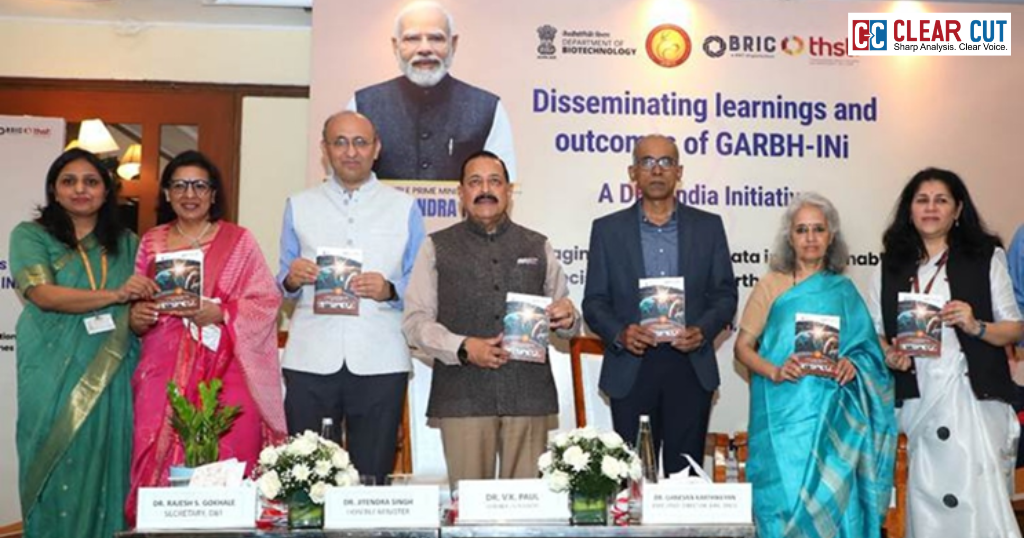
Maternal and child health has remained a critical area of national health concern in India especially considering the high rate of preterm births that are among the leading causes of neonatal death and long term healthcare problems. Here, the Government of India, through the Department of Biotechnology (DBT) has launched the GARBH-INi (Interdisciplinary Group for Advanced Research on Birth Outcomes) programme to overcome such issues with the help of scientific and technological development. The success and the results of this initiative were one of the topics discussed in a recent event at the India Habitat Centre in New Delhi, during which a Union Minister Dr. Jitendra Singh touched upon the need to use indigenous research and artificial intelligence to enhance birth results and secure a healthier generation.
Background and Rationale
India accounts for a significant share of global preterm births, highlighting the urgent need for context-specific solutions that reflect the country’s diverse population and health conditions. Preterm birth is not only a leading cause of neonatal mortality but also has long-term implications for a child’s physical and cognitive development.

Most conventional predictive models for adverse pregnancy outcomes have been developed using data from Western populations and often do not adequately capture the realities of the Indian context, limiting their effectiveness. Recognizing this gap, the GARBH-INi initiative was launched to develop a localized, evidence-based framework. The initiative integrates clinical, biological, and environmental factors to provide a more comprehensive understanding of pregnancy outcomes and improve the ability to predict and address risks associated with preterm birth
The GARBH-INi Initiative Overview.
The GARBH-INi programme is a case of a multidisciplinary project that integrates the fields of clinical epidemiology, multi-omics studies and artificial intelligence to build individual prediction models on pregnancy outcomes. It is one of the flagship projects of the department of biotechnology and is headed by some of the premier research institutions including the Translational Health Science and Technology Institute (THSTI). The programme is concerned with the complexity of genetic, microbial and environmental potatoes that affect the pregnancy and tries to translate the scientific findings into the practical health care solutions.
Important Characteristics and Approach.
The main peculiarity of the GARBH-INi program is creating one of the largest pregnancy cohort studies in South Asia with nearly 12,000 pregnant women. This is a large-scale cohort that can offer significant longitudinal data that can be used by researchers to monitor the outcomes of pregnancy and determine risk factors that may lead to preterm birth. The program has also created a large database of over 1.6 million bio specimens and above one million ultrasound images which is a solid base to high-level biomedical research.
The programme is integrated and multifaceted and involves the combination of clinical data with the latest technologies like artificial intelligence and multi-omics analysis. This technique can be used to build very precise predictive models that can detect high-risk pregnancies early in their course. The indigenous data and the population-specific attributes allow the initiative to make sure that the solutions designed are relevant and able to work in the Indian context.
Significant Results and Accomplishments.
The GARBH-INi project has already reached some key milestones that prove that it can change the situation with maternal and child healthcare in India. Among the most important consequences, the creation of AI-driven models of pregnancy dating, specifically adapted to the Indian population, should be mentioned. These models enhance better estimation of gestational age that is vital in proper medical treatment during pregnancy. The programme has also determined microbiome predictors and genetic markers to aid in the early identification of risks of preterm birth to provide timely medical care.

The other strength is the creation of fast diagnostic instruments that are suitable in assessing risks at an early stage and enhancing clinical decision-making. The program has also put in place the GARBH-INi-DRISHTI platform, which is a multifaceted repository of data that serves researchers with access to a massive source of clinical data, biospecimens, and imaging. Through this platform, there is increased collaboration and encourages more research in the field of maternal and child health both domestically and internationally.
Partnerships and Technological Exchange.
The effectiveness of the GARBH-INi project is also enhanced by the fact that it is more collaborative and technology transfer oriented. The programme has also made it easy to form collaborations among research institutions, healthcare providers, and enterprises of the private sector in order to make sure that scientific findings are placed into practice. Microbiome-based biotherapeutics have been entered into technology transfer agreements and partnerships with health technology firms have resulted in the creation of AI-powered ultrasound reporting systems and risk stratification platforms. These attempts underscore the efforts of the initiative to narrow the research and practice gap in healthcare provision.
Implication to the Healthcare System of India.
The GARBH-INi project is important in enhancing the healthcare system in India as it fosters preventative and individual healthcare solutions. The programme promotes maternal and neonatal mortality rates and positively affects the general health outcomes of the population as it allows the prompt detection of the high-risk pregnancies. It also supports the clinical decision-making process by availing clinical professionals with the data-driven insights and sophisticated diagnostic tools. Moreover, the project meets the overall objectives of the government of India of enhancing primary healthcare and meeting sustainable development objectives on maternal and child health.
Investment to the Indian Bioeconomy and Future Vision.
Besides influencing healthcare, GARBH-INi initiative enhances the development of India bioeconomy due to the support of innovation and researches in the field of biotechnology. The bioeconomy in India has experienced a tremendous growth in the last few years, as it rose to about USD 195 billion in 2017, having started at approximately USD 10 billion back in the year 2014. Scientific research coupled with the inclusion of the public health programs is a show of the national desire to capitalize on the use of biotechnology in nation building. The programme is as well in line with the long-term vision of India to become a developed country by 2047 because maternal and child health has to be improved so as to create a productive and healthy population.
Difficulties and Future Projections.
Although GARBH-INi initiative has been successful, it has some challenges that should be addressed to make the best of out of it. These are the necessity of broader adoption of the developed tools to the healthcare systems, primarily to rural and resource-constrained environments, and the ongoing validation of the predictive models. Scholars have advocated the need to enhance partnerships, improved data analysis, and making sophisticated technologies available to every part of society. Scaling up its applications, as well as incorporating its solutions into the regular healthcare practices, is anticipated to be the next step of the programme.
Conclusion
In conclusion, the GARBH-INi initiative represents a transformative step in addressing maternal and child health challenges in India. By combining advanced research, indigenous innovation, and technological integration, the programme has created a robust framework for predicting and preventing preterm births. Its emphasis on data-driven solutions, collaboration, and real-world application highlights a modern approach to healthcare that is both effective and inclusive. As India continues to invest in such initiatives, the country is well-positioned to achieve significant improvements in health outcomes and build a healthier, more productive future generation.
Clear Cut WASH Desk
New Delhi, UPDATED: March 24, 2026 11:00 IST
Written By: Ruchira Das