

At COP26, when India made its bold promise to achieve net-zero carbon emissions by 2070, very few places captured the promise of this ambition as vividly as the Northeast. Nestled in the Himalayas and enriched by forests, rivers, and biodiversity, the eight Northeastern states of Arunachal Pradesh, Assam, Manipur, Meghalaya, Mizoram, Nagaland, Tripura, and Sikkim all realistically have the potential to not only become the ecological bastions of India, but also face the reality of very sensitive ecosystems, no industrial infrastructure, and connectivity challenges.
While India’s policy framework provides the primary impetus for net-zero efforts in the Northeast, another important aspect that determines those green transition realities comes from foreign countries and multilateral agencies quietly doing their part to shape the nexus of green transitions in the Northeast. From Japanese-funded agricultural reforms to U.S.-funded forestry programs, from the UN’s capacity-building missions to German and British investments in renewable energy, the Northeast is becoming an incubator for global climate partnerships.
The Net-Zero Vision: India’s 2070 Roadmap and the Northeastern Edge
India’s commitment to achieving net-zero by 2070 is predicated on five pillars: increasing its non-fossil energy capacity to 500 GW, meeting 50 percent of its electricity demand from renewables, decreasing carbon emissions by one billion tonnes, reducing carbon intensity by 45 percent, and achieving net-zero by mid-century.
For the Northeast, this commitment has implications for the regional goals of sustainable livelihoods, forest conservation, and energy independence, which are also echoes of the national vision. The Northeast’s unparalleled hydropower potential (of over 58,000 MW based on current estimates), bamboo possibilities, and edging high level of forest cover (65 percent of total area) positions the region to serve as a natural successor to India’s low-carbon future.
States like Arunachal Pradesh are picking up the pace. In its Pakke Declaration 2047 – a plan to achieve net-zero emissions by 2047, which is two decades ahead of the national commitment – the state issued a clear signal of hope for a feasible and proactive regional commitment. The Declaration inscribed the increase the principles of green economy in the governance frameworks, urging endorsements of sustainable forestry, clean energy, and community based conservation action.
Japan: Cultivating Sustainability through the Act East Forum
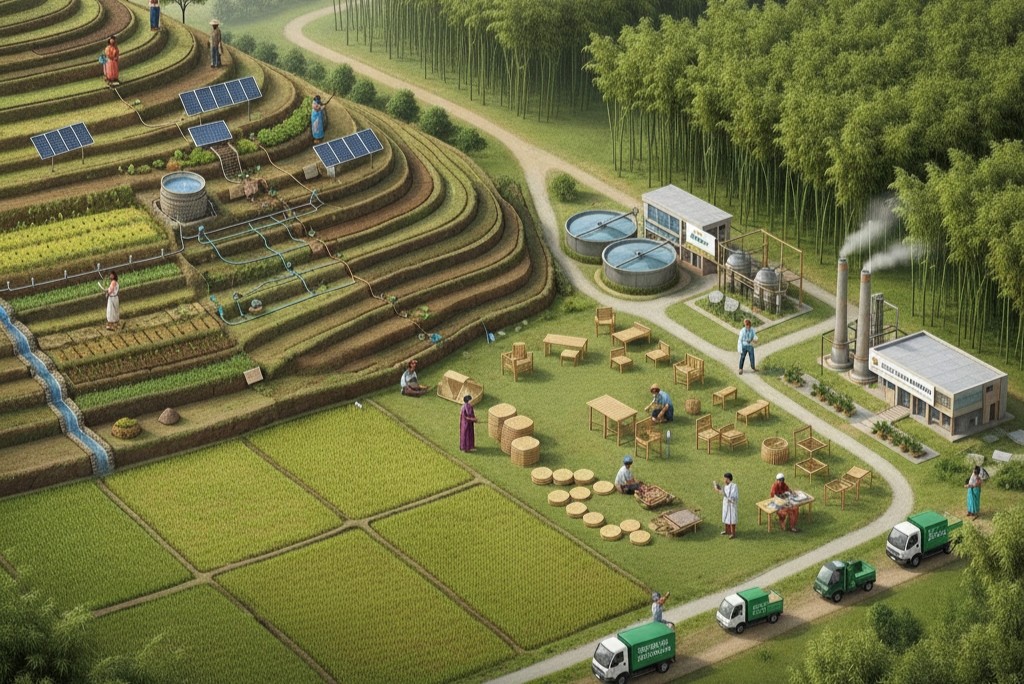
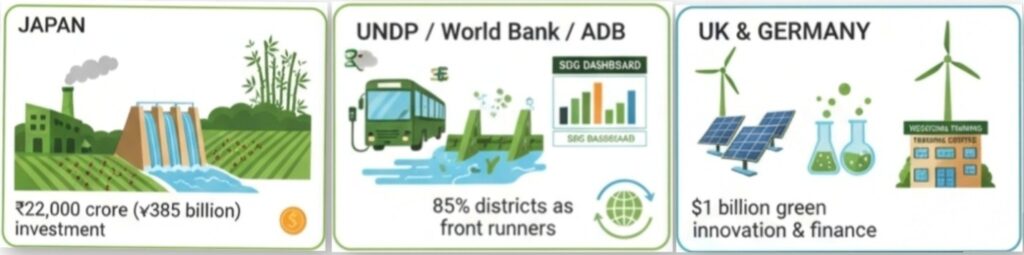
Among foreign partners, Japan is India’s long-term ally in the green transition in Northeast India. After launching the India-Japan Act East Forum (AEF) in 2017, Tokyo aligned its development cooperation with sustainable, low-carbon considerations. Japan’s aid is covering a range of eco-sensitive projects such as the “Capacity Enhancement for Sustainable Agriculture and Irrigation Development in Mizoram,” and “Strengthening Bamboo Value Chain in the North East“. Collectively, the goal is to address soil degradation, improve water-use efficiency related to various industrial processes, and develop bamboo-based bio-industries, all of which are essential to climate resilience. In the announcements coming out of the 7th AEF meeting in 2024, Japan reported that it has already committed a total of ¥385 billion (approximately ₹22,000 crore) to various sectors in the Northeast, which include infrastructure, forest management, and rural connectivity, all sectors that indirectly contribute to the reduction of carbon footprints through improved logistics, greener modes of transportation, and more efficient use of agricultural resources.
Japanese development finance institutions have expressed interest in modernizing hydropower and bio-refineries as well, enhancing the ambitions and goals of India’s ethanol-blending and clean fuel commitments. The bamboo-based bio-refinery in Numaligarh, Assam, partly inspired by clean-tech design from Japan, will be India’s first bio-refinery and is expected to produce up to 60 million litres of bio-ethanol annually and offset fossil fuel by substituting biofuels.
The United States: Sequestering Carbon through the TOFI Programme
The United States, through the U.S. Agency for International Development (USAID), is prioritizing one of the area’s most powerful natural assets – its forests. The Trees Outside Forests in India (TOFI) programme aims to increase tree cover beyond traditional forests to absorb more carbon, with a $25 million investment that extends to seven states, including Assam.
The programme objectives are ambitious: TOFI aims to increase tree cover across 2.8 million hectares and absorb approximately 420 million tonnes of CO₂-equivalent. In Assam, which has 36 percent forest cover, TOFI aligns with the State’s target to achieve 38 percent by 2030 by focusing on agro-forestry and plantation-based systems on farms.
A high-tech nursery established in Jorhat as part of TOFI produces over 1 million seedlings per year, focusing on indigenous species that generate livelihoods while mitigating the impacts of climate change. The initiative creates a link between local economic development and global net-zero goals, allowing farmers to become stewards of the carbon cycle.
United Kingdom and Germany: Innovation and Green Finance
Europe’s climate leadership is finding traction in Northeast India with programs including a new collaboration with the United Kingdom and Germany.
In 2023, India and the UK announced the launch of the Net-Zero Innovation Virtual Centre, a digital space to facilitate technology exchange on decarbonization, green hydrogen, and sustainable transport. The collaboration also promotes linked research “living labs” that test up to 80 percent carbon emissions reduction across industrial sectors, such as at the CSIR-National Chemical Laboratory in Pune.
Germany is also increasing its cooperation on renewable energy with India. Berlin is directing finance and expertise to solar, wind, and battery storage systems through platforms like the Indo-German Green Hydrogen Task Force and the Platform for Investments in Renewable Energy Worldwide.
Additionally, the German development bank KfW and its subsidiary DEG are scaling up to 1 billion dollars of investments focusing on energy infrastructure, climate-smart agriculture, and vocational skilled building. This type of financing pipeline could be used to fund various Northeast projects in micro-hydro, solar rooftops, and off-grid renewables, especially in Meghalaya and Sikkim.
UNDP and Multilateral Development Banks: Building Capacity for a Net-Zero Future
Amid the promotion of technology and capital through bilateral investment, multilateral organizations such as UNDP, the World Bank, and ADB are supporting the institutional architecture for climate resilience in the Northeast.
The UNDP North East Cell, which is based in Guwahati, collaborates with state governments to create territory-specific sustainable development goals (SDGs) by embedding climate risk into planning. The North Eastern Region District SDG Index 2023-24 developed jointly with NITI Aayog and the Ministry of Development of North Eastern Region (MDoNER) is indicative of such progress:
- 85% of districts are now ‘front runners’ in sustainable development, up from 62% in 2021.
- Very substantial progress has been made on SDG 7 (clean energy) and SDG 13 (climate action).
Certain UNDP projects in the region, such as resilient livelihoods in flood-prone Assam, community-based disaster preparedness in Nagaland, and training on climate smart entrepreneurship for MSMEs in Manipur, do not feature “net-zero” branding, but help build the social and administrative community that allows for decarbonization.
This work is complemented with financing from the World Bank and ADB for green urban infrastructure, rural roads, and climate-resilient agriculture. For example, ADB’s Agartala Urban Development Project includes low-emission transport systems, while the World Bank’s Assam Agribusiness and Rural Transformation Project (APART) focuses on sustainable production practices to reduce methane and nitrous oxide emissions.
Beyond the Horizon
Even in this network of global partnerships, challenges remain. Forest degradation, flash floods, and lack of renewable energy infrastructures continue to impede the pace of transformation. Lack of connectivity and expensive logistics continue to dissuade green investment, while the absence of carbon accounting frameworks specific to the region do not allow the quantification of emissions reduction.
Nonetheless, the momentum is clear: The Northeast is changing from being peripheral to the economic map of India, to a climate innovation corridor that connects the local biodiversity to global climate finance and technology. The engagement between bamboo-based industries with hydropower and solar projects to improve community livelihood suggests that sustainability and development do not have to be mutually exclusive from each other.
As India works toward its net-zero objective by 2070, the success of its Northeastern frontier will not simply be measured in megawatts and investments; it will depend on synergy and collaboration — between local communities and global collaborations, traditional knowledge and green innovation, immediate needs and long-term planetary goals.
In this intersection of the local and global, the Northeast is not only a recipient of international support but is also a living laboratory for India’s climate leadership – a region where the aspiration for net-zero is emerging rooted in one bamboo stalk, one micro-grid, and one forest nursery at a time.
Clear Cut Climate Desk
New Delhi, UPDATED: Nov 06, 2025 12:52 IST
Written By: Antara Mrinal