When the UN shared the Food and Agriculture Organization’s shocking headline “Nearly 1.7 billion people live in areas where land degradation is impacting agricultural productivity and threatening food security,” it summarized a global assessment effort, but that’s a complicated technical report condensed down to a single socialize media line. However, the line encapsulates a broad scientific project, the State of Food and Agriculture 2025 (SOFA 2025), a FAO flagship, combining global datasets, remote-sensing and machine-learning modelling to estimate where human-induced land degradation has already reduced agricultural productivity, and who lives there. The finding reincarnates a long-standing environmental issue as an immediate threat to billions of people and to food security and sustainable development goals.
The Headline Number: What “1.7 billion” Actually Means
FAO‘s key headline – around 1.7 billion people – refers to the number of people living within areas where the agency’s analysis suggests human-induced land degradation as a cause of crop yields declining relative to a not-degraded baseline. The distinction is important to read carefully: the number is not an actual head-count of people currently starving from degradation; it is a description of people living in affected areas. The goal is to assess exposure and potential vulnerability: millions more people live places where soil, water and the functions of land are degraded, reducing the ability of local agriculture to produce food reliably.
Data, Indicators and Modelling
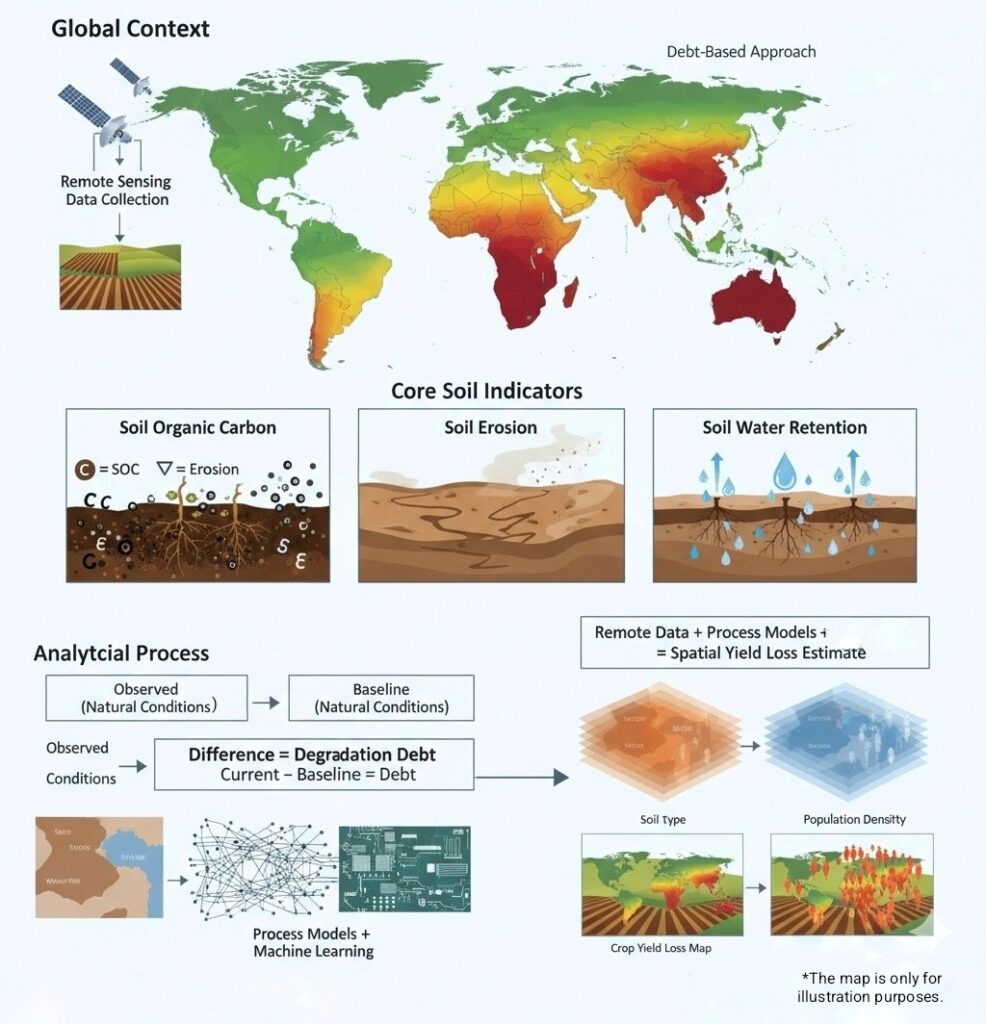
SOFA 2025 adopts a ‘debt-based’ approach to understanding human induced degradation on croplands. The report estimates current values for three core soil/water-based indicators – soil organic carbon, soil erosion and soil water retention – and compares them to an estimated baseline value representing less compromised or more natural conditions. The difference between these values are then considered the ‘debt’ of degradation. These spatially explicit layers are combined with crop growth models and socio-demographic maps to estimate where the degradation may translate into lower yields and which populations (as an example) are experiencing exposure. Each of these indicators draws on global remote sensing products, field datasets and machine learning approaches to map the indicators at a fine scale. In short: remote data + process models + ML = a spatially explicit yield loss estimate due human induced degradation.
The “10% restoration” Thought Experiment and Potential Gains
To bring the abstract into actionable content for policy messaging, FAO offers a scenario in which reversing only 10% of human-directed degradation on current croplands can restore sufficient production to satisfy the annual caloric requirements of approximately 154 million people. This is not a prediction that will happen dependent on itself, but an illustrative calculation to show how big a focused land-restoration could provide for global food availability. The number makes two points simultaneously; (1) meaningful food gains from restoration, and (2) gains will depend on where and how restoration is planned.
The FAO global mapping shows that the burden of degraded cropland is also not evenly distributed. The lower-income countries in sub-Saharan Africa and parts of South and Southeast Asia have higher proportions of cropland in a state of human-induced degradation, with a sizeable population relying on that land. Smallholders with little access to irrigation, inputs, and financial buffers are especially vulnerable, since degradation adds on to existing socio-economic fragility.
Drivers behind the degradation: unsustainable practices and climate stress
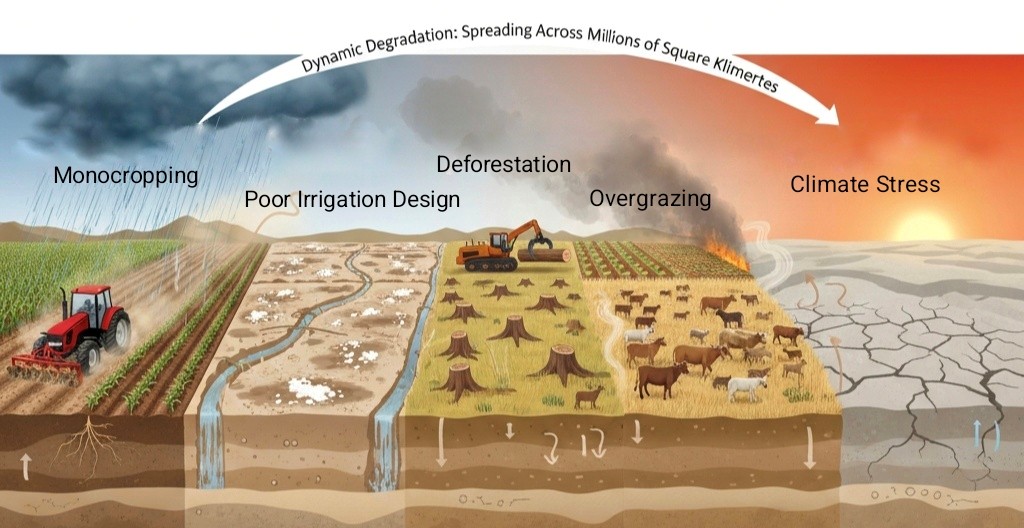
The FAO and other analyses have found that human-caused land degradation has many contributing factors: environmentally unsustainable agricultural practices (intensive monocropping, excessive tillage, excessive biomass removal, poorly designed irrigation schemes that increase salinity), deforestation and land-use change, overgrazing and erosion caused by both wind and water. Climate change is compounding these drivers through more frequent extreme rainfall and droughts, leading as well to a shift in the transitional dynamics of soil formation versus soil loss. Independent studies have also established that the area of degraded land continues to grow and some studies have reported the scale of the land loss footprint to be measured in millions of square kilometres (again in more recent years) and these studies underscore this is a dynamic not a static crisis.
Effects on food security, livelihoods and ecosystems
The pathway from degraded soil to food insecurity is straightfoward: the loss of soil organic matter and water-holding capacity reduces yield, increases the risk of crop failure, and is accompanied by the expansion onto marginal land or increased intensification of unsustainable practices by the farmer, in a non-sustainable damaging cycle. In addition to damage to crops, degraded soils also lose in biodiversity, carbon-sequestration potential, and resilience to climate change extremes. The equity issues are real: communities with limited asset bases (such as smallholders, pastoralists and Indigenous peoples), usually have fewer options in terms of adoption of restorative land management or mobility to adaptive locations and are stuck on collapsing land. The SOFA report explicitly identifies land degradation as a risk to SDG2 (Zero Hunger) and SDG15 (Life on Land) and to the broader agenda of resilient, sustainable food systems, as noted in the table on the page.
The UN’s post distilled its messages to an emotive fact and a plea for awareness, and indeed, FAO’s account remixed the UN account by providing the restoration scenario and links to the full SOFA report text and interactive story. Social media takes land degradation to a place that connects past normalcy, covers across specialities and invites land degradation into policy debates and donor priorities and public consciousness – precisely where money and policy change is required.
Broader context: Land Degradation is Expanding and Interlinked with Other Crises
Independent reports and initiatives have emphasized the pace and extent of degradation in recent years. Journalistic surveys and peer-reviewed mapping indicate millions of square kilometers under diminishing function, as well as salinity and erosion hotspots in the main producing areas. All of this evidence supports the FAO conclusion: that land degradation is a systemic issue that undermines other sustainability and climate goals through a degrading process unless reversed at scale.
For donors, SOFA 2025 provides a communication that carries clear storylines and quantified paths to help prioritize restoration finance to the locations where food gains are the largest; for governments, it builds a technical case for policy instruments pursuant to reward soil stewardship (e.g. payments for ecosystem services, public works to restore watersheds, input subsidies tied to regenerative practices); for communities the message is both a warning and an opportunity-degraded land is a risk to a livelihood, but targeted restoration and better practices can restore productivity and resilience.
From Headline to Action
What social posts do best is what the UN’s X post did expertly: turning a complex report into a shareable fact that piques interest. SOFA 2025 goes deeper into why that fact matters, how it was measured, and what can (and must) be done. It reframes land degradation as a direct, measurable threat to the diets, livelihoods, and futures of nearly 1.7 billion people, not an abstract environmental phenomenon. Advancing from the headlines will require scientific precision, financing where it’s needed, and policies that reward long-term stewardship and not short-sighted extraction. The numbers are out there now; the new question is whether there is political will and financing to do something about it.
With inputs from:
- FAO – FAO report: 1.7 billion people experience lower crop yields due to land degradation (press release / SOFA 2025 summary).
- FAO – The State of Food and Agriculture 2025 – Addressing land degradation across landholding scales (full report / PDF).
- FAO – SOFA 2025 interactive story / summary page.
- FAO (X account) — posts summarizing restoration scenario (“10% restoration → 154 million people”).
- The Guardian – coverage and broader context on accelerating land degradation and global mapping studies.
- Common Dreams summaries reporting on SOFA 2025 and FAO statements.
Clear Cut Climate Desk
New Delhi, UPDATED: Nov 05, 2025 12:20 IST
Written By: Antara Mrinal